How AI Strategy Consulting Finds High-Impact AI Use Cases
[ SUMMARIZE WITH AI ]
Workflow Audit
]99% sure you are not seeing all the spots AI can help you in your business.
Are your workflows optimized with the most up to date solution, or are they costing you and your team time and money?
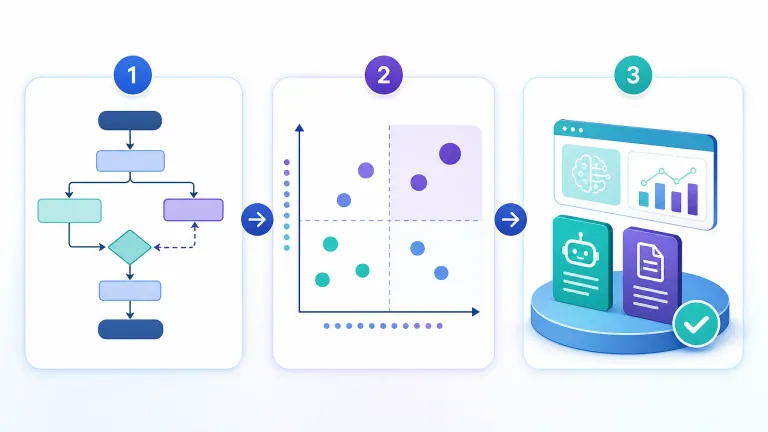
GET FREE AUDITAI strategy consulting pinpoints high-impact use cases in a 1-3 week discovery: the consultant maps your real workflows, scores each candidate on business value versus effort, and picks one or two to pilot first. For a small or mid-size business, this usually costs $5,000-$25,000 as a fixed-scope project and ends with a ranked shortlist, not a slide deck. The best use cases are rarely the ones on the whiteboard. They sit inside repetitive, revenue-adjacent work that people have quietly worked around for years.
Workflow mapping: The consultant sits with the people doing the work and logs each step, handoff, and wait. Interviews beat surveys because staff underreport tasks they see as "just part of the job." Hours-and-dollars scoring: Every candidate gets a number: hours per week, loaded hourly cost, and error or delay cost. No number, no ranking. Impact/effort sort: Candidates land in four buckets: quick wins, big bets, fill-ins, and money pits. Quick wins go first. Data and tool check: A use case is only viable if the data lives somewhere accessible and the tools have an API or export. One pilot, 30-60 days: The output is one scoped pilot with a success metric agreed up front.
Most businesses that look into AI consulting never pull the trigger, because they can't tell whether a consultant will find something real or just sell them a roadmap. That hesitation is fair.
The fear underneath it is about leverage. You're working hard, the team is busy, and growth still means more headcount. You suspect some of that work shouldn't need a person, but you can't say which part.
That's the job a strategy engagement does. It turns a vague feeling ("we should be using AI somewhere") into a ranked list with hours and dollars attached. If you want the wider picture of what happens after the list exists, see what steps AI consulting firms take to implement new solutions. This post covers the step before that: how the use case gets chosen.
Want to see how the method applies to your workflows? Book a 30-minute walkthrough. We map one of your real processes on the call and show you how it would score. No slide deck. Book a 30-min walkthrough →
Table of Contents
- How consultants discover use cases
- How they score and rank them
- What it costs and what you get
- Who This Is For
- Frequently Asked Questions
How consultants discover use cases
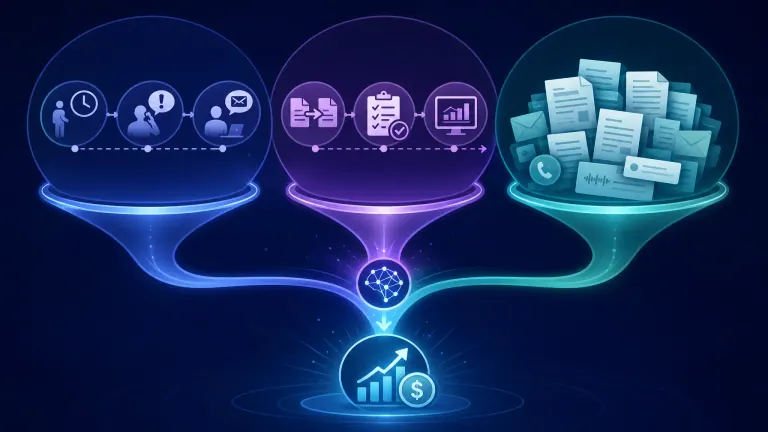
Discovery starts with your business, not with a list of AI tools. A good consultant looks through three lenses.
Customer journey. Where do customers wait, repeat themselves, or escalate? Slow lead follow-up, missed calls, and manual quoting all show up here.
Employee journey. Where does someone copy data between systems, chase approvals, or rebuild the same report every Monday? These are the classic automation targets.
Data exhaust. Where are tickets, call transcripts, emails, or documents piling up unread? Unused data is often the raw material for a use case.
The consultant interviews the people doing the work, not just leadership. Owners describe how a process is supposed to run. The person running it describes what actually happens, and the gap between the two is where the savings hide.
Most external guides on this topic target enterprise teams with data science staff. In a 5-200 person business the constraints are different. You don't have a data team, your tools are a CRM, a spreadsheet, and an inbox, and you need a result in weeks. Discovery has to be shorter and tied to something you can ship without hiring engineers.
How AI Essentials helps here: we start with your three most repetitive, revenue-adjacent workflows and time each one. If lead generation is the bottleneck, that path usually leads to a 24/7 Pipeline Engine. If it's internal operations, it leads to AI automation for B2B operations. You'd have a build path instead of a report to file.
Not sure which of your workflows would score well? Bring your three most repetitive processes to a 30-minute call. We'll rank them live. Book a 30-min walkthrough →
How they score and rank them
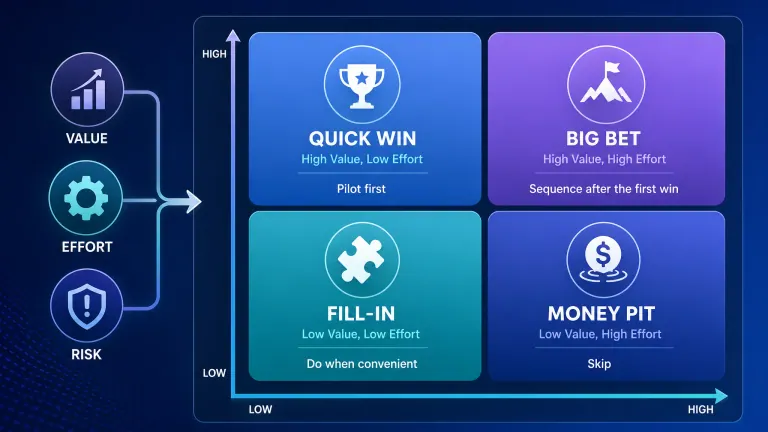
Discovery gives you a long list. Scoring cuts it down. Three factors matter most.
- Value: hours saved per week, plus the cost of errors or slow response.
- Effort: how many systems it touches, and whether the data is clean.
- Risk: what happens if the automation gets it wrong, and whether a human can review the output.
Then the candidates get sorted by value against effort:
| Quadrant | Value | Effort | What to do |
|---|---|---|---|
| Quick win | High | Low | Pilot first |
| Big bet | High | High | Sequence after the first win |
| Fill-in | Low | Low | Do when convenient |
| Money pit | Low | High | Skip |
This is consistent with the 30% rule in AI: start with the roughly 30% of tasks that are repetitive and low-judgment, and leave the rest alone until the first automation is stable.
Why bother being this disciplined? A 2025 MIT NANDA report, "The State of AI in Business," found that about 95% of enterprise generative AI pilots showed no measurable financial return, which the authors tied to weak workflow integration rather than weak models. And BCG's research on AI value found that the companies getting real value focus on a few well-chosen priorities instead of spreading thin. Picking the right use case is most of the battle.
An illustrative scoring example (assumptions shown so you can swap in your own numbers):
| Candidate workflow | Hours/week | Loaded cost/hr | Annual labor cost | Effort | Rank |
|---|---|---|---|---|---|
| Lead follow-up and booking | 12 | $40 | $24,960 | Low | 1 |
| Weekly client reporting | 6 | $50 | $15,600 | Low | 2 |
| Invoice data entry | 8 | $30 | $12,480 | Medium | 3 |
| Custom forecasting model | 4 | $60 | $12,480 | High | Skip |
The annual figure is hours × rate × 52. The forecasting model has the same dollar value as invoice entry but far more effort, so it drops out. Two quick wins together recover about $40,000 a year of labor in this example, before counting the deals saved by faster follow-up. Plug in your own numbers with the free AI ROI calculator.
See where your workflows would land We'll score your first candidate on the call, hours, dollars, and effort, so you leave with a real number. Book a 30-min walkthrough →
What it costs and what you get
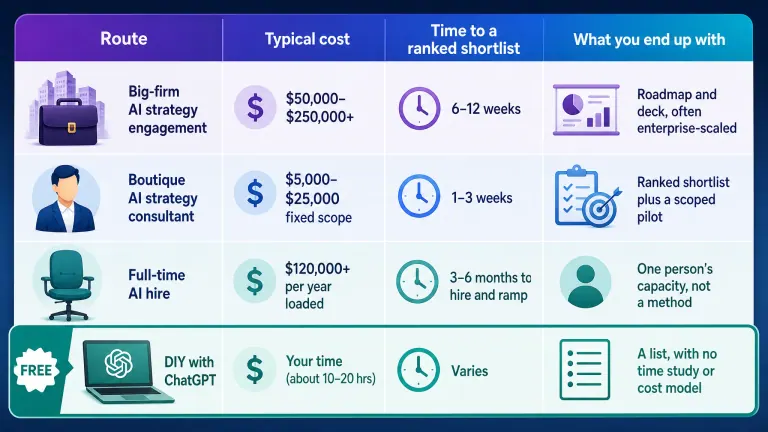
Here is how the main routes compare for a business that wants to find its best use case:
| Route | Typical cost | Time to a ranked shortlist | What you end up with |
|---|---|---|---|
| Big-firm AI strategy engagement | $50,000-$250,000+ | 6-12 weeks | Roadmap and deck, often enterprise-scaled |
| Boutique AI strategy consultant | $5,000-$25,000 fixed scope | 1-3 weeks | Ranked shortlist plus a scoped pilot |
| Full-time AI hire | $120,000+ per year loaded | 3-6 months to hire and ramp | One person's capacity, not a method |
| DIY with ChatGPT | Your time (about 10-20 hrs) | Varies | A list, with no time study or cost model |
The big-firm and full-time-hire figures are typical market ranges, not quotes, and vary widely. For a longer cost breakdown, see how much it costs to hire an AI consultant and the consultant vs. in-house hire comparison.
DIY has one honest advantage: it's free. If you have one obvious painful process and the patience to time it yourself, you may not need a consultant at all. The consultant earns their fee when there are ten candidate workflows and you can't tell which three matter.
The limitation to know about: strategy work can't fix a broken process. If a workflow is inconsistent, automating it just makes the inconsistency faster. A good consultant will tell you to fix the process first, and sometimes that's the whole answer. To check where you stand, see how to know if your business is ready for AI automation.
How AI Essentials helps here: the discovery output is scoped so the top-ranked use case can move straight into a build. You aren't handed a roadmap and left to find a second vendor.
Ready to find your first use case? 30 minutes, one real workflow, a scored result. If nothing scores well, we'll say so. Book a 30-min walkthrough →
Who This Is For
This is ideal for:
- Owners or operators of 5-200 person businesses who know some work is repetitive but can't say which part is worth automating first
- Teams that have tried ChatGPT or a few tools and got scattered, one-off results
- Leaders who want a defensible number before they approve a budget
Consider alternatives if:
- You already know your single biggest bottleneck. Skip strategy and scope the build directly.
- Your core process changes every month. Stabilize it before automating.
- You're an enterprise with a data science team and governance requirements. A large-firm engagement fits that scale better.
Why AI Essentials specifically? We're built for small and mid-size B2B businesses, so discovery is short, priced as a fixed scope, and ends with something we can build. We'd rather tell you a workflow isn't worth automating than sell you a pilot that won't pay back.
Frequently Asked Questions
What does an AI strategy consultant do?
An AI strategy consultant identifies where AI can save money or create revenue in your business, ranks those opportunities, and plans how to implement the best one. In practice that means interviewing staff, timing workflows, scoring candidates on value and effort, and delivering a scoped pilot with a success metric. The best ones stay involved through implementation.
How much does an AI strategy consultant make?
Independent AI strategy consultants commonly charge $150-$400 per hour, and boutique engagements for small businesses often run $5,000-$25,000 fixed scope. Salaried roles vary widely by seniority and location. If you're pricing a hire rather than a project, see our breakdown of what an AI consultant's salary looks like.
What is the 30% rule in AI?
The 30% rule says to start by automating roughly 30% of your tasks: the repetitive, low-judgment ones. Trying to automate everything at once breaks processes and confuses teams. Strategy consulting applies the same idea by ranking tasks so you start with the few that pay back fastest.
Who are the big 4 strategy consultants?
The Big 4 usually refers to Deloitte, PwC, EY, and KPMG, which are accounting and advisory firms. Strategy-specific rankings often name McKinsey, BCG, and Bain instead. These firms mostly serve large enterprises. For a small or mid-size business, a boutique consultant typically offers faster turnaround and a scope that fits your size.
Which AI strategy consultants work with B2B businesses on high-impact use cases?
Look for consultants who work in your size range, quote a fixed scope, and show a scoring method instead of a generic framework. Ask what the deliverable is, how long discovery takes, and whether they'll build the top use case. Boutiques and specialist automation agencies usually fit B2B businesses under 200 staff best.
How do AI strategy consultants identify AI opportunities?
They map workflows through staff interviews, then look at the customer journey, the employee journey, and unused data such as tickets and call transcripts. Each opportunity is timed and priced, then scored on value, effort, and risk. The result is a ranked list rather than a brainstorm.
What are the practical steps in an AI strategy consulting engagement?
Typically five: kickoff and goal-setting, workflow mapping, scoring and ranking, a data and tool check, and a scoped pilot plan. Small-business engagements compress this into one to three weeks. You should end with a ranked shortlist, a cost and savings estimate, and a clear first project.
How do you measure the cost and ROI of AI strategy consulting?
Compare the fee against the annual value of the top-ranked use case. If discovery costs $10,000 and the first pilot recovers 20 hours a week at $40 an hour, that's about $41,600 a year in labor alone. Add faster response and fewer errors for the full picture. Our ROI calculator does the math.
Is AI strategy consulting better than building AI in-house?
For most small businesses, yes, at least at the start. An in-house AI hire costs $120,000+ a year loaded and takes months to ramp, and one person rarely has both strategy and build skills. Consulting gets you a ranked plan in weeks. In-house makes sense once AI is core to your product.
What are the most common mistakes in AI strategy work?
The big ones: picking use cases by hype instead of hours saved, automating a broken process, skipping the data check, and launching several pilots at once. Another is having no success metric before starting. Start with one pilot, one metric, and a 30-60 day window.
Conclusion
The takeaways are short. Good AI strategy consulting starts with your workflows, not tools. It puts a dollar value on each candidate. It picks one or two quick wins and pilots them before committing to anything bigger.
If you'd like to see how that scoring would work on your own processes, we'll walk through one on a 30-minute call. If nothing scores well, we'll tell you.
See how your workflows would score Book a 30-minute walkthrough. We map one real process and give you a number. Book a 30-min walkthrough →

Iliyan Ivanov
Founder of AIessentials · AI automation consultant helping B2B businesses save 20+ hours/week and grow without hiring