AI Consultants for Law Firms: What to Look For and What It Costs
[ SUMMARIZE WITH AI ]
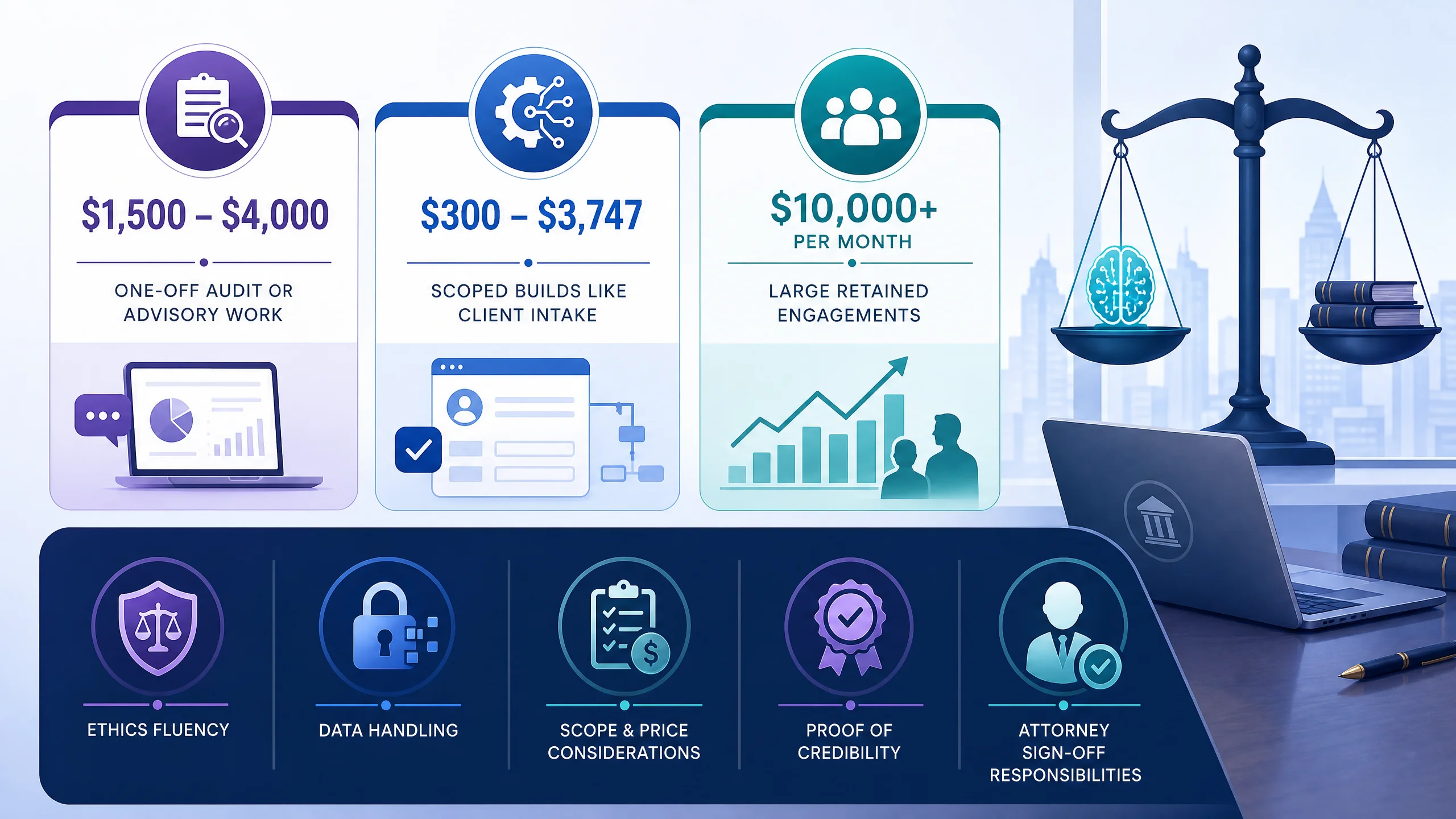
AI consultants for law firms typically cost $1,500 to $4,000 for a one-off audit or day of advisory work, $300 to $3,747 for a scoped build such as client intake, and $10,000 or more per month for large retained engagements. The price tracks scope, not firm size. The consultant worth hiring can explain, in plain terms, how their work fits the confidentiality, competence and supervision duties that ABA Formal Opinion 512 puts on lawyers.
Ethics fluency: Ask which rules they work from (ABA Model Rules 1.1, 1.6 and 5.3 are the ones Opinion 512 builds on) and which state opinions apply to your bar. Data handling: Ask where client information goes, who can see it and whether any tool trains on it. Get the answer in writing. Scope and price: A fixed scope with a fixed price beats an open-ended retainer. Hourly and monthly retainers are common, so ask for a cap. Proof: Ask for references from practices of your size. Be wary of rankings that the ranked firm wrote about itself. Attorney sign-off: The consultant builds the system. A lawyer at your firm stays responsible for how it is used.
You are a managing partner who knows something has to change in intake and follow-up, and you do not want to hand client data to someone who has never read a rules-of-professional-conduct opinion.
Most of what shows up when you search for this is a list of firms written by one of the firms on the list. That tells you who is good at SEO, not who is good at legal work. This guide goes the other way: what the job should look like, what it should cost, and how to test a consultant in the first meeting.
One note on overlap. We already wrote about the price of the most common build, in how much an AI intake system costs for a law firm. This post is about the earlier question of who to hire and how to judge them. Read that one for intake pricing in detail.
Not sure where your firm actually leaks inquiries? Before you interview any consultant, see which stage of intake is losing you cases. It gives you a concrete brief to hand them. Get My Free Map
Table of Contents
- What an AI Consultant Does for a Law Firm
- What AI Consultants for Law Firms Cost
- How to Vet One: The Ethics and Data Questions
- Consultant vs Software vs Hiring
- Who This Is For
- Frequently Asked Questions
What an AI Consultant Does for a Law Firm
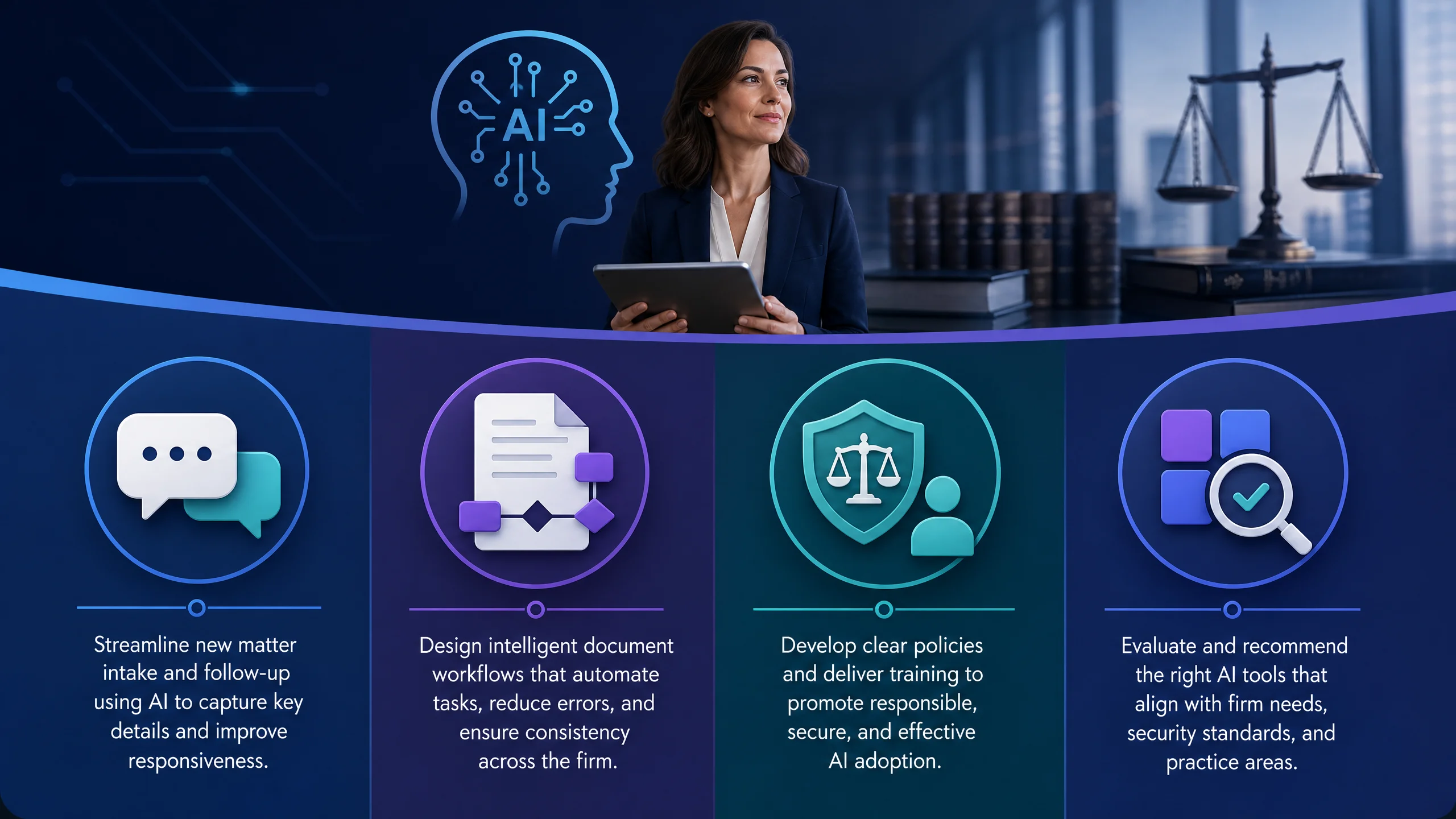
A good consultant does three jobs, in this order: finds where your firm loses time or inquiries, builds or selects the fix, and writes down how it should be used and supervised. Many do only the first and last. Fewer build anything.
The work usually falls into four buckets:
- Intake and follow-up. Reply to every new inquiry fast, ask the screening questions, route or book the consult. This is the easiest place to get a measurable return, and it is the work we do at AIessentials (aiessentials.us).
- Document workflows. Drafting support, summarizing, organizing matter files. Higher risk, because errors carry into work product.
- Policy and training. A written AI-use policy and staff training. This one matters more than it sounds. Clio's 2025 Legal Trends Report found that 79% of legal professionals use AI, yet 53% say their firm has no AI policy or they are unaware of one. Your staff is probably already using AI. The question is whether anyone set the rules.
- Tool selection. Which legal-specific product, if any, is worth the subscription.
How we would build this. When we scope an intake build, the first thing we check is how inquiries arrive today (phone, web form, email, a referral partner) and what happens in the first hour. A typical build has a trigger (new inquiry), an instant reply, a short screening script written with your attorney, a rule for what goes to a person, a calendar link, and a log in whatever you use for case management. Nothing in that chain makes a legal judgment. The attorney decides which cases to take.
That boundary is the thing to look for in any consultant. If the pitch has software making legal decisions, ask who supervises it.
What AI Consultants for Law Firms Cost
There is no independent price survey for this market, so every figure below comes from a vendor or a practitioner describing their own rates. Treat them as ranges to test against written quotes.
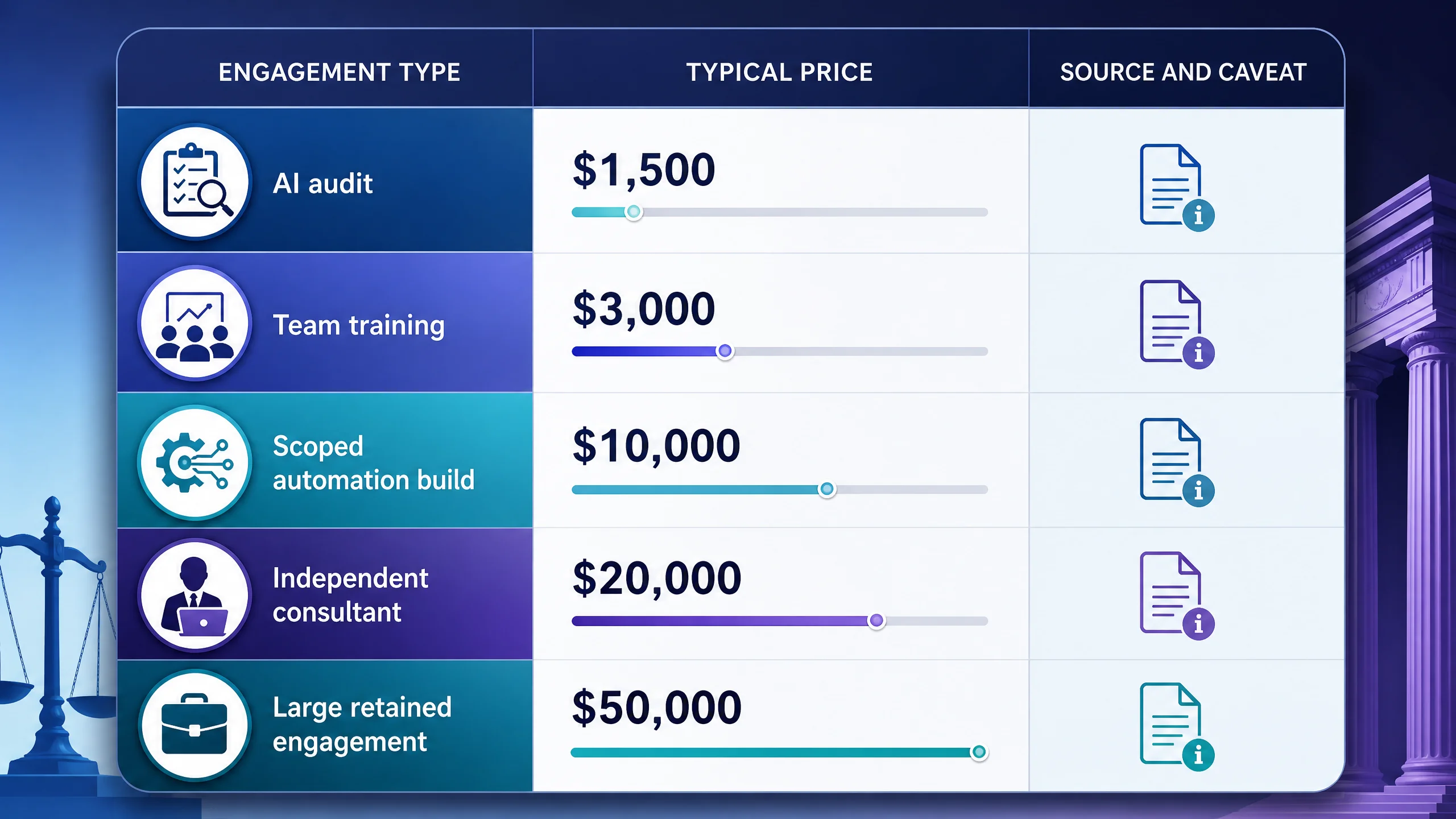
| Engagement type | Typical price | Source and caveat |
|---|---|---|
| AI audit (find the opportunities, no build) | $1,500 | AIessentials AI consulting page |
| Team training, full-day session | $400 to $1,000 | AIessentials, same page |
| Scoped automation build (intake, follow-up) | $300 to $3,747 one-time, plus platform fees | AIessentials automation pricing; intake detail in the cost breakdown |
| Independent consultant, US day rate | About $1,200 to $4,000 | One practitioner's self-reported estimate |
| Independent consultant, full implementation | About £15,000 to £45,000 (roughly $19,000 to $57,000) | Same source, UK pricing, converted at about 1.27 |
| Large retained engagement | $10,000 to $50,000 per month | A vendor's own claim, no source given |
The spread is wide because "AI consultant" covers very different jobs. A $1,500 audit and a $40,000 implementation are different products. Compare them by deliverable, not by price.
Two things push cost up. Integrations: a firm on modern practice-management software connects faster than one on paper sheets and a shared inbox. Review time: anything that touches client documents needs more testing and more attorney time than an intake reply.
A break-even example. This is an illustration, not a result. Say your average matter is worth $4,000 and you currently lose two qualified inquiries a month to after-hours voicemail. That is $8,000 a month. A $2,400 intake build plus about $150 a month in tools costs roughly $2,550 in the first month. A $10,000 monthly retainer would not clear that bar unless it did far more than intake. Run your own numbers in the ROI calculator.
See what the build would target at your firm. The Lead-to-Consult System Map shows where inquiries drop between first contact and booked consult, so any quote you get is for a defined job. Get My Free Map
How to Vet One: The Ethics and Data Questions
ABA Formal Opinion 512, issued on July 29, 2024, is the first formal ABA guidance on generative AI. Summaries of it, including the UNC law library's overview, tie it to the duty of technological competence (Rule 1.1), confidentiality (Rule 1.6) and supervision of nonlawyer help (Rule 5.3). It does not bind any court or disciplinary body, and states such as California, New York and Florida have issued their own guidance. Read your bar's version.
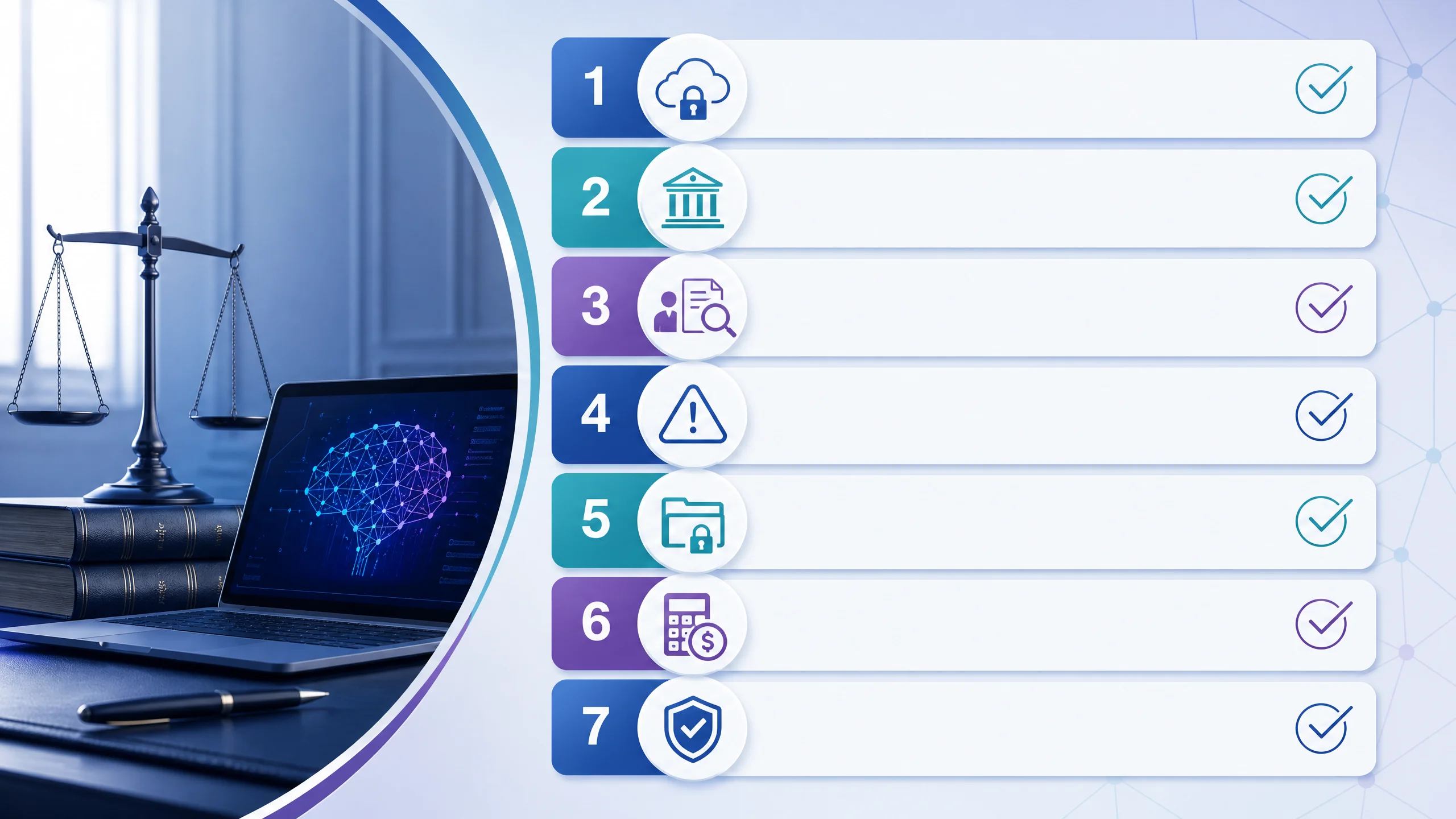
For you, that turns into a first-meeting checklist:
- "Where does client information go?" A good answer names the tools, the data path and whether anything is used to train a model. "Don't worry, it's secure" is not an answer.
- "Which of your past projects touched a law firm?" Ask for a reference you can call. If they have none in legal, ask how they would handle the first one.
- "What does the attorney review, and when?" The screening script, the escalation rules and the client-facing wording should all be approved by a lawyer at your firm.
- "What happens if it gets something wrong?" Look for a plan: a fallback to a human, a log of what was sent, a way to turn it off.
- "What do I own at the end?" You should keep the workflows, the scripts and the documentation, not rent them.
- "What is the price for this scope, and what does it exclude?" Get it as a fixed number.
- "What is the guarantee?" Ours is plain: a 60-day money-back guarantee. If you don't get the outcomes we agree on upfront within 60 days of kickoff, we refund your service fee. Ask every consultant for their version in writing.
Red flags:
- A ranking of "best firms" where the author ranks themselves first
- Percentages with no source ("saves 70% of time")
- A retainer with no deliverable list
- Software that talks to prospects with no attorney-approved script
- Pressure to sign this week
If the consultant can answer the first five without hedging, you have someone who has done this before. If they cannot, you have learned that cheaply.
Consultant vs Software vs Hiring
| Option | Typical cost | Best at | Weakest at |
|---|---|---|---|
| Legal-specific AI software | Monthly subscription per seat | Research and drafting support in one tool | Connecting to your intake and follow-up |
| Consultant-led build | $300 to $3,747 one-time, plus platform fees | A defined workflow wired to your tools | Anything you have not scoped |
| Full-time intake coordinator | $40,000 to $55,000 per year plus benefits (the range in our intake cost guide) | Judgment during business hours | Nights, weekends, overflow |
| Retained AI advisory | $10,000+ per month | Firm-wide strategy for larger practices | Small firms with one clear problem |
If your problem is "inquiries get a slow or no reply," a consultant-led build is usually the cheapest fix. If your problem is "associates need better research tools," start with software, not a consultant. For the full cost comparison between a consultant and an in-house technical hire, see AI consultant vs in-house hire.
How AIessentials helps here: we build the intake and follow-up piece with an attorney-approved script, on the tools you already use. The law-firm page shows what goes live in the first 14 days. If you want the workflow built rather than advised on, that is what we do for B2B and professional-services firms. We have no case study to point you to yet, and we will tell you that on the call.
Who This Is For
This is ideal for:
- Managing partners at solo and small firms who lose inquiries to slow or after-hours replies
- Firms whose staff already use AI tools but have no written policy
- Practices that want a defined, priced build instead of an open-ended retainer
Consider alternatives if:
- Your main need is legal research or drafting. Buy a legal-specific product and a training session.
- You have an intake team that answers every inquiry in minutes, around the clock
- You need a firm-wide transformation program across hundreds of lawyers. That is a different kind of engagement than the ones priced here.
Why AIessentials specifically? We build the workflow, not just the recommendation. Pricing is fixed up front from the service pages, and the guarantee is the one stated above: 60 days, refund of the service fee if the agreed outcomes are not met.
Frequently Asked Questions
Where can law firms find AI consultants?
Start with your state bar's technology resources and peer referrals from firms your size, then interview two or three consultants against the checklist above. Treat "top firms" lists with caution: many are written by a firm that ranks itself first. Ask each for a reference you can call and a written scope with a fixed price.
Conclusion
Hiring from the AI consultants for law firms comes down to three checks: can they explain their work against your confidentiality and supervision duties, will they quote a fixed scope and price, and do they build something you keep.
- Costs run from a $1,500 audit to five-figure monthly retainers, so compare deliverables, not totals.
- The first-meeting questions about data, attorney review and ownership separate experienced consultants from sales pitches.
- For slow inquiry response, a scoped build is usually cheaper than advisory work.
Start with the part you can measure. The free Lead-to-Consult System Map shows where your firm loses inquiries between first contact and booked consult, and the intake setup that fixes it. Get My Free Map
Free Lead-to-Consult System Map
See exactly where your firm loses inquiries before they become consults, and the intake setup that fixes it.
Sent to your inbox within 24–48 hours. Yours to keep.

Iliyan Ivanov
Founder of AIessentials · AI automation consultant helping B2B businesses save 20+ hours/week and grow without hiring