AI Consulting Firms: The 5-Step Implementation Process
[ SUMMARIZE WITH AI ]
Workflow Audit
]99% sure you are not seeing all the spots AI can help you in your business.
Are your workflows optimized with the most up to date solution, or are they costing you and your team time and money?
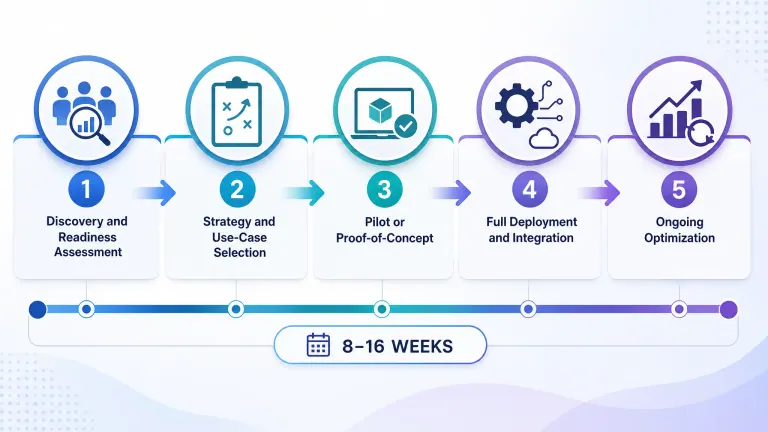
GET FREE AUDITAI consulting firms typically follow a five-phase process: discovery and readiness assessment (1–3 weeks), strategy and use-case selection (1–2 weeks), a pilot or proof-of-concept (2–6 weeks), full deployment and integration (4–12 weeks), and ongoing optimization. Total timeline for a single-workflow implementation usually runs 8–16 weeks from kickoff to a working system.
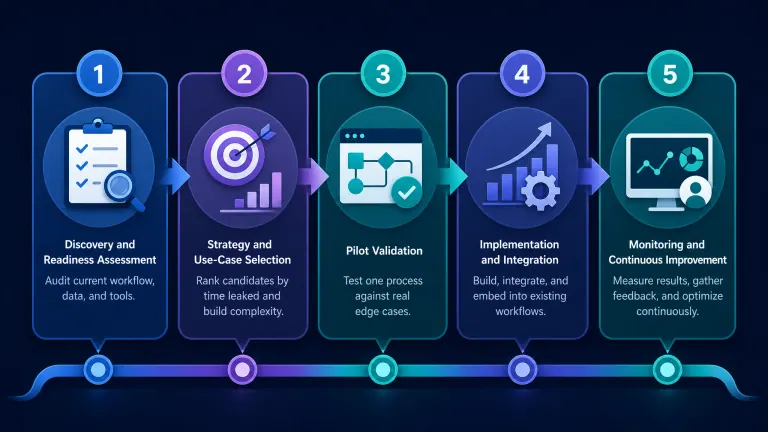
Discovery: The firm audits your current workflows, data quality, and tools to find where automation actually pays off. Use-case selection: Not every manual task is worth automating first — firms prioritize high-impact, low-complexity wins. Pilot validation: A scoped test run on one process before anything touches your full operation. Integration: The system gets built into your existing stack (CRM, email, scheduling) rather than replacing it. Optimization: Post-launch monitoring and adjustment — the phase most DIY attempts skip entirely.
You understand the concept. You have no idea what the first step actually looks like — and every consulting firm's website describes the process in slightly different language, which makes it hard to tell what you're actually paying for.
That's a fair thing to be stuck on. The five phases above are the skeleton almost every AI consulting firm uses, whether they're a two-person boutique or a Big 4 practice. What changes between them is scope, price, and how much of the work you'll be doing yourself. A firm that quotes you $150,000 and one that quotes you $8,000 aren't necessarily doing different work — they might just be doing it for a very different size of business, with a very different level of hand-holding.
The real question isn't "what are the five steps" — it's which of those steps actually apply to your situation, how long each one should take for a business your size, and where the process breaks down when it goes wrong. That's what the rest of this post covers, including a candid look at how firms price this work and what it costs to skip a step.
If you'd rather see this mapped to your own workflows first, you can get a free AI automation assessment that walks through where automation actually pays off before you commit to a project.
Not sure which approach fits your business? Take the 2-minute AI Readiness Check and see whether your process is ready for automation — or what needs to happen first. Take the Readiness Check →
Table of Contents
- The 5 Phases, Broken Down
- How Long Each Phase Actually Takes
- What It Costs — and Where Firms Differ
- Who This Is For
- Frequently Asked Questions
The 5 Phases, Broken Down
Phase 1: Discovery and Readiness Assessment
The firm looks at your current process — not your industry, your actual workflow. What data exists, where it lives, who touches it, and how much of it is manual. According to McKinsey's research on AI at scale, a majority of AI proof-of-concepts stall because this step gets rushed or skipped, not because the technology fails.
For a small business, this usually means a 60–90 minute audit call plus a review of your CRM, email, and scheduling setup. You should walk away from this phase with a specific list of automatable tasks, not a vague "AI can help you" pitch.
Phase 2: Strategy and Use-Case Selection
Not every repetitive task is worth automating first. A good firm ranks candidates by two factors: how much time or revenue is currently leaking, and how complex the fix is. The highest-leverage wins are usually the boring ones — lead follow-up, appointment scheduling, quote generation — not the flashy ones.
How AI Essentials helps here: we score every candidate workflow against both leak size and build complexity before recommending anything, so the first project is one that pays for itself inside a quarter, not a year.
Phase 3: Pilot Validation
A scoped test on one process, with real data, before it touches your whole operation. This is where you find out if the automation actually holds up against edge cases — the customer who emails at 2am, the lead who fills out the form twice, the invoice with a typo in the amount.
Skipping this phase is the single most common reason AI projects fail after launch. Harvard Business Review has documented how consulting firms themselves are restructuring around faster, smaller validation cycles rather than big-bang rollouts — the same logic applies to what they build for clients.
Assessment, not a sales pitch Take the 2-minute AI Readiness Check to see which of your workflows would actually survive a pilot test. Take the Readiness Check →
How Long Each Phase Actually Takes
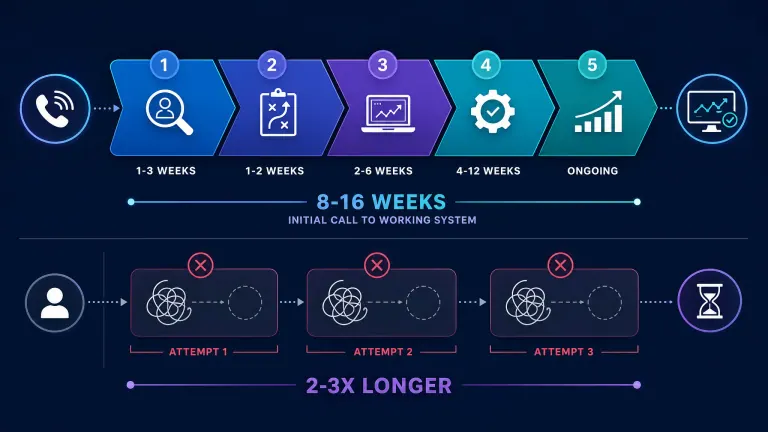
For a single-workflow implementation at a business with 5–200 employees, here's a realistic timeline — not the enterprise 6-month version most articles describe:
| Phase | Typical Duration | What Happens |
|---|---|---|
| Discovery | 1–3 weeks | Workflow audit, data review, scope defined |
| Strategy | 1–2 weeks | Use case selected, success metrics agreed |
| Pilot | 2–6 weeks | Built and tested against real edge cases |
| Deployment | 4–12 weeks | Integrated into existing tools, team trained |
| Optimization | Ongoing | Monitored and adjusted post-launch |
Total: 8–16 weeks from first call to a working system, for one workflow. Multi-workflow "operating system" style projects run longer because Phase 3 and 4 repeat per workflow, but they don't start from zero each time — the discovery and strategy work compounds.
Compare that to the DIY route: most business owners who try to wire this together themselves with off-the-shelf tools report 2–3 failed attempts before something sticks, according to patterns we see repeatedly in the pain inventory of businesses we talk to — tools that worked for two weeks, then broke.
What It Costs — and Where Firms Differ
This is the part most consulting firm websites are vague about. Rates vary by firm size, not by how good the outcome is:
| Approach | Typical Cost | Timeline | Best Fit |
|---|---|---|---|
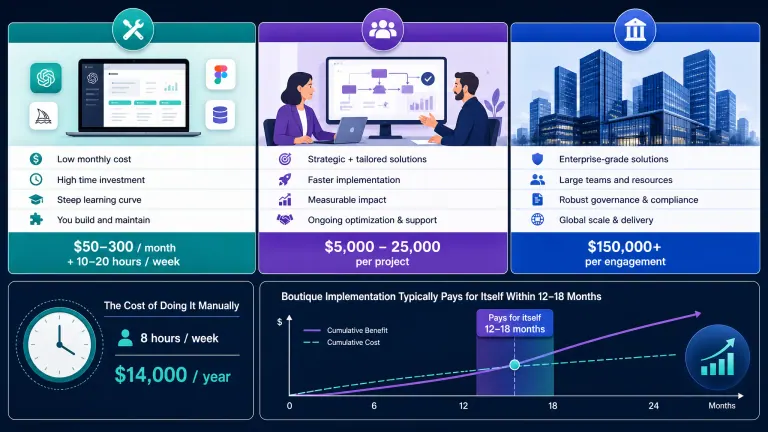
| DIY (Zapier/Make + your team) | $50–$300/mo tools + 10–20 hrs/wk your time | 2–3 attempts, often fails | Very simple, single-step tasks |
| Boutique AI consulting firm | $5,000–$25,000 project, or $150–$350/hr | 8–16 weeks | SMBs, 5–200 employees |
| Big 4 / enterprise firm | $150,000+ | 4–9 months | 500+ employees, complex compliance needs |
| Freelancer / solo consultant | $2,000–$10,000 | Variable, high risk | Very narrow, low-stakes projects |
A boutique firm sized for your business, versus a $150,000 enterprise engagement built for a company ten times your size, isn't a downgrade — it's the right tool for the job. The enterprise process exists because Fortune 500 companies have compliance, procurement, and integration complexity a 20-person company doesn't. Paying for that complexity when you don't need it is the most common way businesses overpay for AI consulting.
If you want to see the fuller cost breakdown, our guide on hiring an AI consultant for a small business walks through pricing models firm by firm.
See what a scoped project actually costs Not sure which pricing tier fits your business? Take the 2-minute AI Readiness Check for a straight answer before you talk to anyone. Take the Readiness Check →
A Simple ROI Check
Before signing with any firm, run this math on the workflow you're considering automating:
- Hours spent per week on the manual task × hourly cost of the person doing it = weekly cost of staying manual
- Multiply by 50 weeks = annual cost of the status quo
- Compare that to the project quote plus any ongoing tool fees
A workflow costing 8 hours a week at a $35/hour loaded rate is bleeding roughly $14,000 a year before you've touched a single automation. A $8,000–$15,000 boutique implementation that eliminates most of that hour count typically pays for itself inside 12–18 months — often faster once you factor in the leads or follow-ups that were previously missed entirely, not just the hours saved.
Who This Is For
This is ideal for:
- Businesses with 5–200 employees who have at least one clearly repetitive, manual workflow
- Owners who've researched AI tools but don't know which phase of implementation they're actually stuck on
- Teams that tried a DIY automation tool and had it break or stall
Consider alternatives if:
- You need enterprise-grade compliance, security review, or multi-department rollout — a Big 4 or specialized enterprise firm fits that scope better
- Your process changes so often that automating it now would mean rebuilding it in three months — fix the process first
- You're only exploring, not ready to commit budget — start with free tools and revisit once you've hit a real bottleneck
Why AI Essentials specifically? We only run the boutique-firm scope described above — 8 to 16 weeks, one workflow at a time, no enterprise overhead you're not using. Every engagement starts with the same readiness assessment described in Phase 1, free, before you commit to anything.
Frequently Asked Questions
Which consulting firm is leading in AI?
Among the largest global firms, Bain, BCG, and Deloitte have made the most public investment in AI capabilities, including partnerships with model providers like Anthropic. For SMB-focused engagements, "leading" depends more on fit to your business size than brand name — a boutique firm that specializes in businesses your size will typically outperform a generalist enterprise practice on speed and cost.
What are the top 10 AI consulting companies?
The commonly cited large-firm list includes Bain & Company, BCG, Deloitte, McKinsey, Accenture, IBM Consulting, The Hackett Group, Slalom, PwC, and EY. These firms primarily serve enterprise clients with six-figure engagement minimums — most aren't structured for a 20-person business's budget or timeline.
Who are the big 7 AI companies?
This usually refers to the technology providers building foundation models and AI infrastructure — commonly grouped as Microsoft, Google, Amazon, Meta, Apple, Nvidia, and Anthropic or OpenAI. These are technology vendors, not consultancies — an AI consulting firm typically builds on top of their tools rather than competing with them.
Who are the big 4 of AI?
This is often confused with the "Big 4" accounting firms (Deloitte, PwC, EY, KPMG), all of which now run AI consulting practices. If the question means AI model providers instead, the most commonly cited group is OpenAI, Google DeepMind, Anthropic, and Meta AI.
AI consulting firm implementation process steps
The typical sequence is discovery, strategy and use-case selection, pilot validation, full deployment and integration, and post-launch optimization. See the phase-by-phase breakdown above for what each step involves at SMB scale.
Phases of AI solution implementation B2B
For B2B businesses, the same five phases apply but scope is usually limited to one or two workflows at a time — lead follow-up, quote generation, or customer onboarding are the most common starting points, because they have clear before/after metrics.
AI project lifecycle consulting
The lifecycle runs from initial audit through pilot, deployment, and ongoing monitoring — it doesn't end at launch. Firms that stop after deployment, without an optimization phase, are the most common reason AI projects degrade in performance within a few months.
Cost of AI consulting services ROI
Boutique AI consulting projects for SMBs typically run $5,000–$25,000 and pay back within 12–18 months when applied to a workflow costing $10,000+ a year in manual labor. Enterprise engagements start around $150,000 and require a proportionally larger workflow to justify the spend.
How AI consulting firms charge
Most charge either a fixed project fee (common for scoped, single-workflow builds) or hourly/day rates (common for larger, multi-phase engagements). Boutique firms serving SMBs favor fixed project pricing because it's easier to budget against a clear deliverable.
Calculating ROI for AI projects B2B
Multiply the weekly hours spent on the manual task by the hourly cost of the person doing it, then by 50 working weeks, to get the annual cost of staying manual. Compare that figure to the total project cost plus any ongoing software fees — most SMB automation projects break even inside 12–18 months when the workflow costs $10,000 or more per year to run manually.
Conclusion
AI consulting firms all run some version of the same five-phase process — discovery, strategy, pilot, deployment, optimization — but the size, cost, and timeline of that process should match your business, not the other way around. A boutique firm running an 8-to-16-week engagement on one high-leverage workflow is usually the right fit for a business with 5–200 employees; a $150,000 enterprise engagement rarely is.
If you want a straight answer on which phase your business is actually ready for, take the 2-minute AI Readiness Check — no sales pitch, just a scoped read on where automation would actually pay off first.

Iliyan Ivanov
Founder of AIessentials · AI automation consultant helping B2B businesses save 20+ hours/week and grow without hiring