Are AI Consulting Companies Worth It for a Small E-Commerce Store?
[ SUMMARIZE WITH AI ]
Workflow Audit
]99% sure you are not seeing all the spots AI can help you in your business.
Are your workflows optimized with the most up to date solution, or are they costing you and your team time and money?
GET FREE AUDITAI consulting companies are worth it for a small e-commerce store when the business has a repeatable, measurable bottleneck (support tickets, abandoned carts, manual order handling) that costs more than the project. Typical projects run $5,000-$25,000, so the break-even rule of thumb is a problem worth at least $30,000-$50,000 a year. Below that, an off-the-shelf tool at $50-$300 a month usually wins.
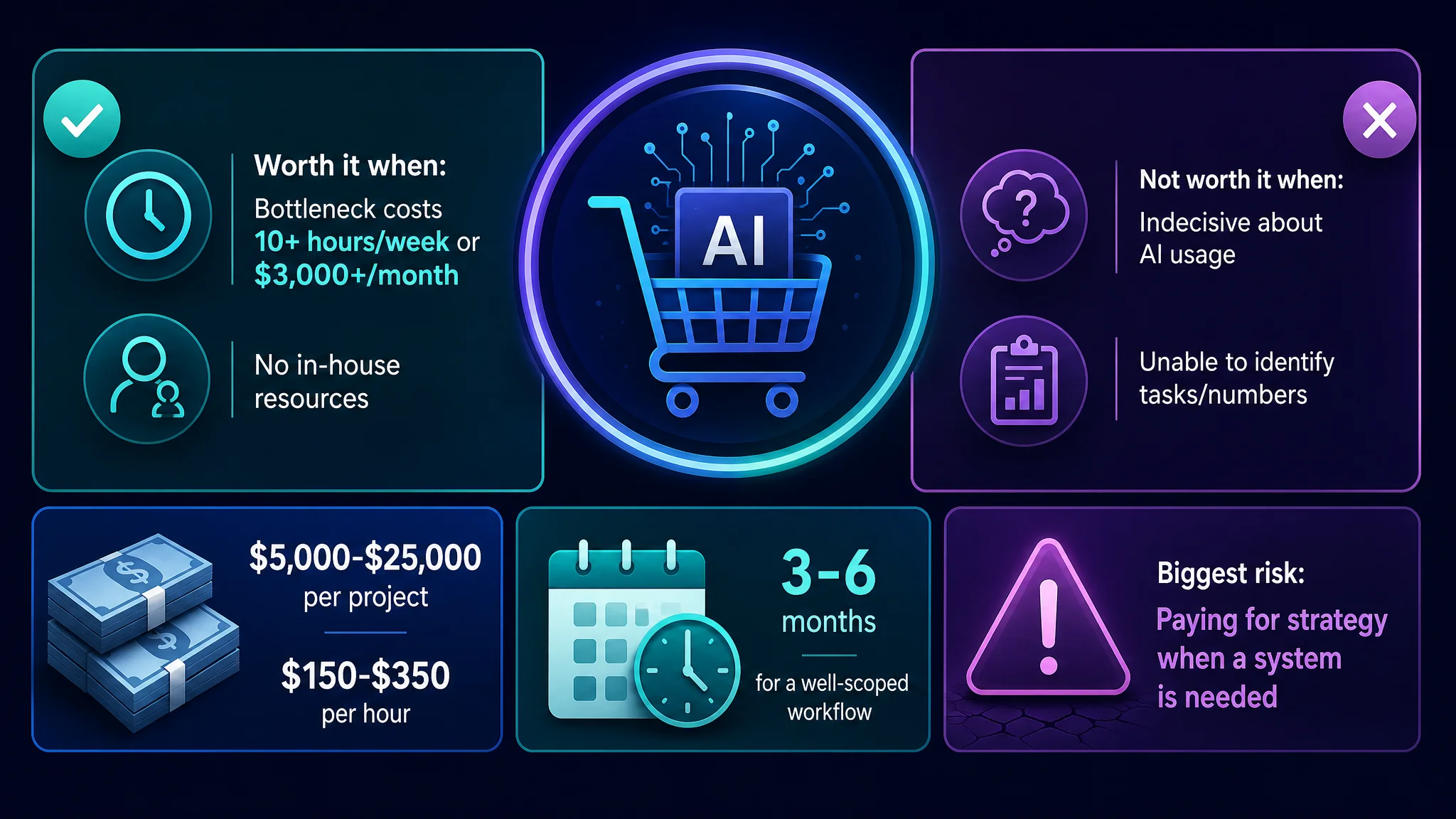
Worth it when: you have a bottleneck that costs 10+ hours a week or $3,000+ a month and no one in-house to fix it. Not worth it when: your problem is "we should be doing something with AI" and you can't name the task or the number. Typical cost: $5,000-$25,000 per project, or $150-$350 per hour (see our full AI consultant cost breakdown). Payback window: 3-6 months for a single, well-scoped workflow. Biggest risk: paying for a strategy deck when you needed a working system.
AI sounds like something built for companies with a data team and a six-figure tech budget, and every vendor you talk to gives you a different answer. That confusion is the real reason most store owners never move.
You don't need to understand how AI works to use it. You need to know three things: which task is eating your time, what that task costs you per month, and whether a tool or a person should fix it. This post gives you a way to answer all three before you talk to anyone.
One note on scope. We already cover what AI consultants cost and when to hire one versus an in-house person. This post answers a narrower question: does it make sense for a store your size?
See how this works for a business like yours Send us your current workflow and monthly volume. In 30 minutes we'll tell you whether a consultant, a tool, or nothing at all is the right call, with the numbers behind it. Book a 30-Minute Walkthrough →
Table of Contents
- Where AI Pays Off in a Small E-Commerce Business
- Tool, Freelancer, or Consulting Company?
- The Math: When the Project Pays for Itself
- Who This Is For
- Frequently Asked Questions
Where AI Pays Off in a Small E-Commerce Business
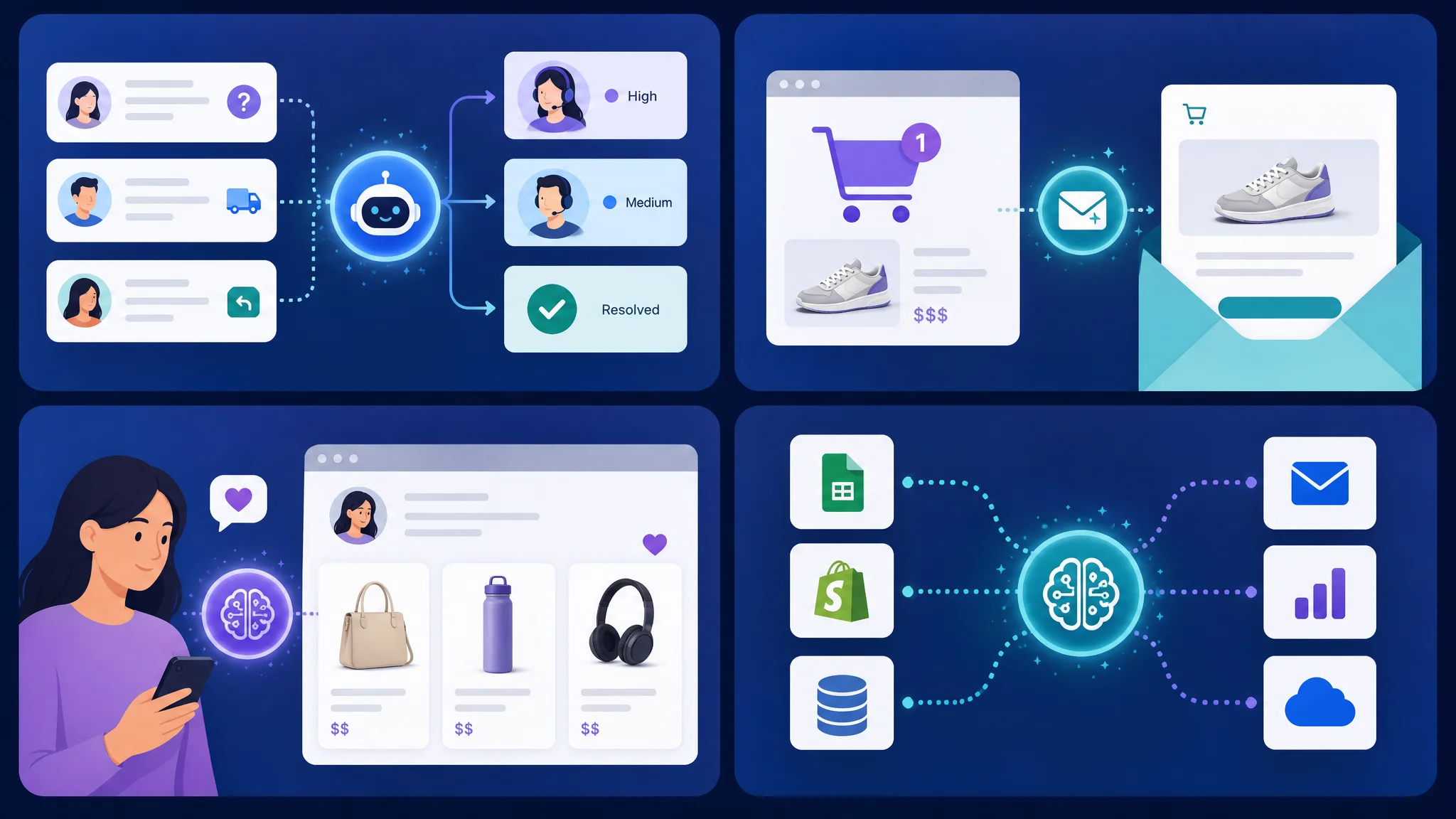
Most e-commerce AI advice lists twelve use cases. In practice, small stores get nearly all of their return from four. Each one maps to a task you probably already do by hand.
1. Customer support triage
Order status, returns, shipping times and sizing questions make up most tickets in a typical store. An AI layer connected to your order system answers those and hands the rest to a person. Stores that do this well don't fire anyone. They stop hiring the next support rep.
2. Cart and browse recovery
Baymard Institute's analysis of 49 studies puts the average documented cart abandonment rate at 70.22%. Much of that is window shopping, but a slice is recoverable with timely, relevant follow-up. This is the one use case where a $30-$100 a month email tool often does the whole job.
3. Personalized recommendations and email
McKinsey's Next in Personalization research found that 71% of consumers expect personalized interactions, and that personalization most often lifts revenue 10-15%. Native tools in Shopify, Klaviyo and similar platforms already cover the basics.
4. Back-office work: orders, inventory, supplier mail, reporting
This is where tools run out and consultants earn their fee. Moving data between your store, your 3PL, your accounting software and your supplier spreadsheets is custom plumbing. No single app does it for your exact stack.
Not sure which of the four is costing you the most? We'll map your week, find the biggest leak, and price the fix, whether or not you hire us. Book a 30-Minute Walkthrough →
Tool, Freelancer, or Consulting Company?
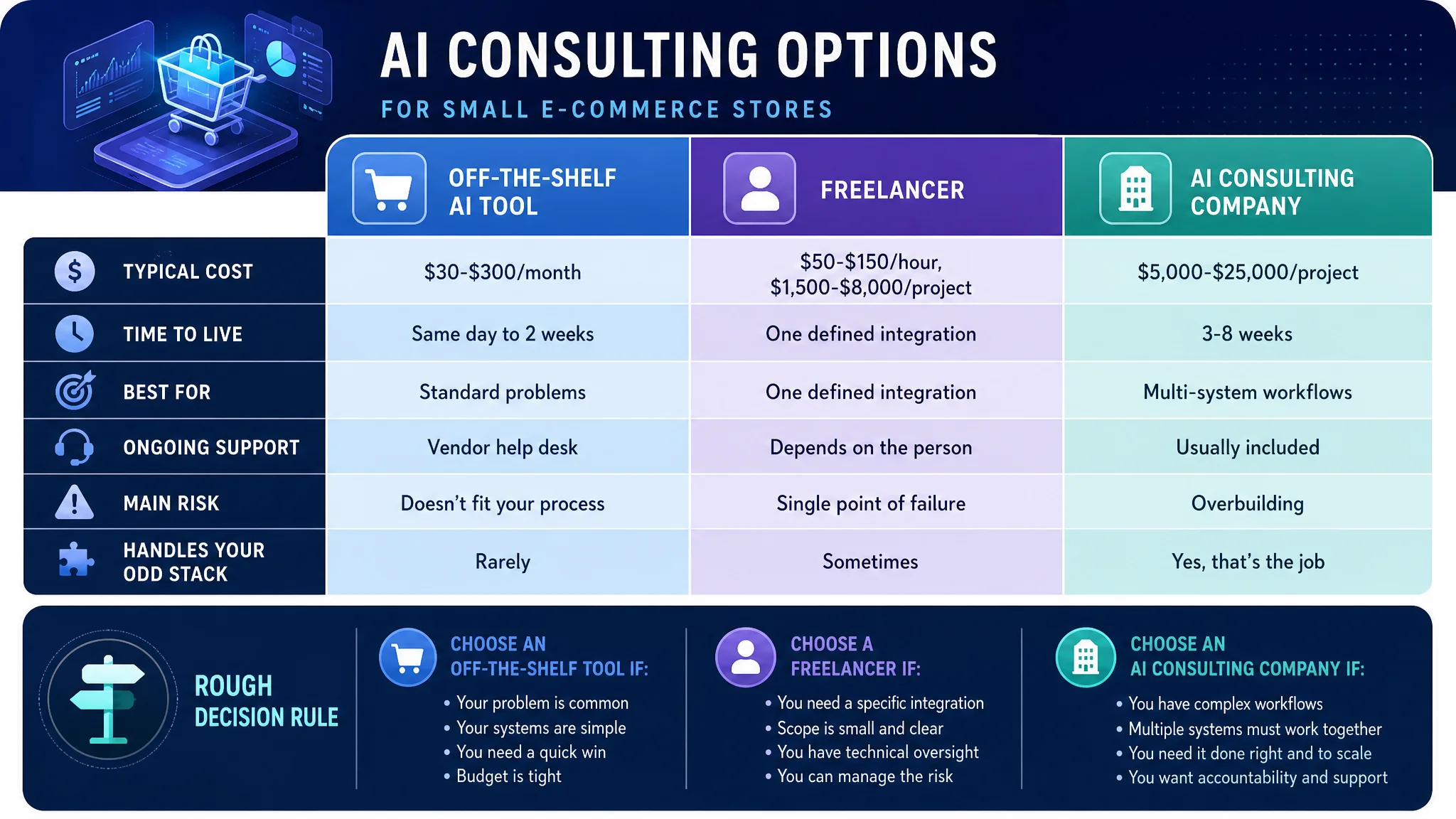
The most useful thing an honest consultant can tell you is "buy the tool." Here's how the three options compare for a small store.
| Off-the-shelf AI tool | Freelancer | AI consulting company | |
|---|---|---|---|
| Typical cost | $30-$300/month | $50-$150/hour, $1,500-$8,000/project | $5,000-$25,000/project |
| Time to live | Same day to 2 weeks | 2-6 weeks | 3-8 weeks |
| Best for | Standard problems (email, chat widget, reviews) | One defined integration | Multi-system workflows, anything touching revenue |
| Ongoing support | Vendor help desk | Depends on the person | Usually included or on retainer |
| Main risk | Doesn't fit your process | Single point of failure | Overbuilding, strategy with no build |
| Handles your odd stack | Rarely | Sometimes | Yes, that's the job |
A rough decision rule:
- Standard problem, standard stack? Buy the tool. Don't pay a consultant to configure something with a setup wizard.
- One clearly defined integration? A good freelancer is cheaper and faster.
- Several systems, a process that touches revenue, and nobody in-house to own it? That's where a consulting company is worth the money.
How to tell a real consulting company from a deck factory: ask what's running in production for a client 90 days after launch. If the answer is a slide, walk away. Ask who maintains it, and what it costs per month to keep alive. Our post on ongoing support from AI consulting firms covers the full checklist.
How we help here: If your problem is a multi-system workflow, our AI automation for B2B businesses work is built for exactly that. And if the honest answer is "buy a $50 tool," we'll tell you that on the first call.
Want a second opinion before you sign anything? Bring us the proposal you've been quoted. We'll tell you what's padded and what's missing. Book a 30-Minute Walkthrough →
The Math: When the Project Pays for Itself
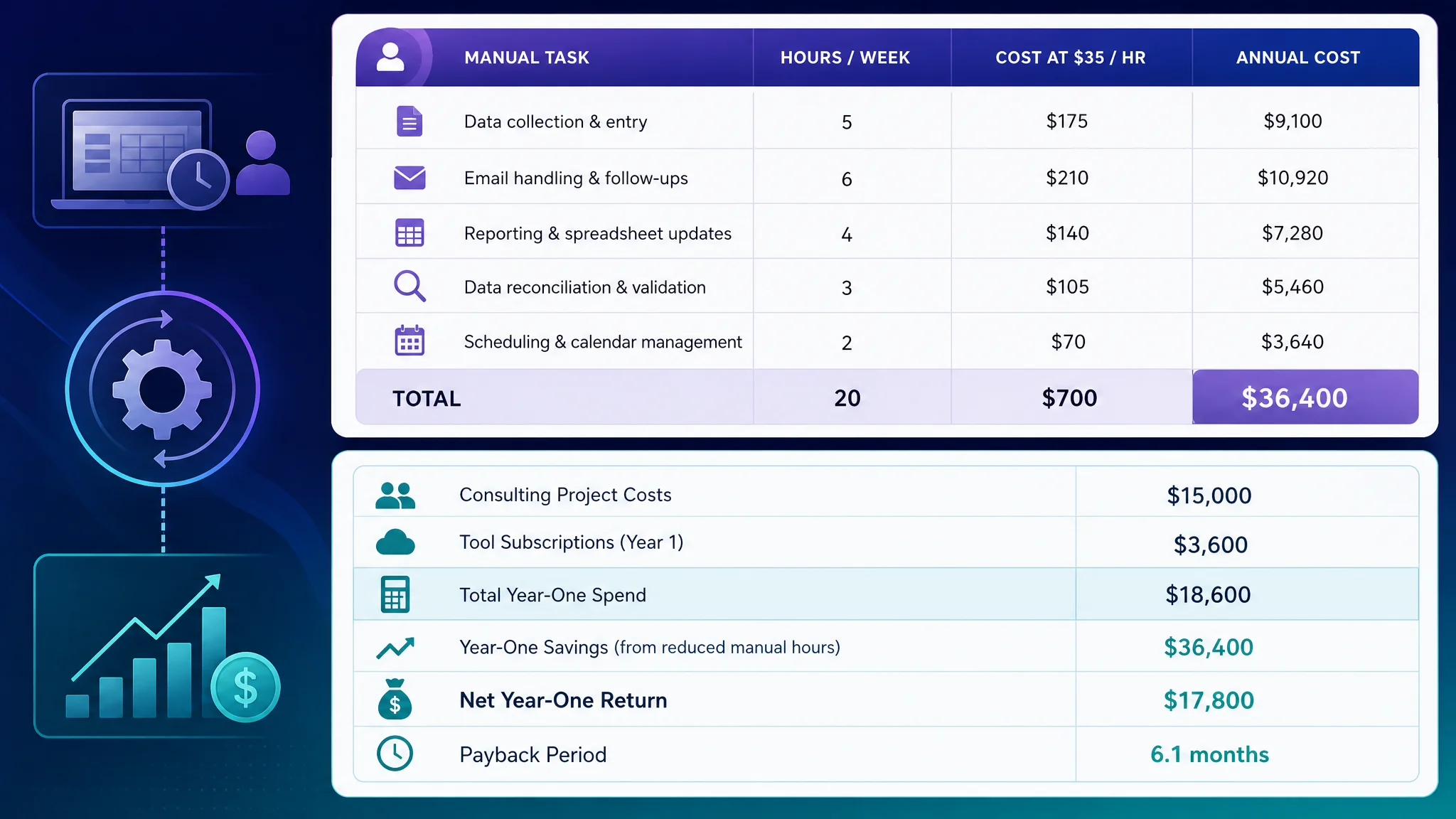
Here is an illustrative model, not a client case study. Take a store with four people, $1.2M in annual revenue, and 900 orders a month. The owner's time is the scarce resource.
| Manual task | Hours/week | Cost at $35/hr loaded | Annual cost |
|---|---|---|---|
| Answering order-status and return emails | 12 | $420 | $21,840 |
| Re-keying orders into the 3PL and accounting | 6 | $210 | $10,920 |
| Weekly sales and inventory reporting | 4 | $140 | $7,280 |
| Supplier reorder emails and follow-ups | 3 | $105 | $5,460 |
| Total | 25 | $875 | $45,500 |
Suppose automation removes 70% of that work. That's roughly $31,850 a year back, or about 17.5 hours a week.
| Cost | Year-one result | |
|---|---|---|
| Consulting project (one integrated workflow) | $12,000 one-time | |
| Tool subscriptions and maintenance | $200/month = $2,400/year | |
| Total year-one spend | $14,400 | |
| Year-one savings | $31,850 | |
| Net year-one return | $17,450 (about 121%) | |
| Payback | About 5.4 months |
Two things make this model honest. First, it only counts labor you'd actually stop paying for or redirect. Second, it ignores upside like faster shipping and fewer errors, because those are hard to prove in advance. If your numbers don't clear roughly a 2x return over three years, skip the project. Our walkthrough on how to calculate the ROI of AI automation lets you swap in your own figures, and the free AI ROI calculator does the same in two minutes.
Where this fails
Be wary if any of these are true:
- Messy data. If product SKUs, customer records or inventory counts don't match across systems, automation just moves the mess faster. Fix the data first.
- No owner. Someone on your team has to own the system after launch, even if that's 30 minutes a week.
- Vague goal. "Use AI to grow" is not a project. "Cut order-status tickets by half" is.
Ready to run the numbers on your own store? We'll plug your order volume, headcount and tools into this model and show you the payback window. Book a 30-Minute Walkthrough →
Who This Is For
This is ideal for:
- Store owners spending 15+ hours a week on repetitive order, support or reporting work
- Operators running 3 or more connected systems (store, 3PL, accounting, helpdesk) with nobody to join them up
- Businesses past roughly $500K in revenue that have already tried the obvious tools and hit a ceiling
- B2B and wholesale sellers whose order and quote processes are heavily manual
Consider alternatives if:
- You're pre-revenue or under about $250K a year. Use free and low-cost tools first.
- Your problem is a standard one (abandoned-cart emails, review requests). A $50 app does it.
- You can't describe the task you want removed. Spend a week tracking your hours before you hire anyone.
Why AI Essentials specifically? We scope one workflow at a time and price it against the hours it saves, so you can see the payback before you commit. We build and hand over a working system rather than a strategy deck. And if a tool solves your problem, we'll say so, because a $50 fix you trust is better than a $12,000 project you resent.
Frequently Asked Questions
Who are the top AI consulting firms?
For enterprise work, the large names are Accenture, Deloitte, McKinsey (QuantumBlack) and BCG. Those firms start well above a small store's budget. For stores under $5M in revenue, the better fit is a boutique firm or a specialist who builds and maintains workflows. Judge any firm by what they have running for clients today, not by their logo.
What does an AI consulting company do?
A good one finds the manual process costing you the most, picks the simplest tool or build that fixes it, implements it, connects it to your existing systems, and trains your team. A weak one produces a roadmap and leaves. Ask for a build plan and a named person responsible for it staying live after launch.
Who are the big 4 of AI?
The phrase usually means the biggest AI model and platform companies: OpenAI, Google, Anthropic and Microsoft. Sometimes it means the Big Four accounting firms, which also sell AI consulting. For a small store, neither group matters much. What matters is whether your chosen tool connects to the platform you already sell on.
How much does it cost to hire an AI consultant?
Most small businesses pay $5,000-$25,000 per project, or $150-$350 an hour. A single-workflow build for a store usually lands around $8,000-$15,000. Monthly maintenance, if separate, typically runs $300-$1,500. Our detailed cost breakdown shows rates by project type.
Is AI consulting worth it for small e-commerce businesses?
Yes, when you have a specific bottleneck that costs more than the project. A store losing 25 hours a week to manual order and support work can pay back a $12,000 project in about five to six months. If your problem is vague or standard, a tool or a freelancer is the better buy.
What are the main benefits of AI consulting for B2B e-commerce?
B2B stores gain most from automating quotes, reorder reminders, account-specific pricing and invoice follow-up. These tasks are manual, repetitive and tied directly to revenue. Faster quoting alone can win deals that used to go cold. Benefits are mostly time recovered and fewer errors, not a magic jump in sales.
What are the steps to implement AI in a small e-commerce store?
Start by tracking where your hours go for one week. Pick the single task with the highest cost. Check whether an existing tool solves it. If not, scope a small build with a clear target, like cutting tickets by half. Launch, measure for 30 days, then fix or expand. One workflow at a time works better than five at once.
What practical AI solutions work for B2B e-commerce?
Order-status and returns bots connected to your order system, automated quote generation, supplier reorder alerts, invoice chasing, and weekly reporting dashboards. These are boring, which is the point. They remove hours of repeat work and are easy to measure. Fancy features like generative product photos rarely beat these on ROI.
What does AI consulting for a small business actually cost compared with the benefit?
Expect $5,000-$25,000 up front plus $200-$1,000 a month in tools and upkeep. The benefit is the labor and error cost you remove. In our model above, $14,400 of first-year spend returned about $31,850 in recovered time. Run your own numbers with the free ROI calculator before committing.
What is the ROI of AI in e-commerce?
It varies widely, which is why you should measure it per workflow. Support automation and back-office work tend to show payback in 3-6 months because the savings are labor you can count. Personalization is slower and fuzzier. McKinsey's often-cited 10-15% revenue lift is a ceiling for strong executors, not a typical first-year result for a small store.
Conclusion
- Worth it: when you have a bottleneck that costs more than the project, and nobody in-house to fix it.
- Not worth it: for standard problems a $50 tool handles, or when you can't name the task.
- Test it: track your hours for one week, price the biggest leak, and compare it against a $5,000-$25,000 build.
Most store owners who look into this never pull the trigger, usually because nobody gave them a straight number. The ones who do start with one workflow, measure it, and expand from there. If you're also weighing the pipeline side, our 24/7 Pipeline Engine covers outbound for B2B sellers.
See how we'd approach your store Book a 30-minute walkthrough. You'll leave with a priced, one-workflow plan, or a straight answer that you don't need us yet. Book a 30-Minute Walkthrough →

Iliyan Ivanov
Founder of AIessentials · AI automation consultant helping B2B businesses save 20+ hours/week and grow without hiring