AI Consultant vs In-House Hire: 2026 Cost Guide
[ SUMMARIZE WITH AI ]
Workflow Audit
]99% sure you are not seeing all the spots AI can help you in your business.
Are your workflows optimized with the most up to date solution, or are they costing you and your team time and money?
GET FREE AUDITFor most small businesses comparing an AI consultant vs in-house hire, the consultant is the lower-risk first move: a defined implementation typically costs $5,000–$25,000, while one technical hire can cost $190,000–$260,000 in the first year after benefits, recruiting, tools, and ramp time. Hire in-house when AI creates continuous, proprietary work—not just two or three workflows to automate.
Lowest first-year cost: A scoped consultant or done-for-you implementation.
Fastest time to value: A consultant with a defined deliverable and existing build process.
Best long-term ownership: An in-house hire when AI is a permanent business function.
Biggest hidden risk: Hiring one person before you know what architecture, skills, and workload you actually need.
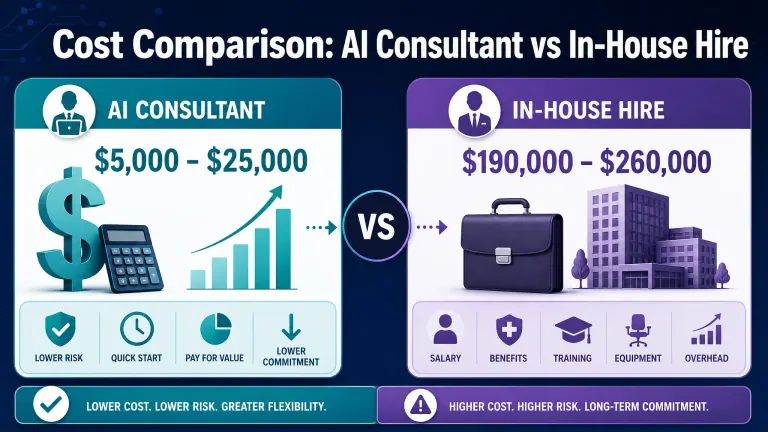
You know AI could remove manual work, but committing to a six-figure salary before the business case is proven can turn one uncertain investment into a permanent cost.
The hourly-rate comparison is misleading. With a consultant, you buy a limited outcome. With an employee, you buy 12 months of capacity whether the implementation needs four weeks or forty. The right question is: Do you need a project completed, or an AI function owned every week?
Not sure whether your workload justifies a hire? We can map the workflows, estimate the savings, and tell you honestly whether a consultant, employee, or fixed-scope build makes financial sense. Get a Free AI Readiness Assessment →
Table of Contents
- The Full First-Year Cost Comparison
- What You Actually Get With Each Option
- The Hidden Cost of a Bad In-House AI Hire
- Decision Matrix: Consultant, In-House, or Done-for-You
- Who This Is For
- Frequently Asked Questions
- Conclusion
The Full First-Year Cost Comparison
The U.S. Bureau of Labor Statistics reports a $133,080 median annual wage for software developers, with the highest 10% earning more than $211,450. An experienced AI automation engineer, machine-learning engineer, or technical AI lead will often sit above that broad median, especially when the role also requires integrations, data design, security, and stakeholder management.
Salary is only the first line. In March 2026, BLS data showed benefits represented 30.1% of private-industry compensation. Recruiting, equipment, software, model usage, and management time sit on top of that.
A transparent first-year model
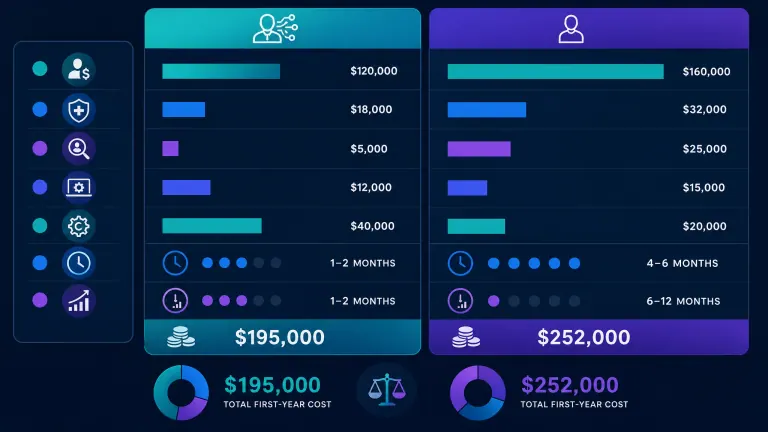
| Cost item | AI consultant | One in-house AI hire | Done-for-you system |
|---|---|---|---|
| Core fee or salary | $5K–$25K project | $150K–$190K salary | $10K–$30K build |
| Benefits and payroll burden | $0 | $45K–$57K | $0 |
| Recruiting and interview time | $0–$2K | $15K–$35K | $0–$2K |
| Tools, APIs, and software | $1K–$6K | $5K–$20K | $1K–$8K |
| Ramp before useful output | 1–3 weeks | 2–6 months | 2–6 weeks |
| Typical first-year total | $6K–$33K | $215K–$302K | $11K–$40K |
These are planning ranges, not quotes. A custom machine-learning product can cost far more. A simple automation can cost less. The point is to compare like with like: a small business buying an outcome versus creating a permanent technical role.
What does delay cost?
Suppose the planned workflows save 20 staff hours per week at a loaded labor cost of $40 per hour. That is $800 per week, or about $41,600 in annual capacity.
- A consultant who ships in six weeks leaves roughly $4,800 of potential savings unrealized during implementation.
- A hire who takes four months to recruit and two more months to ramp delays half a year of value—roughly $20,800.
- If the hire also chooses the wrong stack and the system must be rebuilt, the delay can consume most of the first-year business case.
This is why calculating AI automation ROI should happen before choosing the staffing model. The workload and expected value determine what you can afford—not the other way around.
Get the cost model for your actual workflows. We will estimate implementation cost, annual savings, and payback before you commit to a vendor or a full-time hire. Book a Free Workflow Review →
What You Actually Get With Each Option
Cost matters, but the deliverable matters more. An engagement that produces slides instead of a working system is not cheap. Neither is an employee whose job description combines five incompatible specialties.
What an AI consultant should deliver
A strong implementation consultant should leave you with a prioritized workflow map, a working production system, documentation, training, monitoring, and a clear list of ongoing costs. The contract should make data ownership, account access, intellectual property, support, security, and knowledge transfer explicit.
For current pricing structures, see our detailed guide to AI consultant costs for small businesses. It separates hourly advice from fixed-price implementation, retainers, and larger transformation work. Before scoping either option, our complete guide to AI automation for small business covers how to define the workflow so a consultant or hire has something concrete to build.
What one in-house hire can—and cannot—own
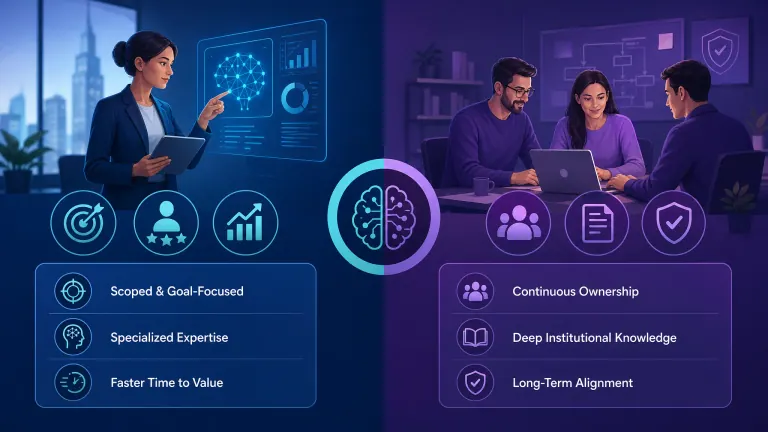
An employee builds deeper context over time. They learn how your team works, see failures as they happen, and can continuously improve the system. They are also available for unplanned work without starting a new procurement cycle.
But “AI hire” is not one skill. Strategy, process discovery, data engineering, automation development, model evaluation, security, change management, and training are separate capabilities. One exceptional generalist may cover several. Few cover all of them at senior level.
The role works best when you already have a technical manager, a full-year backlog, accessible business data, internal workflow owners, and a budget for tools and outside specialists.
Why the hybrid model often wins
The practical sequence is often consultant first, internal owner second. The consultant validates use cases and ships the first systems. An operations employee owns monitoring and improvement. If the work is mainly B2B operations, sales handoffs, reporting, or client delivery, start with AI consultant services that build the automation for you before adding a permanent technical role. Hire a specialist later when the validated backlog becomes a full-time function.
That approach matches broader research. McKinsey’s 2025 global survey found nearly two-thirds of organizations had not begun scaling AI enterprise-wide. High performers were nearly three times more likely to redesign workflows fundamentally. Buying tools or adding a vague “AI person” is not the differentiator; redesigning work around measurable outcomes is.
The Hidden Cost of a Bad In-House AI Hire
The worst outcome is not simply paying too much salary. It is allowing an under-scoped role to create technical decisions the business cannot easily reverse.
Wrong-stack choices
A new hire can select tools based on personal familiarity rather than your needs: custom software where a maintained integration would work, fragile no-code steps without monitoring, or an expensive model where a smaller one is sufficient. The result is tooling debt—overlapping subscriptions, duplicated data, and workflows only one person understands.
Six months of ramp without a validated backlog
Even a talented hire cannot fix an undefined problem. Without workflow owners, baseline costs, success metrics, and risk limits, the first months disappear into experiments. Demos are easy; reliable systems with permissions, exception handling, human review, and adoption are harder. IBM reports that only 25% of surveyed AI initiatives delivered expected ROI and only 16% scaled enterprise-wide.
Key-person risk
If one employee designs every automation, holds the credentials, and understands every exception, you have not built an internal capability. You have created a single point of failure.
Reduce that risk with company-owned accounts, plain-English operating procedures, change logs, tests, and a named business owner. Apply the same controls to consultants: the staffing model changes, but the need for ownership does not.
Avoid paying twice for the same implementation. AI Essentials designs, builds, documents, and hands over connected systems for small businesses, with clear ownership and measurable outcomes. See the AI Operating System →
Decision Matrix: Consultant, In-House, or Done-for-You
Use this matrix before opening a job requisition or requesting proposals.
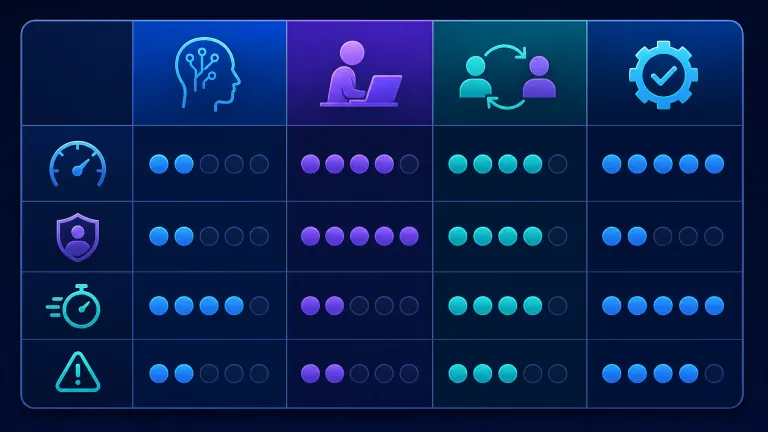
| Your situation | Best starting option | Why |
|---|---|---|
| You have 1–5 defined workflows and need results this quarter | AI consultant | Scoped expertise without permanent payroll |
| You know the outcome but do not want to manage tools or builders | Done-for-you service | One accountable provider owns implementation |
| AI is part of your core product or proprietary advantage | In-house hire or team | Continuous iteration and institutional knowledge matter |
| You have strict data, security, or regulatory requirements | In-house or hybrid | Internal control with specialist support where needed |
| You are unsure which workflows have positive ROI | Audit or short consulting engagement | Validate the backlog before staffing it |
| You need continuous development across several departments | In-house team | Enough recurring work exists to justify fixed capacity |
| You need an automated sales pipeline, not a general AI department | Done-for-you system | Buy the business outcome rather than broad technical capacity |
A simple break-even test
Take the fully loaded annual cost of the hire and divide it by the gross value of your validated AI backlog.
Example: A hire costs $240,000 in year one. Four validated workflows are worth $120,000 total. The employee must create another $120,000 of value merely to break even—and that excludes execution risk. A scoped $25,000 implementation has a much lower hurdle.
If your validated backlog is worth $500,000 annually and needs continuous iteration, a $240,000 employee may be economical. That is the honest case for hiring: enough recurring, measurable work to keep the role productive.
For a defined sales outcome, the 24/7 Pipeline Engine is the done-for-you alternative: a CRM-integrated lead-generation and follow-up system built around qualified meetings rather than a broad technology mandate.
Who This Is For
This is ideal for:
- An owner with repetitive work but no validated need for a permanent AI role
- A team comparing a consultant proposal with the loaded cost of its first AI hire
- A company that needs automation this quarter with a clear handover path
Consider alternatives if:
- AI is the core product and requires proprietary, continuous development
- Regulation or data sovereignty requires all work to remain internal
- Your engineering team can already absorb AI implementation
Why AI Essentials specifically?
AI Essentials helps U.S. small and medium businesses build practical automation tied to time savings, lead generation, and operational capacity. We focus on fixed outcomes, existing-tool integrations, and documented handover—not open-ended strategy work.
Frequently Asked Questions
Is it cheaper to hire an AI consultant or an employee?
An AI consultant is usually cheaper for a defined first project. An implementation may cost $5,000–$25,000, while one experienced technical employee can exceed $200,000 in first-year loaded cost. An employee becomes economical when a continuous, validated backlog uses that capacity every month. Compare total annual cost and time to value, not hourly rates.
How much does an in-house AI hire cost in 2026?
Plan for roughly $190,000–$260,000 before unusually high equity or infrastructure costs. That combines a $150,000–$190,000 salary with benefits, recruiting, equipment, software, and model usage. A senior machine-learning specialist can cost more. The budget should also include management time and value lost during recruiting and onboarding.
How much does an AI consultant charge for a project?
Small-business projects commonly range from $5,000 to $25,000 for a few defined workflows. Strategy-only audits may cost less; custom software, sensitive data, complex integrations, or multi-department deployments cost more. Require deliverables, acceptance criteria, ownership, support, and ongoing software costs in writing. A quote without those items is not a complete price.
When should a small business hire an AI employee?
Hire when AI work is continuous, strategically important, and large enough to justify a full-time role. You need a validated backlog, measurable outcomes, a manager who can evaluate technical work, and a long-term need for iteration. If you are still choosing two workflows, a scoped consultant or audit is safer.
What are the disadvantages of using an AI consultant?
Consultants have less institutional context, may be expensive per hour, and can create dependency if documentation and knowledge transfer are weak. Availability may also be limited after the engagement ends. Reduce these risks with a clear scope, company-owned accounts, explicit intellectual-property terms, documentation requirements, training, and a defined support period. Avoid providers that offer only strategy when you need implementation.
What are the disadvantages of building AI in-house?
In-house work creates fixed payroll, recruiting risk, a slower start, and possible key-person dependency. One hire may also lack the mix of process, data, automation, security, and change-management skills the project needs. The upside is deeper context and continuous ownership. The model works when leadership can define the role precisely and provide enough validated work to sustain it beyond the first implementation.
Can one employee build and manage all our AI systems?
Sometimes, but it is a risky assumption. A strong automation generalist can build integrations and manage model APIs, yet may not also be an expert in data engineering, security, product management, and employee adoption. Define the actual systems first, then hire for the dominant skill set. Budget for specialist review where data sensitivity, compliance, or business impact raises the stakes.
Is a hybrid AI staffing model better?
A hybrid model is often best for a small business. An external specialist can validate use cases and build the first systems quickly, while an internal operations owner learns to monitor and improve them. Later, the company can hire technical staff once the backlog supports it. The key is contractual knowledge transfer and company ownership of accounts, data, documentation, and production access.
How long does an AI implementation take?
A defined automation project often takes two to eight weeks, depending on data quality, integration access, testing, and stakeholder availability. Recruiting and ramping a full-time hire can take several months before production work begins. Custom machine-learning products take longer than workflow automation. Ask providers to separate discovery, prototype, production rollout, training, and post-launch support in the schedule.
How do we avoid hiring the wrong AI person?
Validate the work before writing the job description. Document the workflows, business value, systems involved, security needs, and maintenance expectations. Use a paid practical assessment based on a sanitized real problem, and have a qualified technical reviewer evaluate the candidate. Do not hire a “general AI expert” against a vague mandate. Ambiguous roles attract mismatched skills and make performance impossible to measure.
Conclusion
Choose a consultant for a defined result without permanent payroll. Hire in-house when proven, continuous work justifies the annual commitment. Use a hybrid or done-for-you model for external speed with internal ownership.
The deciding factor in the AI consultant vs in-house hire choice is not who looks cheaper per hour. It is which model creates the required outcome with the lowest total cost, delay, and dependency risk.
Make the staffing decision from real numbers. Bring us your workflow backlog. We will show you what to automate, what it should cost, and whether you should build externally or hire. Book Your Free Assessment →

Iliyan Ivanov
Founder of AIessentials · AI automation consultant helping B2B businesses save 20+ hours/week and grow without hiring