How Can Machine Learning Consulting Services Boost Your Operational Efficiency?
[ SUMMARIZE WITH AI ]
Workflow Audit
]99% sure you are not seeing all the spots AI can help you in your business.
Are your workflows optimized with the most up to date solution, or are they costing you and your team time and money?
GET FREE AUDITMachine learning consulting services improve operational efficiency by finding the repetitive decisions in your operations (sorting requests, forecasting demand, flagging errors) and building a model that makes them faster and more consistently than a person working through a queue. For a small or mid-size B2B business, a scoped project typically costs $8,000–$25,000, takes 8–14 weeks to go live, and pays back in 4–9 months when it targets a high-volume decision. It only works when the problem actually needs pattern recognition. If a simple rule can make the decision, plain automation is cheaper and faster.
Where it helps most: High-volume, repeated decisions that follow patterns in your data, such as triaging inbound requests, forecasting inventory, extracting data from documents, or scoring leads. Typical cost: $8,000–$25,000 for a single scoped workflow, plus a monitoring and retraining fee after launch. Typical timeline: 8–14 weeks from kickoff to a live model, assuming you already have 6+ months of usable historical data. Typical payback: 4–9 months, depending on how many hours the decision eats today and how well the team acts on the model's output. The catch: If the decision can be written as an "if this, then that" rule, you don't need machine learning. Many efficiency problems are really workflow problems.

You already know your team spends too many hours on work that feels like it should run itself. The harder question is whether the fix is a machine learning model, a simpler automation, or neither.
That question matters because most pitches skip it. McKinsey's State of AI survey found that 78% of organizations now use AI in at least one business function, so the pressure to "do something with ML" is real. But RAND's research on AI project failure found that more than 80% of AI projects fail, twice the rate of ordinary IT projects, and a top reason is that teams misunderstand which problem the AI is supposed to solve.
So this guide does what the big consulting pages don't. It shows you which operational problems machine learning really fixes, how to tell when plain automation wins, and what the numbers look like for a business your size. If the repetitive part of your process is rule-based, you can have that part built for you without a model at all.
Not sure which approach fits your business? Take the 2-minute AI Readiness Check and see whether your bottleneck needs a model, a workflow, or just a cleaner process. Check Your AI Readiness →
Table of Contents
- What Machine Learning Actually Fixes
- ML or Plain Automation?
- What an Efficiency Project Costs and Pays Back
- Who This Is For
- Frequently Asked Questions
What Machine Learning Actually Fixes
Think of machine learning as a very fast apprentice who learns from your past decisions. Show it 10,000 support emails and how your team sorted them, and it learns to sort the next one. That's the whole idea. It works when the right answer is hidden in patterns that a human can feel but can't easily write down as rules.
Here are the operational jobs where that tends to pay off for a business with 5–200 people:
Triage and routing. Inbound requests, emails, or tickets that need to reach the right person. A person reads each one for a few minutes. A model reads it in a second and sends it where it belongs. This is the most common first project because the data already exists in your inbox or helpdesk.
Demand and inventory forecasting. If you order stock, schedule staff, or plan capacity from last month's spreadsheet, a forecasting model can use seasonality, promotions, and trends you can't track by hand. The gain shows up as fewer stockouts and less cash trapped in extra inventory. For a deeper look at one version of this, see our post on machine learning consulting for supply chain AI.
Document and data extraction. Invoices, purchase orders, and contracts arrive in a dozen formats. A model reads them and fills in your system, so nobody retypes numbers. Error rates usually drop along with the hours.
Scoring and prioritizing. Which leads to call first, which accounts are about to leave, which invoices will be paid late. Our guide to how machine learning improves business decision-making covers these in more detail, and the churn prediction ROI timeline walks through one project phase by phase.
The three-question test
Before you pay anyone, ask:
- Is the decision made often? Hundreds or thousands of times a month, not a few dozen. Low volume rarely justifies a model.
- Do you have history? At least 6 months of past examples with the outcome recorded, ideally a few thousand rows. No data means no model.
- Can a rule do it? If a smart intern could write the logic on one page, you don't need machine learning.
If you answer yes, yes, no, you have a real ML candidate. Anything else, keep reading.
See how we scope this for a business like yours Book a 30-minute walkthrough and we'll tell you honestly whether your bottleneck is a model problem or a workflow problem, before quoting anything. Book a 30-Min Walkthrough →

ML or Plain Automation?
This is the part the top-ranking pages leave out. We read the top three results for this topic: three vendor service pages, each running roughly 4,200–4,500 words. None gave a price, none gave a timeline, and none said when you shouldn't use machine learning. That's understandable, since they're selling ML.
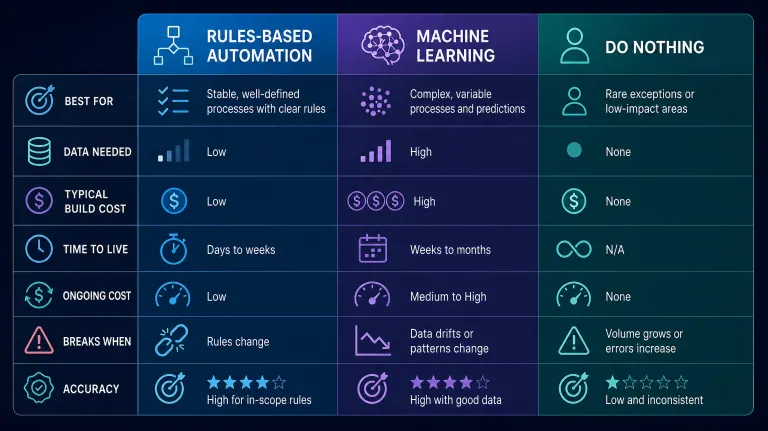
But for most small and mid-size businesses, the honest answer to "how do I get more efficient?" is a mix. Rules-based automation handles the predictable 40–60% of the work. Machine learning only earns its cost on the part that rules can't handle.
| Rules-based automation | Machine learning | Do nothing | |
|---|---|---|---|
| Best for | Predictable steps: form goes to CRM, invoice goes to approver | Messy, pattern-based calls: sorting free-text, forecasting, scoring | n/a |
| Data needed | None to start | 6+ months of labeled history | n/a |
| Typical build cost | $2,000–$5,000 | $8,000–$25,000 | $0 |
| Time to live | 1–3 weeks | 8–14 weeks | n/a |
| Ongoing cost | $50–$200/month in tool fees | Monitoring and retraining, often quarterly | Staff time, every month |
| Breaks when | A connected app changes | The data changes ("drift") | Someone's out sick |
| Accuracy | Exact, because rules are rules | Good but never perfect; needs a human check on edge cases | Depends on the person |
A practical way to decide: start with the rules. Automate everything predictable first, which also cleans up your data and makes any later model more accurate. Then look at what's left over. If a big, repeated, judgment-heavy chunk remains, that's your ML project, and you'll scope it with real numbers instead of hope.
This order also protects you from the failure pattern Gartner flagged: at least 30% of generative AI projects abandoned after proof of concept, with unclear business value and poor data among the causes. A rules-first approach gives you a quick win to prove value before you commit to the bigger build.
How AI Essentials helps here: we build the workflow layer, the routing, follow-ups, and handoffs that rules can handle, and we'll tell you plainly when the leftover problem needs a specialist ML team instead.
Want the predictable part running first? We map your process, automate the rule-based 40–60%, and flag what's left for a model, so you spend on ML only where it pays. Book a 30-Min Walkthrough →
What an Efficiency Project Costs and Pays Back
Let's run real numbers. The example below is an illustrative estimate, not a client result. Swap in your own volumes and hourly cost.
The situation: a 25-person B2B distributor gets 1,200 customer requests a month by email and web form. Someone reads each one, decides who handles it, and logs it. That takes about 6 minutes per request.
- Manual triage today: 1,200 × 6 min = 120 hours/month
- At a loaded labor cost of $35/hour: $4,200/month spent just sorting
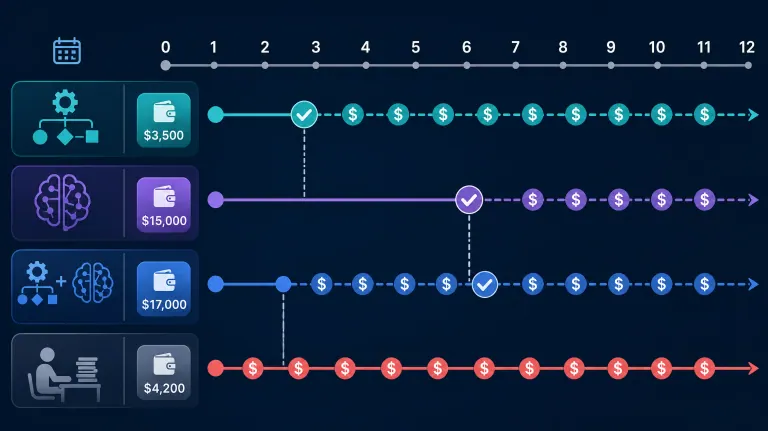
| Option | Share of requests handled | Hours saved/month | Monthly saving | Build cost | Monthly upkeep | Payback |
|---|---|---|---|---|---|---|
| Rules-based automation | ~45% (clear keywords, known customers) | 54 | $1,890 | $3,500 | $100 | ~2–3 months (incl. build time) |
| ML triage model | ~70% (reads free text and intent) | 84 | $2,940 | $15,000 | $400 | ~6 months |
| Rules first, then ML on the rest | ~75% combined | 90 | $3,150 | ~$17,000 total | ~$450 | ~6 months, with savings starting in month 2 |
| Do nothing | 0% | 0 | $0 | $0 | $0 | Pays $4,200/month forever |
Look at what happens. The ML model alone handles more volume, but it takes six months to earn back its cost. The rules-first path starts paying in month two, and the ML layer then picks up what's left. Same end state, much less risk along the way.
You can also compare this against hiring. A full-time ops coordinator in the US runs roughly $50,000–$65,000 a year in salary before benefits. Our breakdown of AI consultant versus in-house hire goes through that math, and our AI consultant cost guide shows what rates look like by project type.
To test your own version, plug your volumes into the free AI ROI calculator. If the payback period comes out past 12 months, pick a smaller first project.
Ready to see your own numbers? Book a 30-minute walkthrough and we'll run this same calculation against your request volumes and labor costs. Book a 30-Min Walkthrough →
Who This Is For
This is ideal for:
- Operators of 5–200 person B2B businesses who lose hours every week to sorting, checking, or re-entering things by hand
- Owners who've been pitched "AI" a few times and want an honest read on what actually needs machine learning
- Teams with at least 6 months of recorded history (tickets, orders, invoices) and a repeated decision they make hundreds of times a month
Consider alternatives if:
- You need a custom model built from scratch, such as computer vision or a proprietary prediction engine. A specialist ML firm is the right fit, not a general automation provider.
- Your volume is low (a few dozen decisions a month). A checklist or a part-time hire is cheaper.
- You have no historical data. Start by collecting it, and automate the rule-based steps in the meantime.
Why AI Essentials specifically? AI Essentials is a done-for-you AI automation provider for small and mid-size B2B businesses. We start with the rule-based workflow layer because it pays back fastest and cleans up the data any later model needs. We'll also tell you straight when your problem needs a dedicated ML team, rather than selling you a model you don't need.
Frequently Asked Questions
Is $100 an hour good for consulting?
For general business consulting, $100 an hour is reasonable for a mid-level specialist. Machine learning consulting usually runs $150–$300 an hour, since the work needs data science skills. Many firms quote a fixed project fee of $8,000–$25,000 for one scoped workflow instead, which makes your budget easier to predict.
How much does an AI consultant cost?
AI consultants typically charge $150–$350 an hour, or $5,000–$25,000 for a scoped single-workflow project. Enterprise engagements with large firms start much higher, often six figures. For a small or mid-size business, a fixed-scope project with a clear deliverable is usually the safer way to buy.
What is a machine learning consultant?
A machine learning consultant helps a business decide where machine learning fits, then plans or builds the model. The job covers choosing the problem, checking your data, building and testing the model, connecting it to your tools, and setting up monitoring. Good ones also tell you when you don't need ML at all.
What are some reputable machine learning consulting firms?
Large firms like Accenture, Deloitte, IBM Consulting, and Itransition serve enterprise clients. For small and mid-size businesses, boutique firms and automation specialists usually fit better on price and speed. Whoever you consider, ask for a fixed scope, a named timeline, and a recent project at your company's size before signing.
How does machine learning consulting improve operational efficiency for B2B companies?
It replaces repeated manual judgments with a model that makes them in seconds. Common wins are request triage, demand forecasting, document extraction, and lead scoring. The gain is hours saved per month plus fewer errors. It works best on high-volume decisions with at least six months of recorded history behind them.
What are the implementation steps in an ML consulting project?
Most projects run in five steps: scope the problem, audit your data, build and test a model, connect it to your live tools, then monitor and retrain it. Expect 8–14 weeks end to end. The data audit is the step that most often changes the plan, so insist on it before any build begins.
How do you work out the ROI of machine learning consulting?
Multiply hours spent on the decision each month by your loaded hourly cost. Estimate the share the model can handle, then subtract monthly upkeep. Divide the project cost by that net monthly saving to get payback. If payback is over 12 months, scope a smaller first project or start with rules-based automation.
Is machine learning consulting better than building an in-house team?
For most small businesses, yes at the start. A data scientist costs $90,000–$130,000 a year and needs months to produce a usable model, and one hire rarely covers data, engineering, and deployment. A consulting project gets one workflow live in 8–14 weeks. In-house makes sense once you have several ML use cases running continuously.
What are the most common mistakes in B2B machine learning projects?
The usual four: picking a problem a simple rule could solve, starting with too little or messy data, building a model nobody acts on, and skipping monitoring after launch. RAND's research points to misunderstanding the problem and missing data as leading causes of AI project failure.
How do you avoid machine learning project failure?
Start small with one high-volume decision, and automate the rule-based steps first. Confirm you have clean historical data before paying for a build. Name an owner who will act on the model's output, and agree in writing on monitoring and retraining after launch. A narrow scope with a clear payback target beats an ambitious one.
Conclusion
Machine learning consulting can cut real hours out of your operations, but only when the problem is high-volume and pattern-based. Rules-based automation handles the predictable 40–60% faster and cheaper, and it prepares your data for any model you add later.
Three things to take with you: run the three-question test before you pay anyone, automate the rule-based steps first, and insist on a payback number in writing before any build starts.
If you want help sorting your bottleneck into "rules," "model," or "neither," book a 30-minute walkthrough. We'll tell you which one it is, and what it would cost, before you commit to anything.

Iliyan Ivanov
Founder of AIessentials · AI automation consultant helping B2B businesses save 20+ hours/week and grow without hiring