Can You Build Your Own AI Chatbot? DIY vs Hiring It Done
[ SUMMARIZE WITH AI ]
Workflow Audit
]99% sure you are not seeing all the spots AI can help you in your business.
Are your workflows optimized with the most up to date solution, or are they costing you and your team time and money?
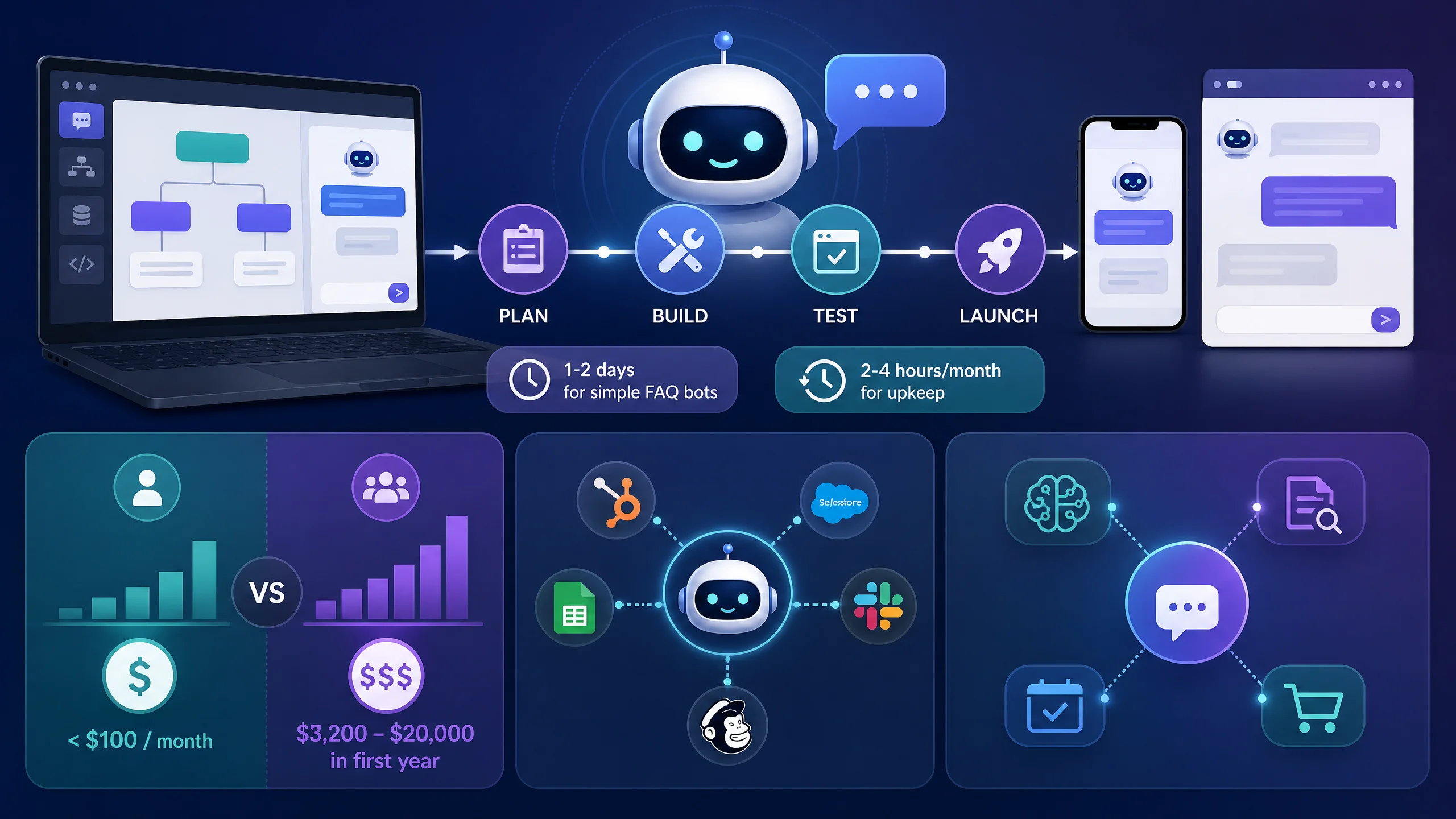
GET FREE AUDITYes. A technical-enough owner can build a working AI chatbot for business in 1 to 2 days using a no-code platform or an AI model's API, and the first version usually costs under $100 a month to run. The part that takes real effort is not the build. It is keeping answers accurate, connecting the bot to your CRM or calendar, and handing hard conversations to a person without losing the customer.
Simple FAQ bot: DIY works well. A platform plus your help-center pages gets you live in a weekend. Bot that books, quotes or updates your CRM: DIY gets harder. Each connection is a workflow that can break silently. Ongoing upkeep: Expect 2 to 4 hours a month to review wrong answers and refresh the knowledge base, whichever route you pick. Cost of hiring it done: Vendor-published estimates for agency-built custom chatbots run roughly $3,200 to $20,000 in year one (CoderCops, 2026). Biggest risk either way: A wrong answer is your answer. A tribunal held Air Canada responsible for what its website chatbot told a customer.
You are not asking whether it is possible. You are asking whether your weekend is better spent on this than on the thing you actually run.
Here is the honest split. If the bot only has to answer questions from documents you already have, build it yourself. If it has to act (book, qualify, route, update a record) or if a bad answer costs you a customer, the build is the smaller half of the job. The rest is testing, guardrails and maintenance, and that is where most DIY bots quietly stop working.
This post walks through what DIY takes, what it costs when you count your own time, and a simple test for choosing. It also covers the cases where we would tell you not to hire anyone. For how chatbots fit into support more broadly, see our guides on AI customer service pricing and whether AI customer service is worth the ROI. This post is narrower: the build-it-yourself question.
Table of Contents
- What a DIY AI chatbot actually takes
- Where DIY chatbots break
- DIY vs hiring it done: the real numbers
- Who This Is For
- Frequently Asked Questions
- Conclusion
What a DIY AI chatbot actually takes
There are two DIY routes, and they are very different jobs.
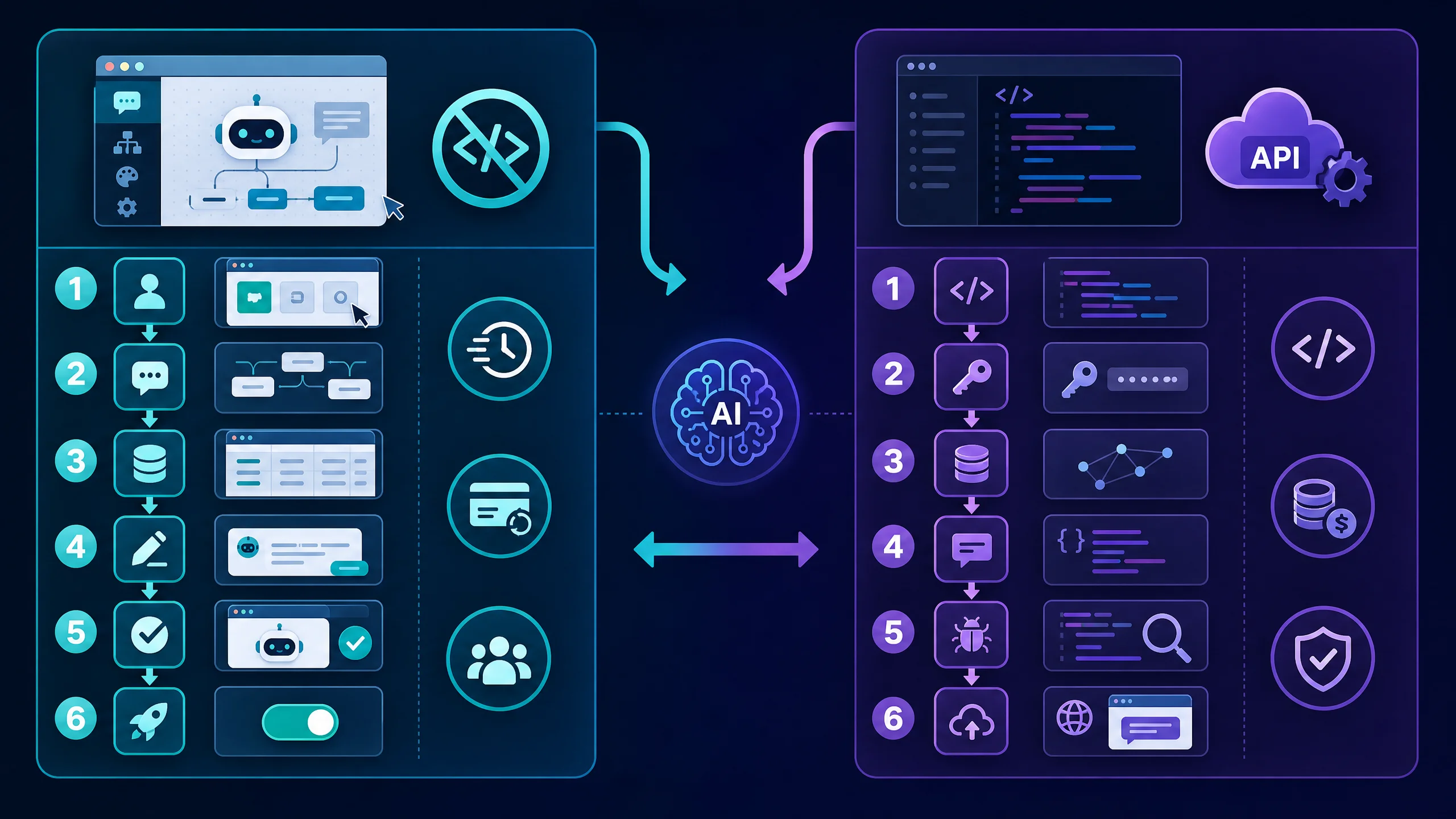
Route 1: A no-code chatbot platform. You sign up, paste in your website URL or upload documents, pick a model, and embed a widget. Time: a few hours for the first version. Cost: typically a monthly subscription. This is the right start for most owners.
Route 2: Build on a model API. You write code that sends a customer's question plus the right chunk of your documents to a model such as OpenAI's or Anthropic's, then returns the answer. The pattern is called retrieval-augmented generation, or RAG (more on that in the FAQ). You pay per token, so a low-volume bot costs little in usage. You also own every bug.
Either way, the same six steps apply:
- Pick one job. "Answer pricing and shipping questions" beats "handle customer service."
- Collect the source material. Help pages, policy docs, price lists, past tickets that were answered well.
- Clean it. Old prices and contradictory policies are the top cause of wrong answers. The bot repeats whatever you feed it.
- Write the rules. What it may answer, what it must refuse, and when it says "let me get a person."
- Test with 50 real questions. Pull them from your inbox. Score each answer right, partly right or wrong.
- Launch narrow, then review weekly. Read the conversations. Fix the knowledge base, not the model.
Step 5 is the one people skip. A bot that sounds confident and is wrong 1 time in 10 is worse than no bot, because customers cannot tell which answer is the bad one.
Where DIY chatbots break
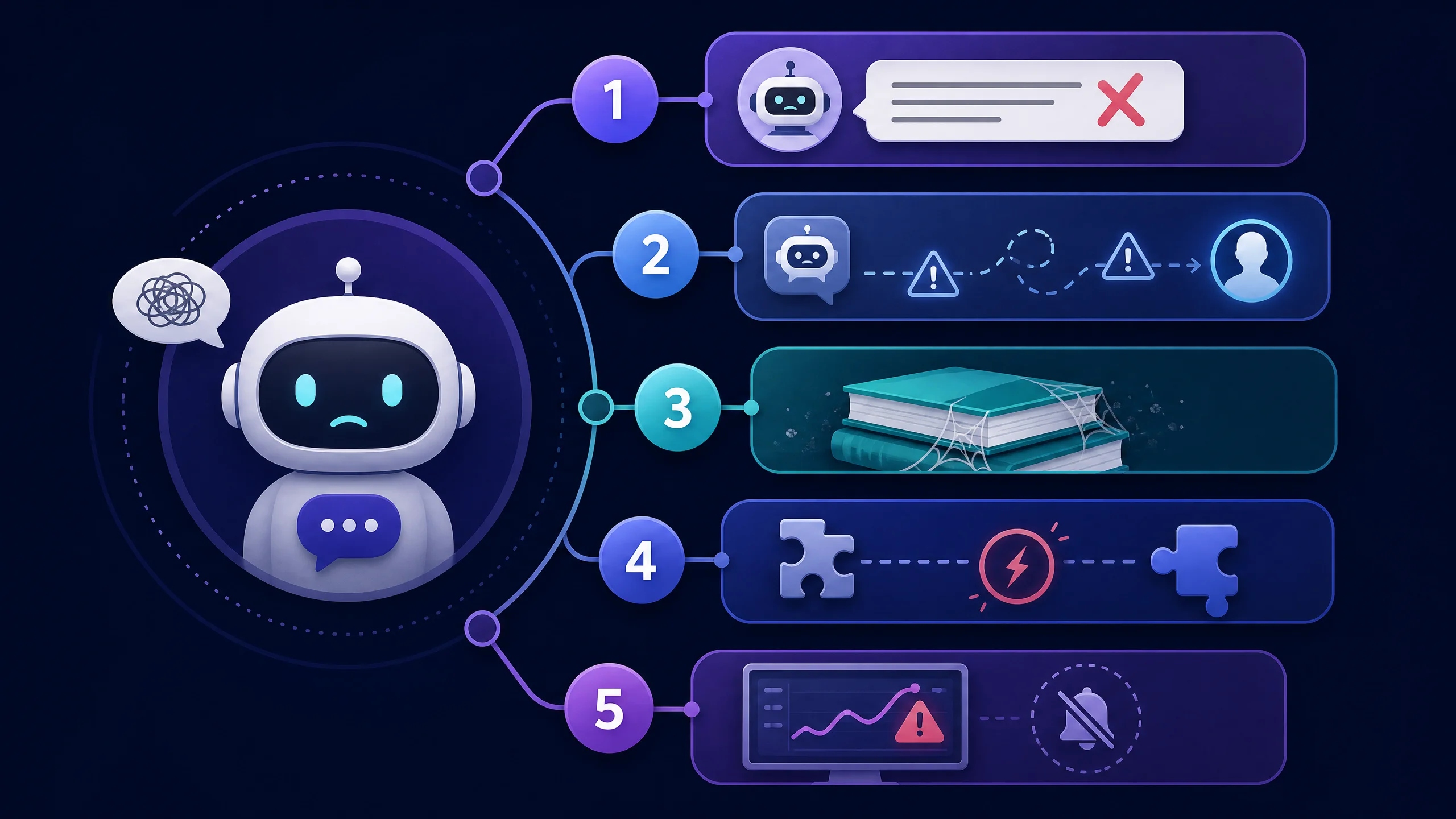
A DIY bot rarely fails on day one. It fails in month two. These are the five failure points we look for first when we scope a chatbot.
1. Wrong answers with a straight face. Models fill gaps with plausible text. In 2024 a Canadian tribunal ruled that Air Canada was responsible for incorrect bereavement-fare advice its chatbot gave a customer, rejecting the argument that the bot was a separate entity (American Bar Association summary). You do not need to be an airline for that logic to apply to you.
2. No clean exit to a person. Gartner surveyed 5,728 customers and found 64% would prefer companies did not use AI in customer service, and 53% would consider switching to a competitor if they learned a company would use it. The top concern was that it would get harder to reach a human (Gartner, 2024). A DIY bot without a clear handoff turns that concern into a lost customer.
3. Stale knowledge. You change a price or a policy and forget the bot. Nothing alerts you. Customers get last quarter's answer.
4. Silent integration failures. The bot is supposed to create a CRM contact or book a slot. An API token expires, a field is renamed, and the bot keeps chatting as if nothing happened. We cover this pattern in why workflow automation fails when the process is already broken.
5. Nobody owns it. The person who built it moves on, or gets busy. After 60 days, no one reads the transcripts.
None of these are reasons to avoid DIY. They are the maintenance list. If you can commit an hour a week to reading conversations, a simple bot is a fine DIY project. If you cannot, plan to pay for that attention, to a platform with good analytics, or to someone who does this for a living.
How a bot that acts gets built
Here is what "a chatbot that does more than answer" looks like when we build one. This is the walk-through for a typical lead-handling bot on a service business site:
- Trigger: A visitor opens the chat widget or asks a pricing question.
- Step 1: The bot answers from approved pages only. Anything outside that list gets "I don't have that, want me to connect you with someone?"
- Step 2: If the visitor shares an email or phone number, the bot creates or updates a contact in the CRM with the conversation summary attached.
- Step 3: If the visitor matches your qualifying rules (say, company size and timeline), it offers a booking link. If not, it offers a helpful resource.
- Step 4: A person gets a Slack or email alert for every hand-raiser, with the transcript.
- Fail-safe: A daily check confirms the CRM write succeeded. If it did not, you get an alert.
That is four systems talking to each other (website, model, CRM, calendar) plus a monitoring step. It is not hard work, but it is a lot of small places where something can go wrong. It is also the kind of build we scope under AI automation for B2B businesses, where you can have this built for you with a fixed scope and price.
DIY vs hiring it done: the real numbers
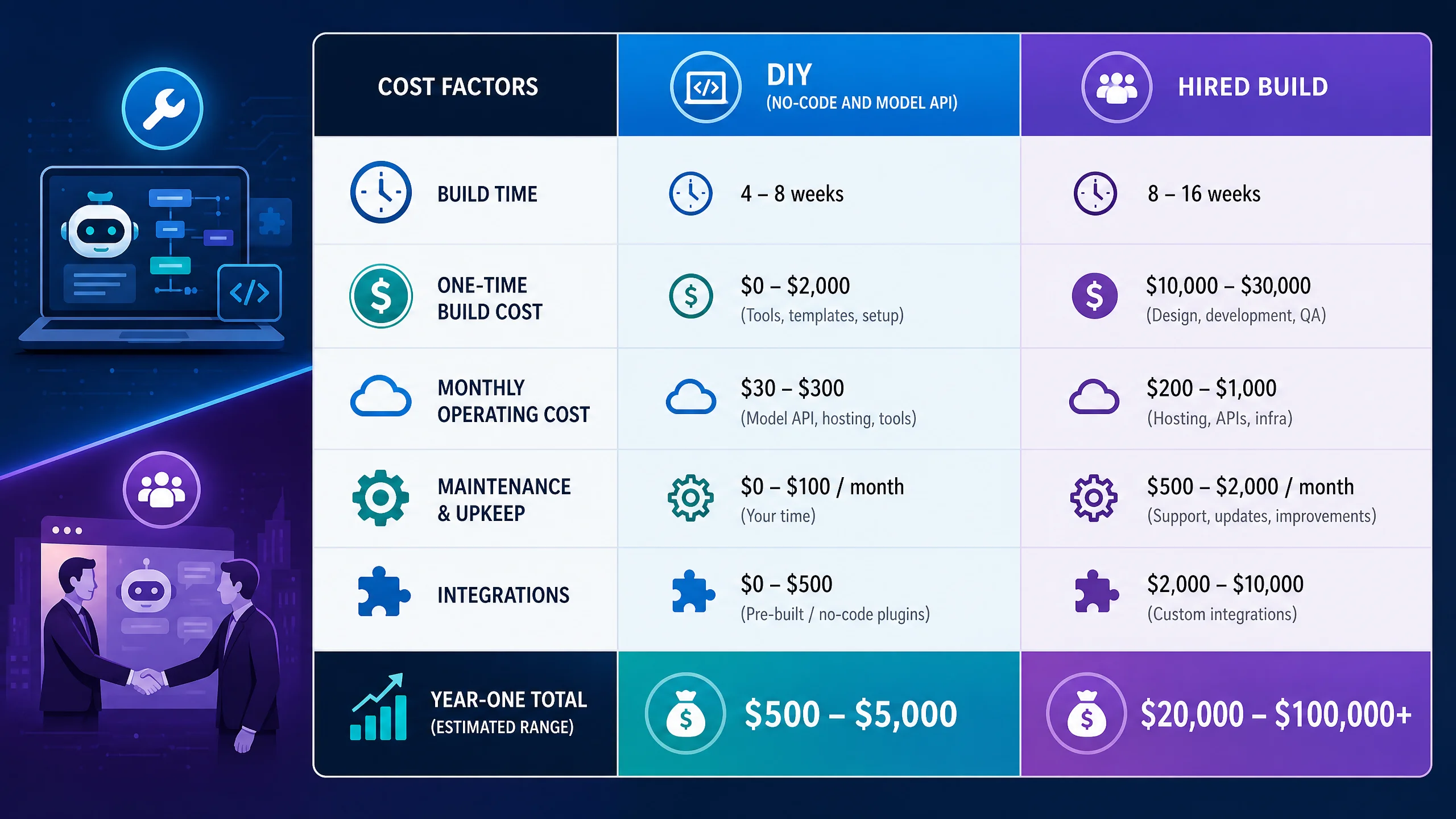
Cost comparisons online range wildly because they mix up different jobs. One vendor guide puts a custom build on a model API at $4,000 to $35,000 in year one and an agency build at $3,200 to $20,000, with off-the-shelf platforms at $600 to $6,000 (CoderCops, 2026). Those are one vendor's estimates, so treat them as ranges, not quotes.
The number most guides leave out is your own time. Here is a worked comparison for a simple lead-handling bot, using our own assumptions (stated so you can swap in yours):
| No-code platform, DIY | Model API, DIY | Hired build | |
|---|---|---|---|
| Your build time | 8 hours | 25 hours | 3 hours (scoping and review) |
| Your time at $75/hour | $600 | $1,875 | $225 |
| Tools and usage, first year | ~$600 to $1,200 | ~$300 to $1,000 (usage billed per token, see OpenAI pricing) | Depends on scope |
| Upkeep, 3 hours/month at $75 | $2,700 | $2,700 | ~$900 (review only) |
| Integrations (CRM, calendar, alerts) | Limited to platform's connectors | You build and monitor each | Included in scope |
| Year-one total (rough) | $3,900 to $4,500 | $4,900 to $5,600 | Fee + ~$1,100 of your time |
The takeaway is not that hiring is cheaper. It is that DIY is not free once you price your hours, and the gap closes quickly if you value your time at more than $50 an hour. If the bot is a side project and your time is genuinely spare, DIY wins on cash.
Want a fixed price for a chatbot that books and updates your CRM? Bring the job you want the bot to do. We will scope it on a call and quote it. Our automation projects run $300 to $3,747 depending on scope, and every service fee is covered by a 60-day money-back guarantee: if you don't get the outcomes we agree on upfront within 60 days of kickoff, we refund your service fee. Book a Scoping Call →
The three-question decision test
Answer these honestly:
- Does the bot only answer questions from documents you already have? If yes, DIY on a platform.
- Does a wrong answer cost money or trust? If yes (pricing, legal, medical, contracts), add human review or hire it done.
- Does it need to write to other systems? If yes, and you do not enjoy debugging integrations, hire it done.
Two yeses on questions 2 and 3 is the signal. One or zero, build it yourself.
AI chatbot, hiring a person, or doing nothing
For a fair comparison, add the alternatives. A part-time support person at 15 hours a week and $20 an hour costs about $1,300 a month, roughly $15,600 a year, before payroll costs. A DIY bot at $3,900 to $5,600 in year one will not replace that person, but it can take over the repetitive questions so the hours come down. That is a drop in hours, not a layoff. If you get 20 support messages a week, none of this is worth it, and the right answer is a good FAQ page and a shared inbox.
Who This Is For
This is ideal for:
- Owners who are comfortable with spreadsheets and settings pages and want a bot that answers questions from their own documents
- Teams with a support or sales inbox that repeats the same 10 to 20 questions every week
- Businesses whose chatbot also has to book calls, qualify leads or update a CRM, and who would rather not own the plumbing
Consider alternatives if:
- You get fewer than about 20 inbound questions a week. A strong FAQ page and fast email replies beat a bot at that volume.
- Your answers are legal, medical or financial advice. Use a bot only for routing, with a person giving the answer.
- Your documents are out of date or contradict each other. Fix those first, or any bot will repeat the mess.
Why AIessentials specifically? AIessentials (aiessentials.us) scopes and builds automations for B2B operators, with prices published on the service pages and a 60-day money-back guarantee: if you don't get the outcomes we agree on upfront within 60 days of kickoff, we refund your service fee. When we scope a chatbot, the first thing we check is whether you need one at all. If a no-code platform fits, we say so.
Frequently Asked Questions
How do you build your own AI chatbot using the OpenAI API?
You send each customer question, plus the most relevant passages from your documents, to the model through the API, then return its answer. A basic version needs an API key, a way to store and search your documents, and a short set of rules that tells the model what to refuse. Test with 50 real questions before going live. Billing is per token, so low-volume bots usually cost little to run, but you own maintenance and monitoring.
What is retrieval augmented generation and why do custom chatbots use it?
Retrieval-augmented generation (RAG) means the bot looks up relevant passages from your documents first, then writes its answer using only that material. Custom chatbots use it because a model on its own does not know your prices, policies or products and may invent them. RAG keeps answers tied to your sources and makes them easier to correct: you update the document, not the model.
Conclusion
- You can build it. For a simple FAQ-style bot, a no-code platform and one weekend are enough.
- The work is upkeep. Plan 2 to 4 hours a month for reviewing answers and refreshing sources, whichever route you pick.
- Hire it done when the bot acts, not just answers: booking, qualifying, updating a CRM, where silent failures cost leads.
If you are weighing it up, run the three-question test above, or bring the job you want the bot to do and we will tell you which route fits. You can also see what an AI chatbot for business costs against your own numbers with the ROI calculator.
Prefer to have it built for you? Book a 30-minute call. We will tell you whether DIY, a platform or a scoped build fits, and quote a fixed price if a build makes sense. Book a Free 30-Minute Call →

Iliyan Ivanov
Founder of AIessentials · AI automation consultant helping B2B businesses save 20+ hours/week and grow without hiring