Claude.ai Alternatives for B2B Sales Outreach (2026)
[ SUMMARIZE WITH AI ]
Workflow Audit
]99% sure you are not seeing all the spots AI can help you in your business.
Are your workflows optimized with the most up to date solution, or are they costing you and your team time and money?
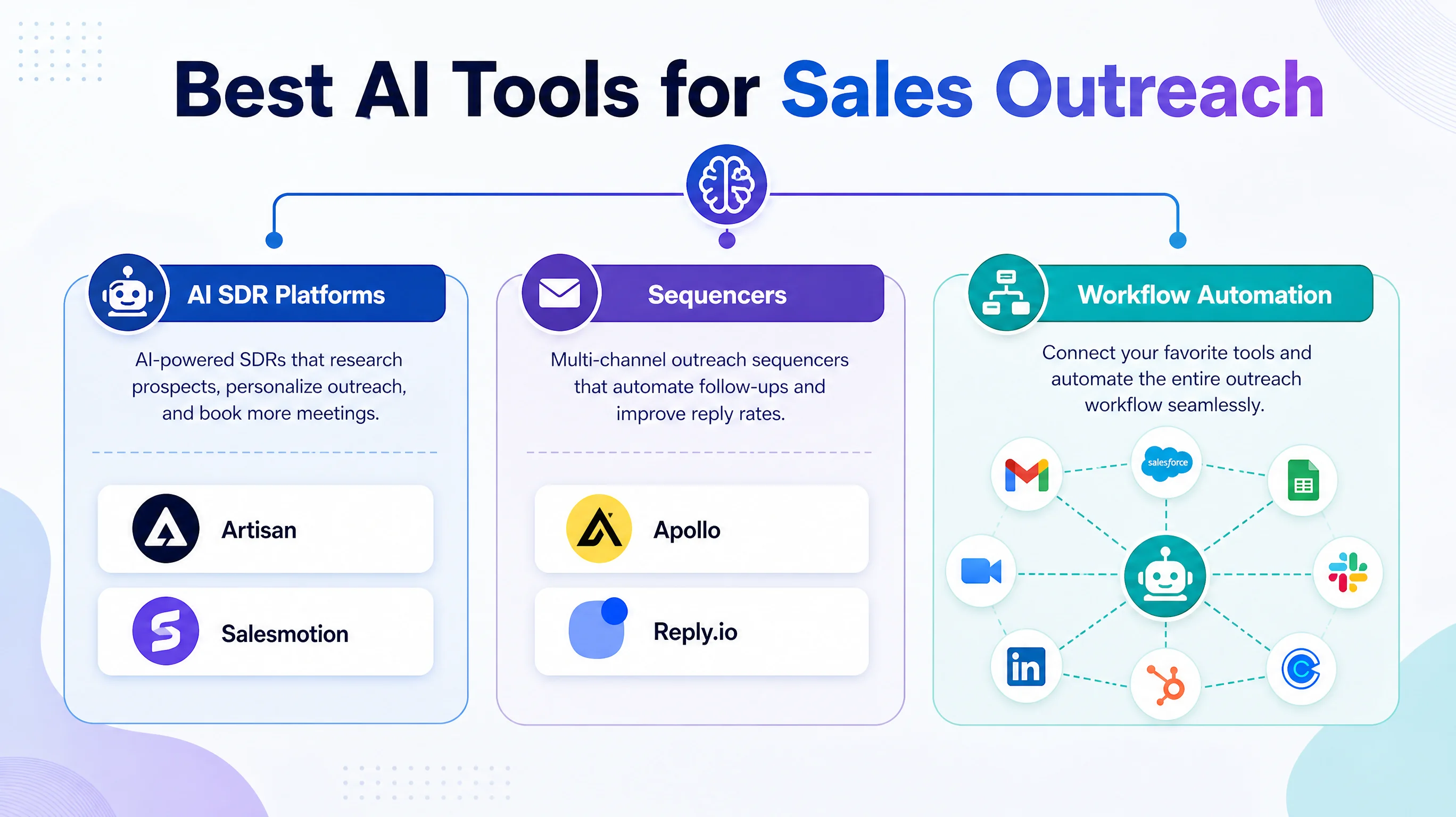
GET FREE AUDITClaude.ai has no built-in outreach automation — it's a chat interface you prompt manually, not a system that sends, sequences, or follows up on its own. For B2B sales teams automating outreach, the better fit depends on what's actually broken: AI SDR platforms like Artisan or Salesmotion for full prospecting cycles, sequencers like Apollo or Reply.io for multichannel cadences, or a workflow automation layer that connects your existing tools (including Claude) into one system.
Chat tools vs. outreach platforms: Claude, ChatGPT, and Gemini draft copy and answer questions — none of them send emails, track replies, or trigger follow-ups without a human copying and pasting. AI SDR platforms: Tools like Artisan (Ava) and Salesmotion run the research-to-send cycle autonomously, priced from roughly $85 to $200 per user per month. Sequencers with AI features: Apollo and Reply.io bolt AI writing and scoring onto proven multichannel sequencing, usually the cheapest entry point at $49–$70 per user per month. The gap none of them close: none of these tools talk to your CRM, calendar, and support inbox at the same time — that requires a workflow layer built around your specific stack.
You already know Claude isn't going to automate your pipeline by itself. The question is which category of tool actually closes the gap for your team.
That question gets harder to answer because most "Claude alternatives" content compares general-purpose chat assistants against each other — ChatGPT vs. Gemini vs. Claude for writing and research. That's the wrong comparison if your actual job is outbound sales. The tools that replace Claude for sales work aren't other chatbots. They're built for a completely different task: finding the right accounts, writing personalized first-touches, and following up without a human remembering to.
The honest version of this comparison also has to include the option most "best-of" lists skip: instead of adding another point solution to your stack, connecting what you already have — CRM, inbox, calendar, and yes, an LLM like Claude — into one automated sequence. That's often cheaper and less disruptive than ripping out your current sequencer for a new AI SDR platform.
Not sure which approach fits your team? Take the 2-minute AI Readiness Check and get a straight answer on whether you need a new tool or just better automation around the ones you have. Take the AI Readiness Check →
Table of Contents
- What Claude Actually Does (and Doesn't Do) for Outreach
- Claude Alternatives Compared
- What This Actually Costs vs. Hiring or Doing It Manually
- Who This Is For
- Frequently Asked Questions
What Claude Actually Does (and Doesn't Do) for Outreach
Claude is a general-purpose AI assistant. It's excellent at writing a cold email that doesn't sound like a template, summarizing a prospect's LinkedIn profile you paste in, and drafting follow-up sequences you ask it for. What it can't do is send that email, know when the prospect opened it, or decide on its own that three days of silence means it's time for touch two.
That's not a Claude weakness specifically — ChatGPT and Gemini have the same ceiling. These tools have no memory of your CRM, no send capability, and no trigger logic. Every action requires a human to copy the output somewhere else.
For a solo founder writing five emails a week, that's fine. For a sales team running hundreds of touches a month, it's the exact bottleneck AI was supposed to remove. Gartner's 2026 seller survey found AI already saves reps an average of 4.8 hours a week — but 72% of sales organizations aren't reinvesting that saved time into pipeline-building activity, because the AI tool ends at the draft and a human still owns everything after it (Gartner, 2026).
The teams getting real leverage from AI in sales aren't the ones with the best prompts. They're the ones who've automated everything downstream of the draft: enrichment, sending, tracking, and follow-up. Our AI Operating System approach is built around that exact gap — connecting the AI tools you already use to the systems that actually run outreach.
Take the 2-minute AI Readiness Check Find out whether your bottleneck is the tool or the automation around it. Check your readiness →

Claude Alternatives Compared
There isn't one "best" Claude alternative for sales — there are three categories, and picking the wrong one means paying for capability you won't use, or missing the capability you actually need.
| Category | Examples | Best for | Typical cost |
|---|---|---|---|
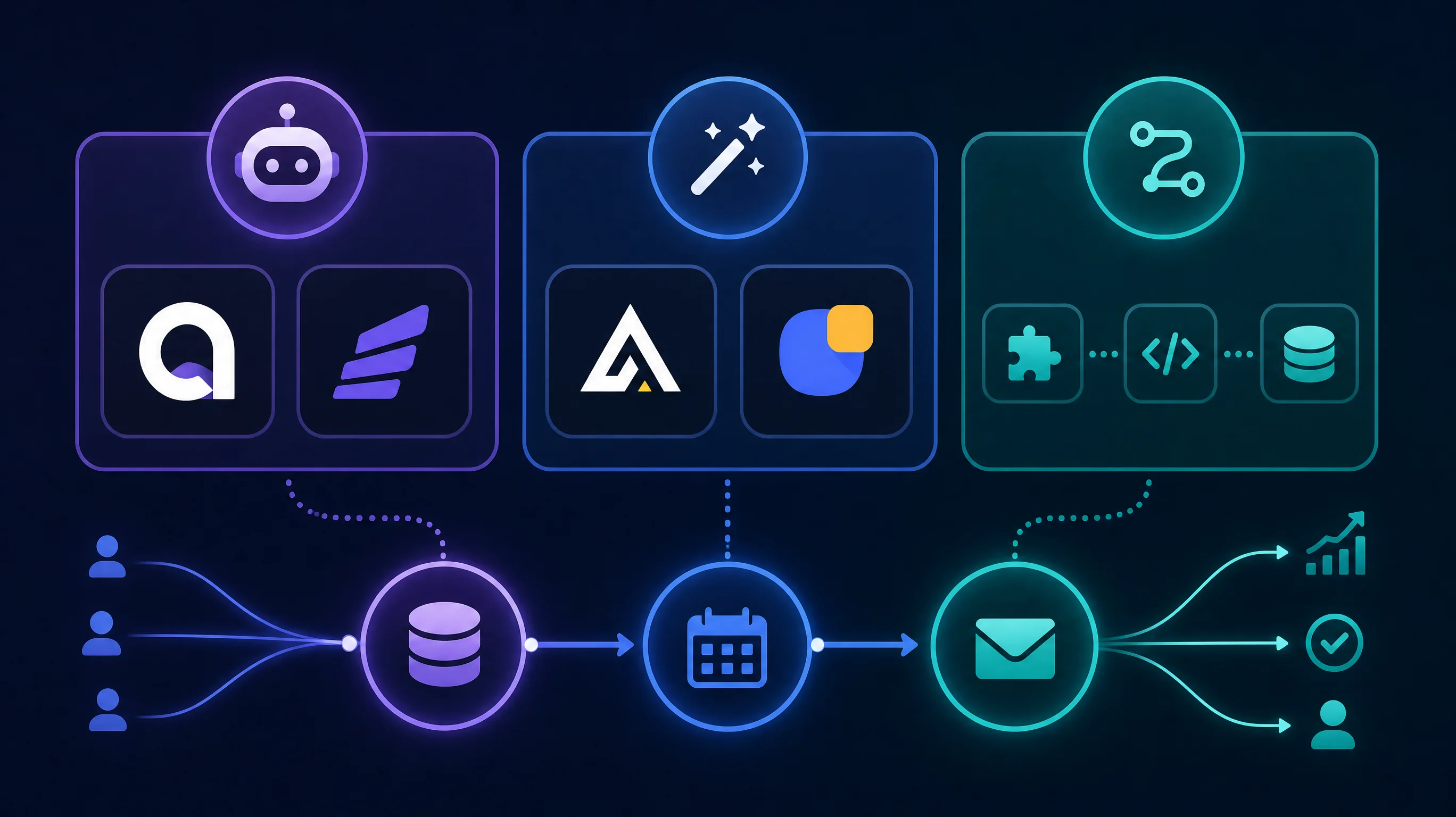
| AI SDR platforms (autonomous) | Artisan (Ava), Salesmotion | Teams that want the full research → write → send cycle run without a human touching each lead | $85–$200/user/mo |
| AI-enhanced sequencers | Apollo, Reply.io | Teams with a working process that just needs AI writing, scoring, and multichannel cadences bolted on | $49–$70/user/mo |
| Workflow automation layer | Custom-built (n8n, Zapier + your CRM + an LLM) | Teams whose real problem is disconnected tools — CRM, calendar, inbox, and chat AI that don't talk to each other | Project-based, often less than a year of a sequencer subscription |
AI SDR platforms are the closest thing to "Claude, but it actually sends the emails." Artisan's Ava works from a database of 15,000+ target accounts and runs prospecting end-to-end; Salesmotion reported a 42% increase in sales velocity for one customer after deployment. The tradeoff is autonomy — you're trusting the platform's judgment on tone, timing, and targeting, and it takes weeks to tune that trust.
AI-enhanced sequencers are the safer bet if your team already has a process that works and just needs less manual grind. Apollo's 275M+ contact database and built-in dialer make it a reasonable single-tool replacement for a data provider plus a sender. The AI features here assist a human-run process rather than replacing it — which means less risk, but also less of the "no human touches this" leverage teams are chasing.
A workflow automation layer is the option most comparison lists leave out entirely, because it isn't a single product you can put in a listicle. It's connecting Claude (or any LLM) to your CRM, calendar, and inbox so a lead reply automatically updates the deal, a stale opportunity automatically triggers a follow-up, and a qualified inbound automatically gets booked — without buying a second platform to run alongside the first. If you've read our post on rescuing sales teams drowning in bad leads with conversational assistance, this is the same principle applied to outbound instead of inbound.
For a broader look at Claude specifically against other chat assistants (not sales-specific), see our ChatGPT vs. Claude comparison for small business — that post covers writing quality and general use; this one is about what happens after the draft is written.
See which category fits your situation Not every team needs an AI SDR platform. Take the 2-minute AI Readiness Check to find out. Take the check →
What This Actually Costs vs. Hiring or Doing It Manually
The comparison that matters isn't AI tool vs. AI tool — it's AI-assisted outreach vs. what you're doing today, whether that's a rep doing it manually or a new SDR hire.
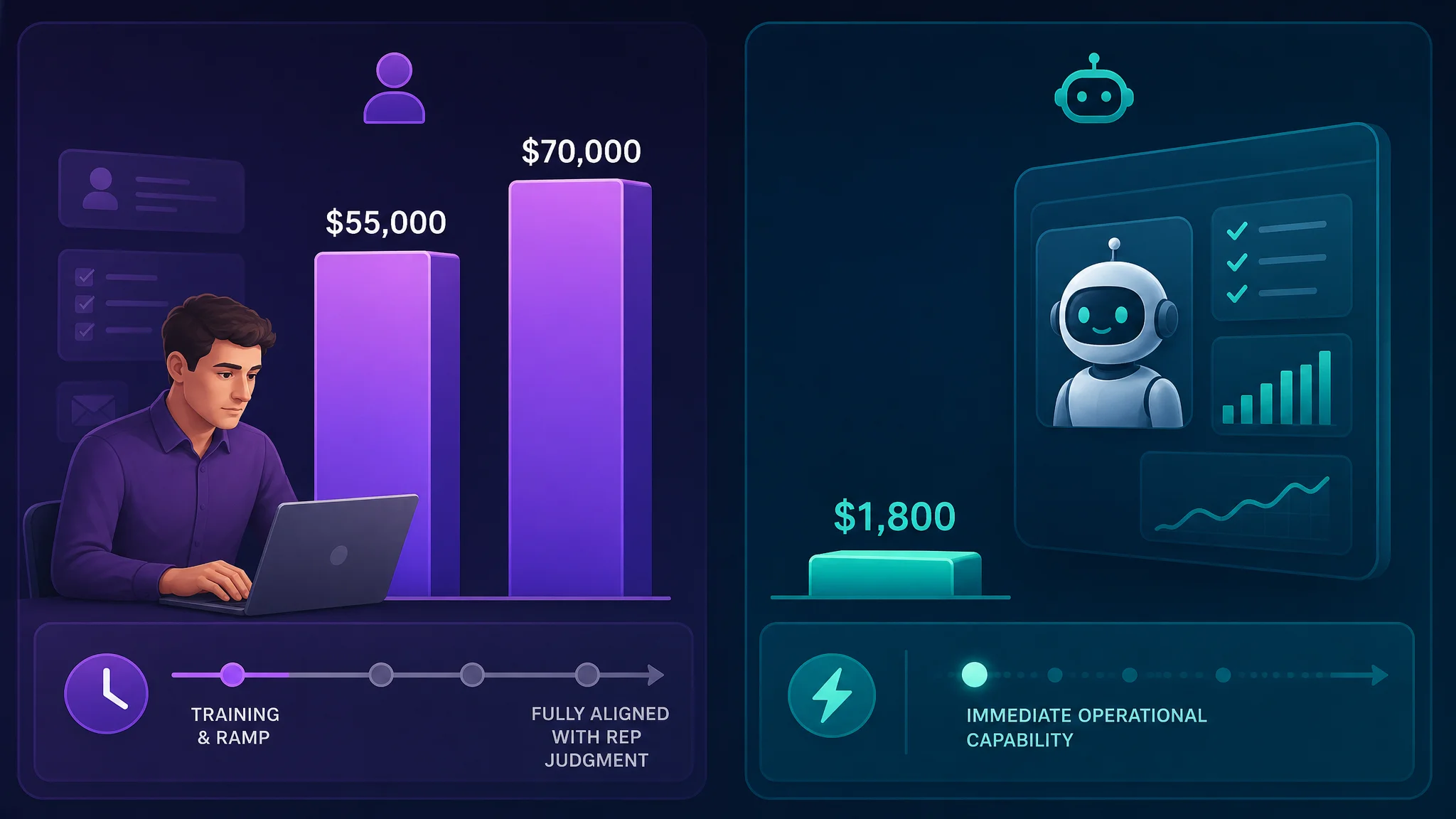
A junior SDR costs $55,000–$70,000/year in base salary alone (before benefits, tools, and ramp time), and typically takes 3–6 months to hit full productivity. A mid-tier AI SDR platform at $150/user/month runs $1,800/year — roughly 3% of that cost — and starts working the day it's configured, though it needs 2–4 weeks of tuning to match a trained rep's judgment on tone and qualification.
| Manual (rep doing it by hand) | AI-enhanced sequencer | AI SDR platform | New SDR hire | |
|---|---|---|---|---|
| Monthly cost | $0 tool cost, high time cost | $50–$70/user | $85–$200/user | $4,500–$5,800/mo salary |
| Ramp time | None, but slow output | 1–2 weeks | 2–4 weeks | 3–6 months |
| Touches/week at scale | 20–40 per rep | 100–200 per rep | 300+ per rep | 20–40 (same as manual) |
| Requires human oversight | Full-time | Partial | Partial | Full-time |
McKinsey estimates generative AI could open up $0.8–$1.2 trillion in incremental annual productivity across sales and marketing functions — but that gain shows up only when the tool changes the volume of qualified activity a team can sustain, not just the speed of drafting one email (McKinsey, "The Economic Potential of Generative AI"). That's the real test for any Claude alternative: does it change how many qualified conversations your team has, or just how fast one draft gets written.
Gartner projects AI agents will outnumber human sellers 10 to 1 by 2028 — yet fewer than 40% of sellers say those agents have actually improved productivity (Gartner, 2026). The gap between adoption and results is almost always a wiring problem, not a tool problem — the AI agent works, but it's bolted onto a process that was never redesigned around it.
Get a walkthrough for your specific stack Not sure which combination actually pays for itself? Take the 2-minute AI Readiness Check. Take the check →
Who This Is For
This is ideal for:
- Sales teams currently copying Claude or ChatGPT output into email manually, one prospect at a time
- Teams evaluating whether to buy an AI SDR platform or fix the process they already have
- Founders and RevOps leads who want their CRM, inbox, and calendar acting on leads automatically instead of waiting on a rep to update a field
Consider alternatives if:
- Your outbound volume is under 50 touches a week — a sequencer or even Claude with a simple checklist may be enough for now
- You haven't defined your ICP or qualification criteria yet — no tool fixes a targeting problem, automated or not
- Your team has bandwidth concerns with adopting a new platform right now — sequencing what you already use often gets you most of the gain with none of the migration
Why AI Essentials specifically? We don't sell one point solution — we assess which category (or combination) actually fits your existing stack, then build the automation layer that connects it, instead of asking you to rip out tools that already work.
Frequently Asked Questions
What are Claude.ai's B2B sales automation capabilities?
Claude.ai has no native sales automation capability. It can draft emails, summarize prospect research you paste in, and help write sequences — but it can't send messages, track opens or replies, or trigger follow-ups. Every output requires a human to move it into your actual sending tool.
What are Claude.ai's main use cases for B2B sales?
Sales teams primarily use Claude for drafting cold email copy, personalizing outreach based on pasted-in prospect research, summarizing call transcripts, and brainstorming objection-handling responses. It supports the writing and thinking side of sales, not the execution side.
What's the best AI alternative to Claude.ai for B2B sales automation?
There's no single best answer — it depends on your bottleneck. Artisan or Salesmotion if you want a fully autonomous AI SDR. Apollo or Reply.io if you want AI features added to a sequencer you already trust. A custom workflow layer if your real problem is disconnected tools, not a missing AI feature.
How do AI tools for B2B sales automation compare on price?
AI-enhanced sequencers like Apollo and Reply.io start around $49–$70 per user per month. Autonomous AI SDR platforms like Artisan and Salesmotion run $85–$200 per user per month. A custom workflow automation build is typically a one-time or project-based cost that can undercut a year of sequencer subscriptions once you factor in tool consolidation.
How do you implement AI for B2B sales automation?
Start by mapping where a human is currently the bottleneck — research, writing, sending, or follow-up. Pick the tool category that removes that specific bottleneck rather than the one with the most features. Run a 2–4 week pilot on a subset of your pipeline before rolling it out to the full team, and keep a human reviewing the first batch of AI-generated outreach before it goes out unsupervised.
What's the real cost and ROI of AI in B2B sales?
A mid-tier AI SDR platform costs roughly 3% of a junior SDR's annual salary and starts producing output immediately, though it takes 2–4 weeks of tuning to match a trained rep's judgment. McKinsey estimates generative AI could add $0.8–$1.2 trillion in annual productivity across sales and marketing — but only when it increases qualified activity volume, not just drafting speed.
What are common mistakes teams make with B2B AI sales automation?
The most common mistake is buying an AI SDR platform to fix a targeting problem — no tool compensates for an undefined ICP. The second is treating AI output as ready-to-send without human review during the first weeks, which risks tone and accuracy issues at scale. The third is adding a new platform instead of automating the tools already in place.
Are there case studies on B2B sales automation with AI?
Yes — reported outcomes include a 42% increase in sales velocity after one company deployed an AI sales agent platform, and Gartner reports AI already saves individual sellers an average of 4.8 hours per week. The caveat: Gartner also found 72% of sales organizations aren't reinvesting that saved time into higher-value activity, so tool adoption alone doesn't guarantee the productivity gain.
What's the timeline for implementing B2B AI sales automation?
AI-enhanced sequencers can be live within 1–2 weeks. Autonomous AI SDR platforms typically need 2–4 weeks of tuning before they're trusted to run unsupervised. A custom workflow automation layer connecting your existing tools usually takes 3–6 weeks depending on how many systems it needs to integrate.
When should a sales team move from Claude.ai to a dedicated automation tool?
The signal is volume and repetition: once a rep is spending more time copying AI-drafted content into a sending tool than writing it, or the team can't track who's been followed up with, that's the point where a dedicated platform or workflow layer pays for itself.
Conclusion
Claude was never built to automate outreach — it drafts, it doesn't send, sequence, or follow up. The right alternative depends on what's actually broken: an autonomous AI SDR platform if you want the full cycle run without a human touching each lead, an AI-enhanced sequencer if your process already works and just needs a boost, or a workflow layer if your real problem is tools that don't talk to each other.
Not sure which one fits your team? Take the 2-minute AI Readiness Check and get a straight answer before you buy anything.

Iliyan Ivanov
Founder of AIessentials · AI automation consultant helping B2B businesses save 20+ hours/week and grow without hiring