ML Consulting for Supply Chain AI ROI (2026)
[ SUMMARIZE WITH AI ]
Workflow Audit
]99% sure you are not seeing all the spots AI can help you in your business.
Are your workflows optimized with the most up to date solution, or are they costing you and your team time and money?
GET FREE AUDITThe best machine learning consulting services for supply chain AI combine a narrow, single-use-case scope, a working proof of concept on your own data before you sign a full contract, and a documented ROI model tied to specific metrics — not a generic platform pitch. Firms that meet all three typically deliver measurable ROI (reduced forecast error, lower carrying costs, fewer stockouts) within 6-9 months. Firms that skip the proof of concept and sell you a "full transformation" up front are the ones that show up in the failure statistics.
Proof of concept first: A firm that won't run a scoped pilot on your actual data before the full engagement is selling you a platform, not a result. Single use case, not "AI transformation": Demand forecasting, inventory optimization, and logistics routing are three different problems with three different models — a firm proposing to fix all of them in one contract is overreaching. ROI tied to your metrics: Forecast accuracy, carrying cost, and on-time delivery rate — not vague "efficiency gains" — should be in the statement of work before kickoff. Data readiness assessment before pricing: A quote that comes before anyone has looked at your data quality is a guess, not an estimate. Implementation timeline of 8-16 weeks: Anything longer for a single use case usually means scope creep, not thoroughness.
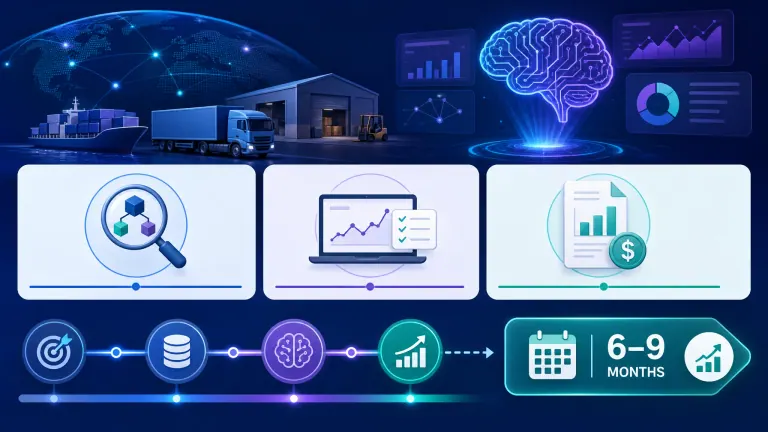
Implementation slots for supply chain AI projects that can still hit a Q4 ROI target are filling — most consulting firms need 8-16 weeks from kickoff to a working model, which means projects starting after early October won't show results until 2027.
You already know AI can cut supply chain costs — the research isn't the hard part anymore. The hard part is telling which consulting firm will actually deliver a working model against your data versus which one will hand you a strategy deck and a six-figure invoice. Most businesses that look into machine learning consulting for supply chain never move past the research phase, and the ones who do usually get burned once before they get it right.
This post breaks down exactly what separates a consulting engagement that pays for itself from one that doesn't, what a realistic supply chain AI ROI actually looks like by use case, and the specific questions to ask before you sign anything. If you'd rather skip the research and get a scoped estimate against your own data, you can run a free AI ROI calculation that maps a supply chain AI project to your actual numbers first.
3 implementation slots open this month We're taking 3 new supply chain AI engagements for Q4 delivery — after that, the next available start pushes into 2027. Book a 30-minute walkthrough to see if your data is ready. Book Your Slot →
Table of Contents
- What Realistic ROI Looks Like By Use Case
- The Red Flags That Predict a Failed Engagement
- Consulting Firm vs DIY vs Hiring In-House
- Who This Is For
- Frequently Asked Questions
What Realistic ROI Looks Like By Use Case
Supply chain AI ROI isn't one number — it depends heavily on which problem you're solving. Vendors that quote a single blended ROI figure across "supply chain AI" are usually rounding three very different projects into one marketing stat.
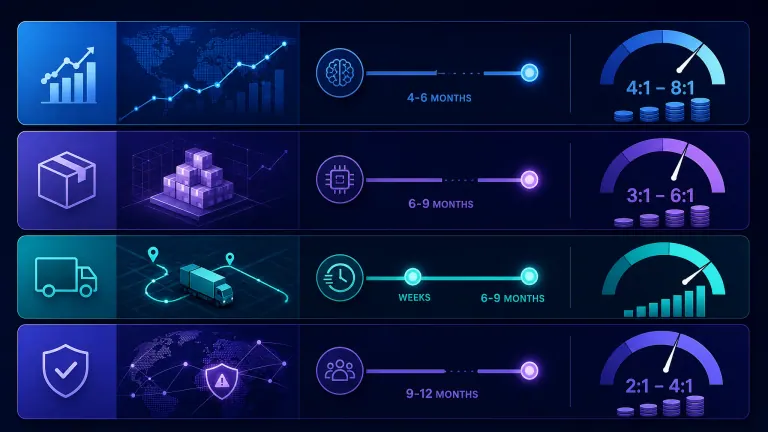
Demand forecasting is the most mature use case and the one with the clearest data. McKinsey's research on AI in distribution operations puts achievable forecast error reduction at 20-50% versus traditional statistical methods, which typically translates to a 65% drop in lost sales from stockouts and a 20-30% reduction in excess inventory carrying costs. Most demand forecasting engagements break even in 4-6 months once the model is scoring a full seasonal cycle — the same 4-6 month break-even pattern shows up in ML consulting for churn prediction, which is worth reading if forecasting isn't your only planned use case.
Inventory optimization builds on top of forecasting and takes longer to show ROI because it requires the forecasting layer to already be reasonably accurate — expect 6-9 months to first measurable savings, with two-year returns commonly in the 3:1 to 6:1 range depending on inventory carrying costs and SKU complexity.
Logistics and routing optimization has the fastest time-to-signal because route efficiency is measurable within weeks of deployment, but the engineering lift is heavier — integrating with a TMS or fleet system usually adds 4-6 weeks to the timeline compared to a pure forecasting model.
| Use case | Time to first ROI signal | Typical 2-year ROI | Data requirement |
|---|---|---|---|
| Demand forecasting | 4-6 months | 4:1 to 8:1 | 12-24 months of clean sales history |
| Inventory optimization | 6-9 months | 3:1 to 6:1 | Forecasting layer + current SKU-level cost data |
| Logistics/routing | 6-12 weeks (efficiency), 6-9 months (full ROI) | 3:1 to 5:1 | Fleet/TMS integration + 6+ months of route data |
| Supplier risk scoring | 9-12 months | 2:1 to 4:1 | Supplier performance history, often fragmented across systems |
How AI Essentials helps here: we scope one use case at a time against your actual data before quoting a full engagement, so the ROI number in your proposal is a projection based on your numbers, not an industry benchmark. You can see how that scoping process works with a free AI ROI calculation.
See exactly what your data supports Before you sign anything, get a data-readiness read and a use-case-specific ROI estimate — free, no commitment. Get Your ROI Estimate →
The Red Flags That Predict a Failed Engagement
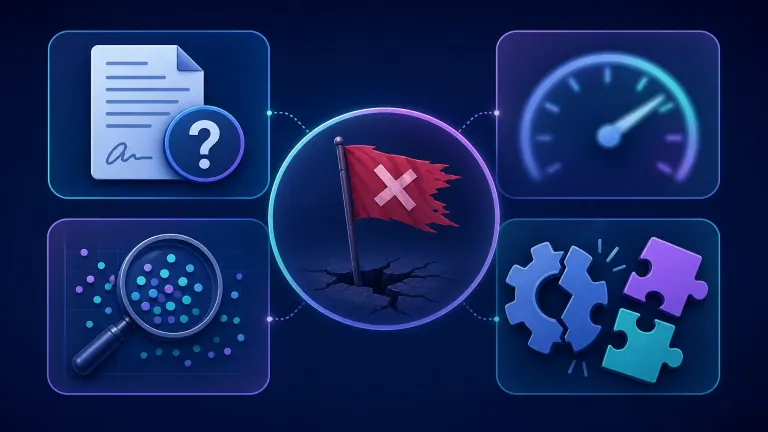
Gartner's 2026 survey on supply chain operating model transformation found that only 17% of supply chain organizations are pursuing genuine AI-driven transformation, while the remaining 83% are either applying it incrementally or struggling to scale beyond a pilot. That gap between "pilot that worked" and "system that scaled" is where most consulting money gets wasted, and it usually traces back to a handful of predictable mistakes at the vendor-selection stage.
No proof of concept before the contract. If a firm is willing to sign a full-scope, full-price engagement before running a small pilot against your actual data, that's not confidence — it's a firm that hasn't seen your data quality problems yet and doesn't want to find them before the ink is dry. This is the same discovery-before-commitment pattern covered in how AI consulting firms structure their implementation process — a scoped discovery phase should always come before a full-price contract, in supply chain or anywhere else.
Vague success metrics. "Improve supply chain efficiency" is not a metric. "Reduce forecast error on the top 200 SKUs by 25% within 6 months" is. A firm that won't commit to a specific, measurable target in the statement of work is protecting itself, not you.
No mention of your data quality. Every real supply chain AI engagement starts with a data audit, because most companies' supply chain data is scattered across an ERP, a WMS, spreadsheets, and someone's inbox. A firm that skips straight to pricing hasn't done the work to know if the project is even feasible yet.
One-size-fits-all platform pitch. Firms selling a proprietary platform license instead of a scoped consulting engagement are optimizing for recurring software revenue, not your specific use case — and you inherit a vendor lock-in problem on top of the AI project itself.
Not sure which of these applies to your situation? Book a 30-minute walkthrough and we'll flag anything in your current setup that would sink a supply chain AI project before it starts. Book a Walkthrough →
Consulting Firm vs DIY vs Hiring In-House
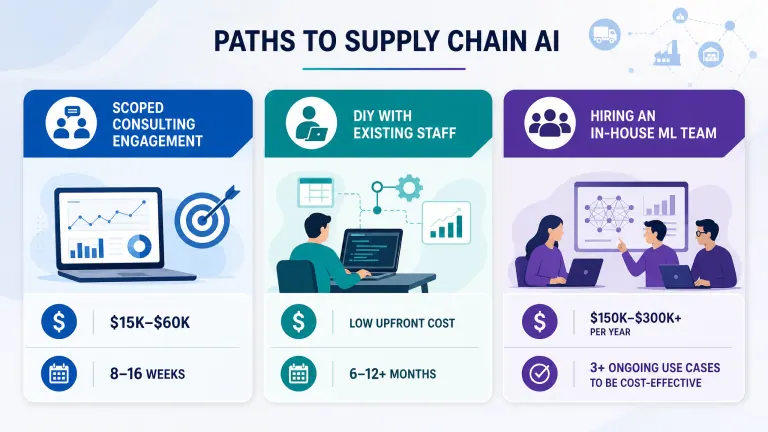
The honest comparison isn't "consulting firm vs. no AI" — it's consulting firm vs. the two other realistic paths: building it yourself with existing staff, or hiring a full-time data science team.
| Path | Upfront cost | Time to working model | Ongoing cost | Best fit |
|---|---|---|---|---|
| Consulting engagement (single use case) | $15K-$60K | 8-16 weeks | Maintenance retainer, ~$2K-$5K/mo | Companies that need one problem solved well and don't want to build a permanent team for it |
| DIY with existing ops/analytics staff | $0-$5K in tools | 6-12 months, often longer | Opportunity cost of staff time | Companies with an analyst who already knows Python and has bandwidth to learn on the job |
| Hire in-house ML team | $150K-$300K+/year in salaries | 4-9 months to first model, plus hiring time | $150K-$300K+/year ongoing | Companies planning multiple ongoing AI use cases across supply chain, not just one |
DIY is the option that looks cheapest and usually costs the most in wasted time — a 2026 Gartner press release on supply chain technology trends notes that companies without a clear AI-specific skill set are the ones stalling out at the pilot stage, which matches what shows up when an internal team tries to own a forecasting model on top of their existing job. Hiring in-house makes sense once you have three or more supply chain AI use cases planned — for a single project, the fixed cost of building a team rarely pays back faster than a scoped consulting engagement.
The honest limitation: a consulting engagement that ends after deployment leaves you needing either a maintenance retainer or in-house capability to keep the model accurate as your business changes. Ask any firm you're evaluating what happens to model accuracy 12 months after they leave.
Get the real numbers for your situation We'll run the cost comparison — consulting vs. DIY vs. in-house — against your actual project scope. Compare Your Options →
Who This Is For
This is ideal for:
- Businesses with 12+ months of usable supply chain data (sales history, inventory records, or route data) sitting in an ERP, WMS, or spreadsheet
- Companies that have one clear, specific supply chain problem — high stockout rates, excess inventory, or inefficient routing — not a vague "we should use AI somewhere" mandate
- Teams that want a working model in one quarter, not a year-long "transformation" engagement
Consider alternatives if:
- Your supply chain data is under 6 months old or scattered with no single source of truth — a data cleanup project needs to happen before any ML engagement will work
- You're planning to build AI capability across five or more use cases over the next two years, where an in-house team's fixed cost pays back faster than repeated consulting engagements
- You need the model live in under 4 weeks — no responsible firm can properly scope, build, and validate a supply chain model that fast
Why AI Essentials specifically? We scope one use case at a time against a small proof-of-concept on your real data before quoting the full engagement, so you see whether the ROI case holds up before committing budget. Most engagements run 8-16 weeks from kickoff to a working, deployed model — not a slide deck.
Frequently Asked Questions
Is $100 an hour good for consulting?
For general business consulting, $100/hour is reasonable. For specialized machine learning consulting with supply chain domain expertise, expect $150-$350/hour, or a project-based fee of $15,000-$60,000 for a single use case — hourly rates below $100 for ML work usually signal junior talent or offshore generalist teams without supply chain-specific experience.
How much does an AI consultant cost?
A supply chain-focused ML consulting engagement typically runs $15,000-$60,000 for a single use case (demand forecasting, inventory optimization, or routing) delivered over 8-16 weeks. Larger, multi-use-case engagements or ones requiring heavy systems integration can run $75,000-$200,000+. Get a data-readiness assessment before accepting any quote — the price should reflect your specific data and scope, not a generic package.
What is a machine learning consultant?
A machine learning consultant is a specialist who builds and deploys predictive models — like demand forecasts or inventory optimization algorithms — tailored to a company's specific data and business problem, as opposed to selling a pre-built software platform. The best ones scope a narrow use case, validate it against your real data with a proof of concept, and hand off a working, measurable system rather than a strategy document.
What are some reputable machine learning consulting firms?
Reputable firms share three traits regardless of size: they run a proof of concept on your data before the full contract, they commit to specific measurable metrics in the statement of work, and they're transparent about ongoing maintenance needs after deployment. Rather than choosing by firm size or brand recognition alone, evaluate any candidate against those three criteria plus references from a completed supply chain engagement similar to yours.
How do I choose an ML consulting firm for supply chain optimization?
Start by requiring a proof of concept on your own data before any full-scope contract — this single filter eliminates most firms that oversell. Then check whether they've committed to specific metrics (forecast error percentage, carrying cost reduction) rather than vague "efficiency" language, and ask what post-deployment support costs, since model accuracy degrades without maintenance.
What does machine learning consulting for supply chain typically cost?
Single-use-case engagements (one problem, like demand forecasting) typically run $15,000-$60,000 over 8-16 weeks. Multi-use-case or systems-heavy engagements (routing optimization requiring TMS integration, for example) run $75,000-$200,000+. Cost scales primarily with data quality and integration complexity, not with the sophistication of the AI model itself.
What's the real ROI of AI/ML in supply chain management?
ROI varies significantly by use case: demand forecasting typically delivers a 4:1 to 8:1 two-year return with break-even around 4-6 months, while supplier risk scoring — the hardest use case to model well — often takes 9-12 months to show measurable ROI at a lower 2:1 to 4:1 range. Any vendor quoting a single blended ROI number across all supply chain AI applications is oversimplifying.
What are the alternatives to hiring an ML consulting firm for supply chain?
The two realistic alternatives are DIY with existing analytics staff (cheapest upfront, but 6-12+ months to a working model and high opportunity cost of staff time) or hiring a full in-house ML team ($150K-$300K+/year, best justified only if you're planning three or more ongoing AI use cases). For a single, well-defined problem, a scoped consulting engagement usually beats both on total cost and time-to-value.
What are the most common mistakes in AI/ML supply chain implementation?
The most common mistake is scoping "AI transformation" instead of one specific use case — trying to fix forecasting, inventory, and routing in a single engagement stretches timelines and buries accountability. The second most common is skipping the data quality audit and discovering mid-project that the historical data isn't clean enough to model, which is exactly what a proof-of-concept phase is designed to catch early.
How long does a supply chain machine learning project usually take?
A single-use-case engagement — one problem, one model — typically takes 8-16 weeks from kickoff to a deployed, working model, assuming 12+ months of usable historical data already exists. Projects that stretch past 6 months for a single use case usually indicate either a data quality problem discovered mid-project or scope creep beyond the original use case.
Conclusion
The consulting firms that deliver real supply chain AI ROI share three habits: they prove the model works on your data before you commit to the full contract, they scope one use case at a time instead of selling "transformation," and they attach the ROI number to your specific metrics instead of an industry benchmark. Everything else — firm size, years in business, case study logos — matters less than those three filters.
Implementation slots for Q4 delivery are limited to 3 this month. If you want to see whether your data supports a working model and what the realistic ROI looks like for your specific use case, book a 30-minute walkthrough before the next available start pushes into 2027.

Iliyan Ivanov
Founder of AIessentials · AI automation consultant helping B2B businesses save 20+ hours/week and grow without hiring