How BPM Software Reduces Compliance Risk in Financial Services
[ SUMMARIZE WITH AI ]
Workflow Audit
]99% sure you are not seeing all the spots AI can help you in your business.
Are your workflows optimized with the most up to date solution, or are they costing you and your team time and money?
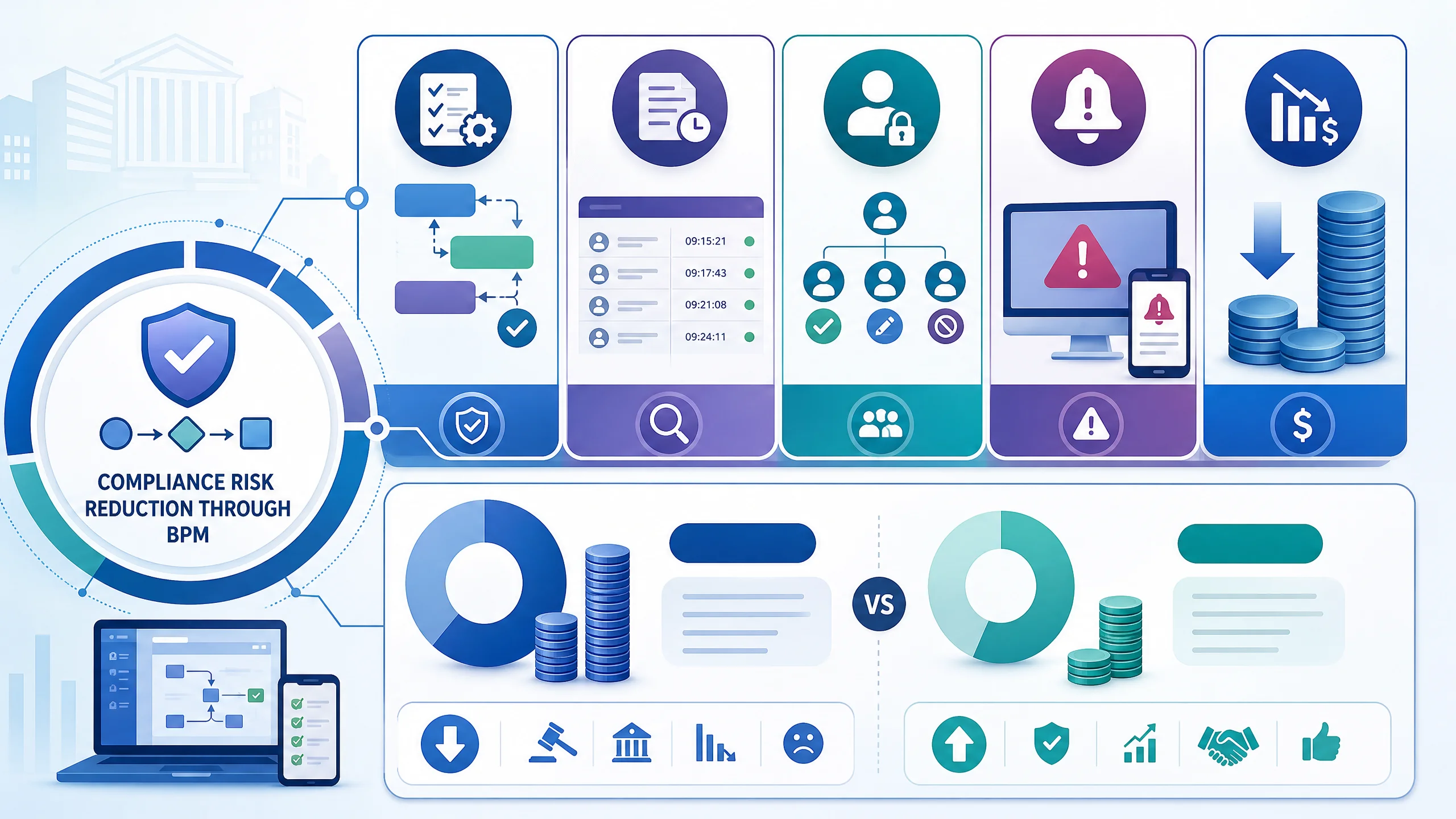
GET FREE AUDITBPM business management process software reduces compliance risk in financial services by turning written procedures into enforced workflows: every step must happen, in order, by an authorized person, and every action is time-stamped in an audit trail. The risk it removes is mostly human inconsistency (a skipped check, a missing approval, a file that can't be found), not bad intent. It does not make a firm compliant on its own; it makes compliance provable.
Enforced steps: A file cannot move to the next stage until required checks (KYC, sanctions screening, supervisor sign-off) are complete. Audit trail: Each action is logged with who, what and when, so an examiner's request becomes a report instead of a scramble. Role-based access: Only authorized roles can view, approve or override, which cuts the quiet policy breaches that come from shared inboxes and spreadsheets. Exception alerts: Overdue reviews and threshold breaches trigger alerts before they become findings. Cost of the alternative: A Ponemon Institute study found non-compliance cost companies an average of $14.82 million a year, 2.71 times the $5.47 million spent on compliance itself.
Most compliance failures at smaller financial firms aren't dramatic. They're a KYC refresh that slipped past its due date, an approval given by email and never filed, a policy update that never reached the person doing the work. Nobody notices until an audit does.
Those are silent leaks. They sit inside processes that "mostly work," so no one prices them. BPM software exists to close exactly that gap: between the procedure on paper and what people actually do on a busy Tuesday.
This guide covers what BPM does and doesn't do for compliance, what a realistic exposure looks like in numbers, and when a lighter workflow is the better call. If you're still sizing the cost side, our BPM software pricing breakdown has the license and implementation numbers. This post is about the risk side, which that one doesn't cover.
Not sure whether a BPM suite or a lighter workflow fits your compliance process? Take the 2-minute AI Readiness Check. We map one regulated workflow and tell you which approach fits, including when the answer is "you don't need a suite." Take the AI Readiness Check →
Table of Contents
- Where Compliance Risk Actually Hides
- What BPM Software Does About It (and What It Doesn't)
- The Numbers: Exposure vs. Cost of Control
- Who This Is For
- Frequently Asked Questions
Where Compliance Risk Actually Hides
Regulators rarely fine firms for not having a policy. They fine them for not being able to show the policy was followed. That distinction explains most of the risk.
The SEC's off-channel communications sweep is the clearest example. Firms were not charged with fraud. They were charged with failing to keep records of business messages. Over 100 entities have been penalized more than $3 billion in total since 2021, according to Holland & Knight's review of the enforcement sweep. The underlying failure was a process failure: the rule existed, but no system made it hard to break.
Three places this shows up in a typical small or mid-size financial business:
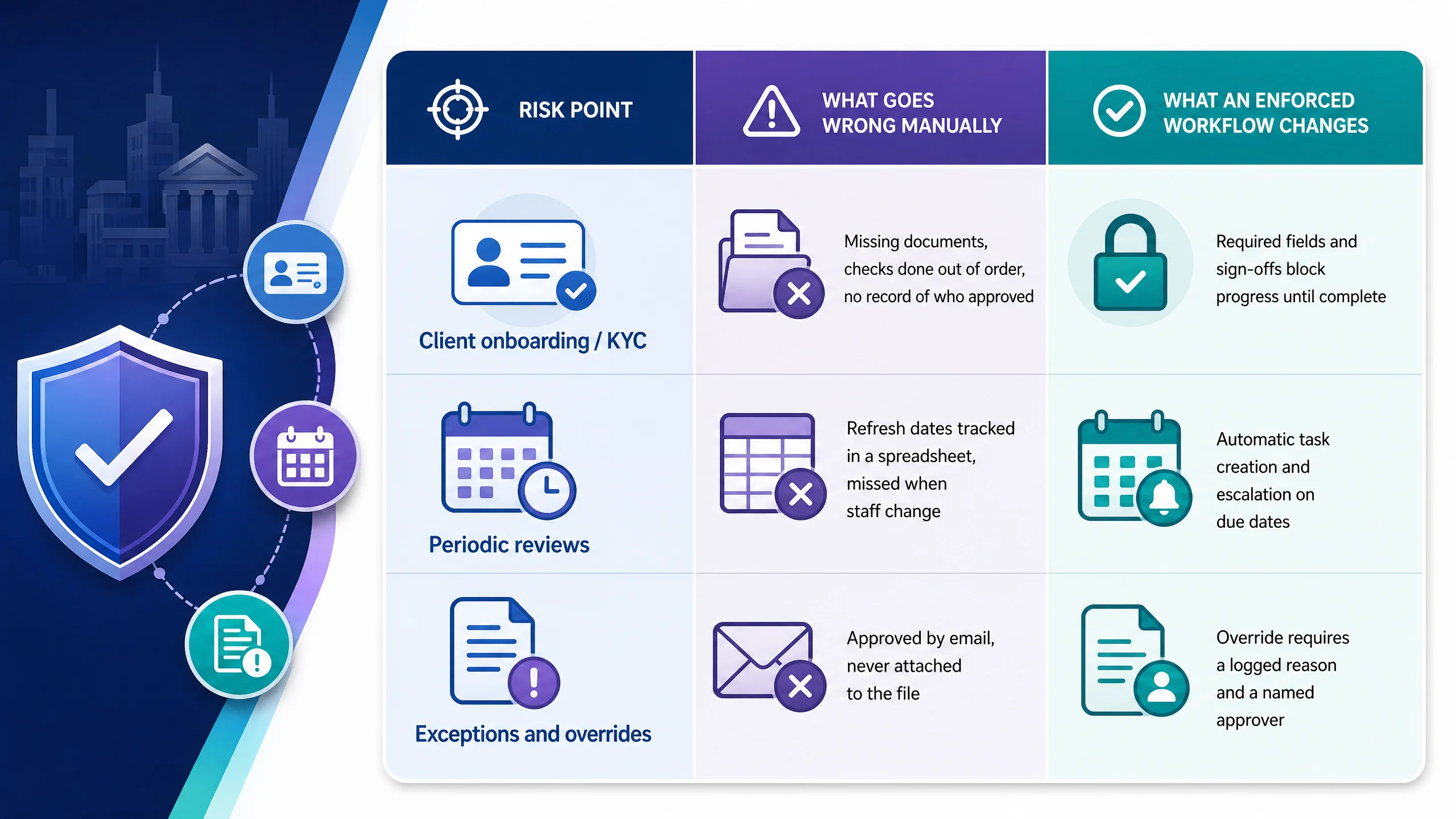
| Risk point | What goes wrong manually | What an enforced workflow changes |
|---|---|---|
| Client onboarding / KYC | Missing documents, checks done out of order, no record of who approved | Required fields and sign-offs block progress until complete |
| Periodic reviews | Refresh dates tracked in a spreadsheet, missed when staff change | Automatic task creation and escalation on due dates |
| Exceptions and overrides | Approved by email, never attached to the file | Override requires a logged reason and a named approver |
None of these needs advanced AI. They need a process that can't be skipped.
Find the three places your compliance process leaks Our free Workflow Leak Report walks one regulated workflow end to end and shows where a skipped step would go unnoticed. Get the Leak Report →
What BPM Software Does About It (and What It Doesn't)
The honest version matters here, because compliance buyers get burned by overclaiming.
What it does well
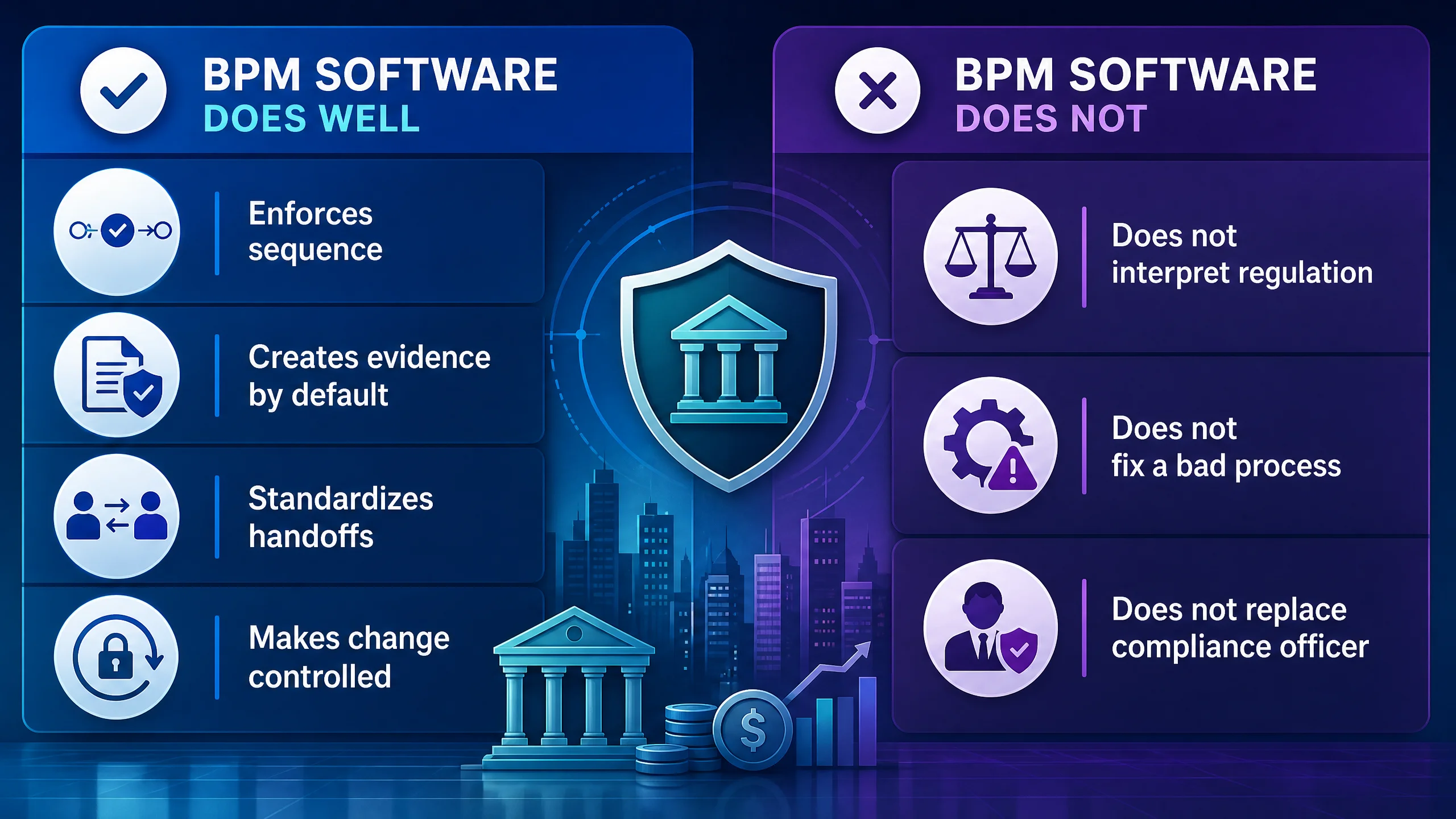
- Enforces sequence. The workflow engine will not let a step be skipped. That's the single biggest risk reducer.
- Creates evidence by default. Logs are a by-product of doing the work, not a separate task.
- Standardizes handoffs. Work moves between roles without anyone retyping data into a second system.
- Makes change controlled. When a regulation changes, you update the workflow once, instead of retraining and hoping.
What it does not do
- It does not interpret regulation. Someone still has to decide what the rule requires.
- It does not fix a bad process. If your procedure is wrong, you'll now enforce the wrong thing very consistently. We cover this in why workflow automation fails when the process is already broken.
- It does not replace a compliance officer, legal review, or your core regulated systems of record.
BPM suite vs. manual vs. lightweight workflow
| Approach | Typical annual cost | Audit trail | Best fit |
|---|---|---|---|
| Manual (spreadsheets, email) | Staff time only; hidden | Weak, reconstructed after the fact | Very low volume, single-person processes |
| Lightweight workflow automation | $3,000 - $25,000 build + $50 - $500/mo tools | Good for the workflows it covers | One or two high-volume, defined processes |
| Full BPM suite | $18,000 - $500,000+ license, plus 1x - 3x implementation | Strong, org-wide | Many regulated processes, large teams, formal governance |
License ranges come from the same published vendor pricing used in our BPM pricing guide. Treat them as ranges, not quotes.
How AI Essentials helps here: most firms under 200 staff don't need a full suite. They need two or three processes (onboarding, periodic review, exception approval) made un-skippable. That's a scoped project, and if you want it built rather than bought, see our AI automation for B2B businesses service.
Which of your processes actually needs a suite? Take the 2-minute AI Readiness Check and get a straight answer on suite vs. lighter workflow, with numbers. Take the AI Readiness Check →
The Numbers: Exposure vs. Cost of Control
Here is a worked example. The inputs are our assumptions for a small financial services firm, not a benchmark, so swap in your own.
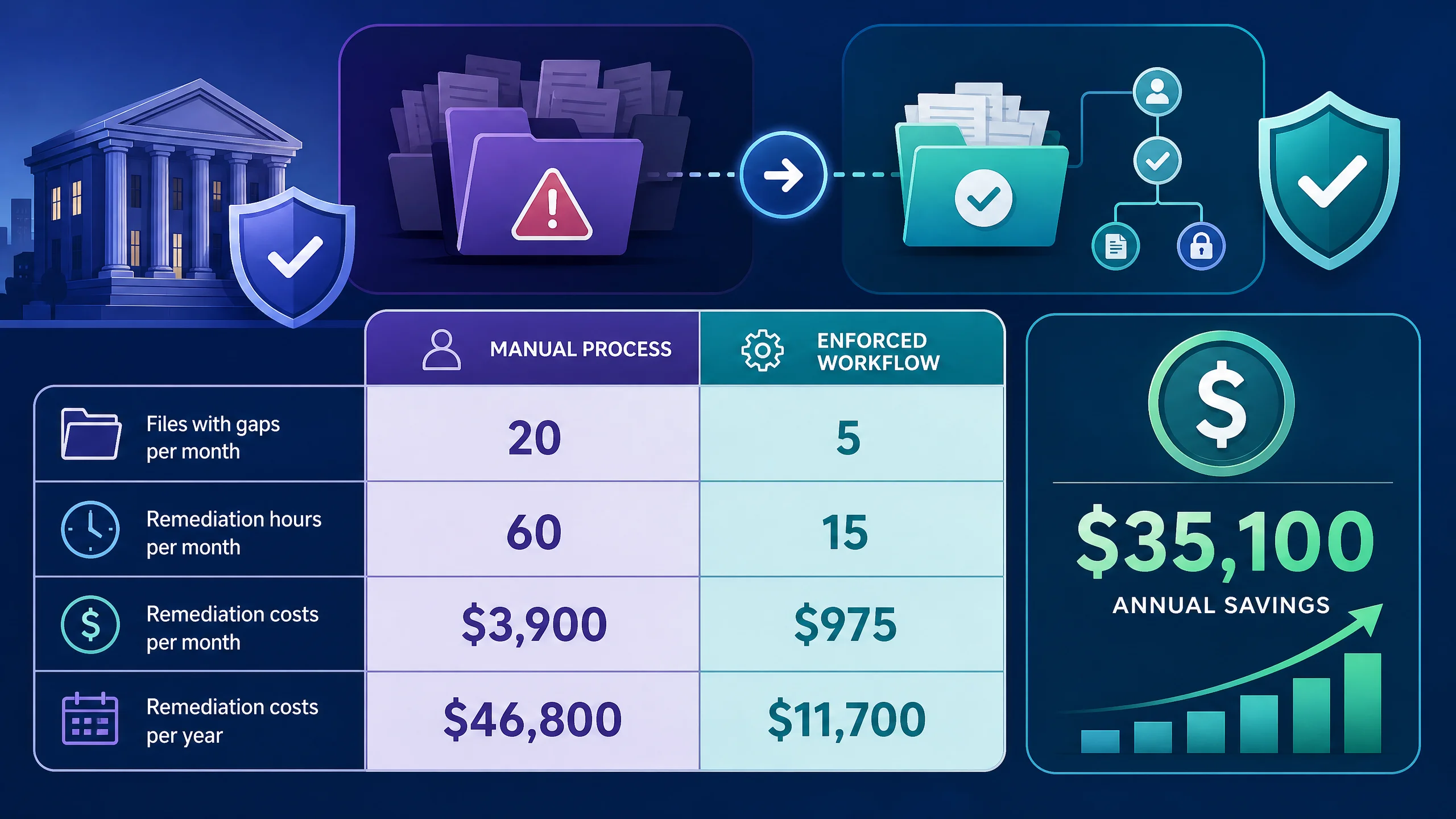
Assumptions: 40-person firm, 500 client files reviewed or refreshed per month, 4% of files have a documentation gap under manual handling, each gap takes 3 hours to remediate at a $65 loaded hourly cost, and 1% of files still have a gap once required steps are enforced.
| Line | Manual process | Enforced workflow |
|---|---|---|
| Files with a gap per month | 20 (4% of 500) | 5 (1% of 500) |
| Remediation hours per month | 60 | 15 |
| Remediation cost per month | $3,900 | $975 |
| Remediation cost per year | $46,800 | $11,700 |
| Annual saving (direct labor only) | n/a | $35,100 |
That $35,100 counts remediation labor only. It excludes the item that actually matters: the chance that one of those 20 monthly gaps is the file an examiner pulls.
Compare that to cost of control. A scoped workflow build in the $8,000 - $25,000 range plus modest tooling pays back on labor alone in roughly 3 to 9 months in this example. The Ponemon figure above is the reason the unpriced part is worth taking seriously: firms in that study spent 2.71 times more on non-compliance than on compliance.
Two caveats. First, your gap rate may be lower than 4%; measure it on 50 recent files before you believe any estimate, including this one. Second, a full BPM suite shifts this math: at a $90,000+ yearly license, you need volume across many processes to justify it. Use our free AI ROI calculator to run your own volumes, and see which ROI metrics actually prove BPM value for the sales and marketing side of the same decision.
Want this table with your numbers in it? Book a 30-minute walkthrough. We take one process, count the gaps with you, and price the fix. Book a Walkthrough →
Who This Is For
This is ideal for:
- Owners or operations leads at financial services firms (advisors, lenders, brokers, insurance agencies) with 10 to 200 staff who run compliance steps through email and spreadsheets
- Teams that have had an audit finding, a near-miss, or a records request that took days to answer
- Firms comparing a full BPM suite against a smaller, purpose-built workflow
Consider alternatives if:
- You are a large institution with dozens of regulated processes and a formal governance team; a full enterprise suite from an established vendor is likely the right call
- Your problem is a regulatory interpretation question, not a process problem; you need counsel, not software
- You process fewer than about 50 files a month; the savings may not justify any build
Why AI Essentials specifically? We scope fixed-price workflow projects for B2B businesses doing $300K+ in revenue, with a 10+ hrs/week time-savings guarantee. We tell you up front when a suite is overkill, and we don't act as your compliance advisor; we build the workflow your compliance team specifies.
Frequently Asked Questions
Is SAP a BPM tool?
Not primarily. SAP is an enterprise resource planning (ERP) system. It does include process management products, such as SAP Signavio for process modeling and SAP Build Process Automation for workflows. But most firms using SAP for finance run their approvals and compliance steps in the ERP itself, and add a dedicated BPM or workflow tool only when those processes cross multiple systems.
What does BPM software do?
BPM software models a business process, then runs it: it routes tasks to the right people, enforces required steps and approvals, connects to other systems, and records every action. Managers get dashboards on cycle time and bottlenecks. In a compliance context, the main value is that a process is followed the same way every time and leaves an audit trail.
What is the best BPM software?
It depends on size and scope. Low-code platforms such as Kissflow suit small teams and published pricing. Appian and Nintex fit mid-market firms with several processes. Pega and IBM Business Automation Workflow suit large enterprises with formal governance. For one or two regulated workflows, a purpose-built automation is often cheaper than any of them.
What are some examples of BPM software?
Common examples include Appian, Pega, IBM Business Automation Workflow, Camunda, Kissflow, Nintex, and ProcessMaker. Each differs in pricing model and complexity. Pega and IBM target large enterprises with quote-only pricing, while Kissflow and Camunda Cloud have lower entry points. Compare them against the specific process you need to control, not against feature lists.
How does BPM software reduce compliance risk in financial services?
It enforces required steps, restricts actions by role, logs every action with a timestamp, and flags overdue or out-of-threshold items automatically. That removes the main source of compliance failure: inconsistent human execution. It also shortens audit preparation, since evidence is generated as work happens rather than reconstructed afterward.
What are the main steps to implement BPM software for compliance?
Start with one regulated process. Map how it actually runs (not how the policy says). Mark the required controls, then build the workflow with those controls as non-skippable steps. Pilot on live files for 30 days, check the audit log against a manual review, then expand. Most small-firm projects run 4 to 10 weeks for the first workflow.
How much does BPM software for financial services cost?
Low-code SaaS runs roughly $12,000 to $30,000 a year. Mid-market suites run $60,000 to $300,000, and enterprise suites $150,000 to $500,000 or more. Implementation typically adds 1x to 3x the first-year license. A scoped single-workflow build instead costs about $8,000 to $25,000. The right number depends on how many processes you need to control.
How does BPM compare with simpler alternatives for compliance?
A BPM suite covers many processes under one governance model, but costs more and takes longer to deploy. Manual tracking is cheap upfront but leaves weak evidence. A lightweight workflow automation sits between: strong controls on one or two processes at a fraction of the suite's cost, without org-wide governance features.
What are common mistakes in BPM implementation for compliance?
The most common is automating a broken or undocumented process, which enforces the error consistently. Others: starting with too many workflows at once, skipping end-user input so staff route around the system, not assigning an owner for each workflow, and treating the audit log as set-and-forget instead of sampling it regularly.
Are there case studies of BPM reducing compliance risk in financial services?
Vendor case studies exist, but most are self-reported and unaudited, so read them skeptically. Independent evidence is thinner. The Ponemon Institute study on compliance costs and the SEC's recordkeeping enforcement record are better anchors for sizing risk. We don't have a published financial services case study yet, and we won't invent one.
Conclusion
BPM software lowers compliance risk by making required steps un-skippable and evidence automatic. It does not interpret rules or fix bad procedures. For most firms under 200 staff, the best first move is not a suite but two or three well-built workflows on the processes where a gap would hurt most.
Measure your gap rate on 50 recent files first. That number tells you whether you have a $5,000 problem or a $50,000 one.
Not sure which approach fits your business? Take the 2-minute AI Readiness Check and see whether a suite, a lighter workflow, or neither makes sense for your compliance process. Take the AI Readiness Check →

Iliyan Ivanov
Founder of AIessentials · AI automation consultant helping B2B businesses save 20+ hours/week and grow without hiring