ML Consulting for Churn Prediction: ROI Timeline (2026)
[ SUMMARIZE WITH AI ]
Workflow Audit
]99% sure you are not seeing all the spots AI can help you in your business.
Are your workflows optimized with the most up to date solution, or are they costing you and your team time and money?
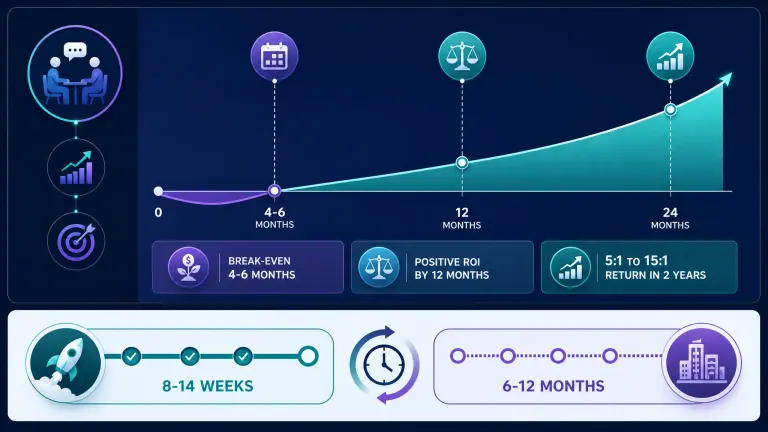
GET FREE AUDITA churn prediction engagement with a consulting partner typically breaks even in 4–6 months and delivers a 5:1 to 15:1 return within two years. Full deployment — from kickoff to a live model scoring your customers — usually takes 8–14 weeks, not the 6–12 months some enterprise timelines suggest.
Time to deployment: 8–14 weeks for a consulting-led project, assuming you already have 3–6 months of usable customer data. Time to first ROI signal: 4–6 months after launch, once the model has scored a full sales cycle of customers and you can measure retention lift. Churn reduction range: 20–35% reduction in churn is typical for a well-scoped model connected to a real retention workflow, not just a dashboard. Two-year ROI: 5:1 to 15:1, depending on customer lifetime value and how aggressively the retention team acts on the model's flags. Data requirement: Most models need a minimum of 3–6 months of clean historical customer data; some need 1–2 years for seasonal businesses.
Most businesses that look into machine learning consulting services for churn prediction never pull the trigger — usually because the timeline feels vague and the ROI feels theoretical until it's their money on the line. Here's what separates the ones that do move: they ask for a specific number, not a range, before they sign anything.
That specific number depends on things a generic timeline can't tell you — how clean your customer data actually is, whether your retention team has a real playbook for what to do when the model flags an at-risk account, and whether "churn" even means the same thing across your CRM and your billing system. A model that's 90% accurate is worthless if nobody acts on its output within the window that matters. The same discovery-to-optimization pattern shows up in most AI consulting implementation processes — churn prediction just applies it to one specific, high-stakes workflow.
The rest of this post breaks down what happens in each phase of a churn prediction engagement, what typically goes wrong when the ROI timeline slips, and how to tell whether a consultant's estimate is realistic or just optimistic. If you'd rather map this to your own numbers directly, you can get a free AI automation assessment that scopes a churn model against your actual customer data before you commit budget.
See how we built this for a business like yours Book a 30-minute walkthrough and we'll show you what a churn prediction timeline looks like against your actual customer data — not a generic estimate. Book a Walkthrough →
Table of Contents
- The 8-14 Week Timeline, Phase by Phase
- Why ROI Shows Up in Month 4-6, Not Month 1
- What Makes the Timeline Slip
- Who This Is For
- Frequently Asked Questions
The 8-14 Week Timeline, Phase by Phase
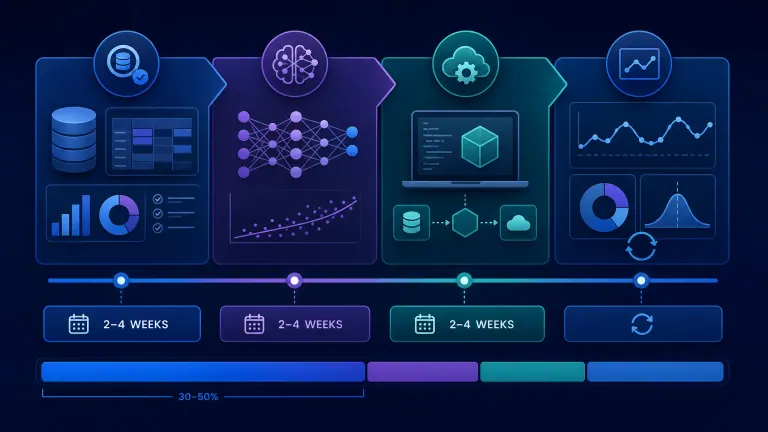
A churn prediction project with machine learning consulting services moves through four phases, and each one has a different failure mode if it's rushed or skipped.
Data audit and prep (2-4 weeks). This is where 30-50% of the total project timeline actually lives, even though it's the phase clients want to skip. A consultant pulls customer data from your CRM, billing system, and support tickets, then checks whether "churned" is even defined consistently across those systems. If your CRM says a customer churned when they downgrade and your billing system only flags full cancellations, the model trains on the wrong signal.
Model build and validation (2-4 weeks). The consultant trains a model — often starting with something simple like logistic regression — on a training window, then tests it against a holdout month to measure real accuracy before anyone trusts it. This is also where the false-positive rate gets tuned: a model that flags too many customers as "at risk" burns your retention team's time on false alarms.
Deployment and integration (2-4 weeks). The model gets connected to wherever your retention team actually works — usually the CRM or a Slack alert, not a standalone dashboard nobody opens. This is the phase most DIY and some rushed consulting engagements skip, which is why models that score well in testing never move the churn number in practice.
Monitoring and retraining (ongoing). Customer behavior shifts, and a model trained on last year's patterns degrades. Good consulting engagements include a monitoring cadence — usually monthly for the first quarter, then quarterly — to catch drift before it erodes accuracy.
Having this built for you removes the two most common failure points — inconsistent churn definitions and skipped deployment — that cause DIY attempts to stall after the model is technically "done" but never actually used.
Not sure if your data is ready for this? Take the 2-minute AI Readiness Check and find out whether your customer data can support a churn model today — or what needs to happen first. Take the Readiness Check →
Why ROI Shows Up in Month 4-6, Not Month 1
The gap between "model deployed" and "ROI visible" trips up almost every business that's never done this before. Three things have to happen in sequence, and none of them can be rushed.
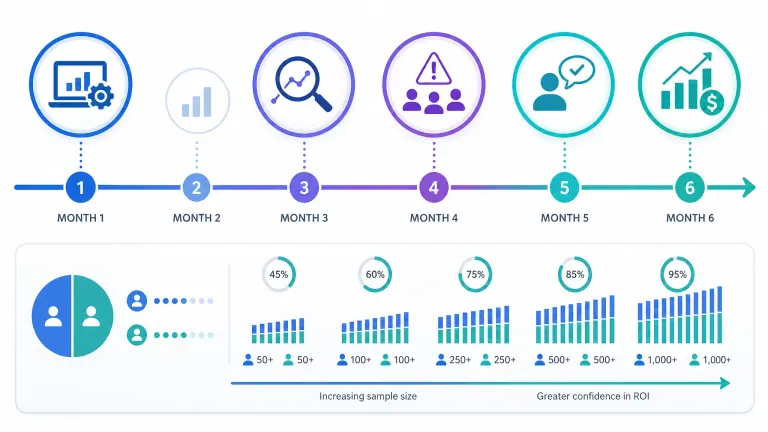
First, the model needs a full scoring cycle — usually one full sales or billing cycle — before its predictions can be checked against what actually happened. A monthly-billing SaaS business can validate in 4-6 weeks; a business with an annual contract cycle needs longer.
Second, your retention team needs time to act on the flags and for those actions to show results. Research from McKinsey on AI-driven customer analytics consistently finds that the organizations seeing the largest ROI are the ones that built a specific action — a call, a discount offer, a check-in — tied to each risk tier, not just a report.
Third, you need enough churned and retained customers in that window to measure the lift with statistical confidence. A business with 40 customers a month will need longer to get a reliable read than one with 4,000.
This is why 5:1 to 15:1 ROI figures are typically measured over a two-year window, not the first quarter. The first 4-6 months are about proving the model works and the process around it holds — the compounding return comes after that, as the retention playbook gets tuned against real outcomes.
How AI Essentials helps here: we build the retention action into the same engagement as the model, so "who does what when the model flags an account" is answered before launch, not figured out after.
See the real numbers before you commit Book a 30-minute walkthrough and we'll size the ROI timeline against your actual customer count and contract length. Book a Walkthrough →
What Makes the Timeline Slip
Every consulting firm quotes 8-14 weeks. Not every project actually finishes in that window. Here's what pushes it out, and how to price the alternative.
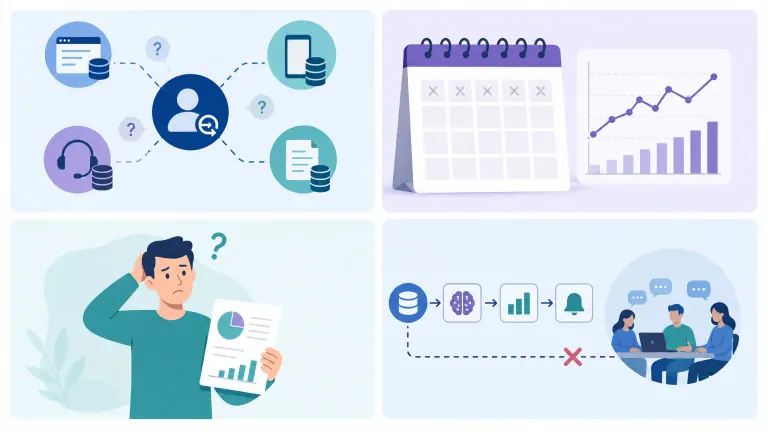
| Cause of delay | Typical impact | How to prevent it |
|---|---|---|
| Inconsistent churn definition across systems | +2-4 weeks | Agree on one definition of "churned" before data pull begins |
| Less than 3 months of clean historical data | +4-8 weeks or model isn't viable yet | Audit data availability before scoping the project |
| No owner for acting on model output | ROI never materializes | Assign a specific team/person to the retention playbook before launch |
| Model built but never integrated into daily workflow | ROI delayed indefinitely | Require deployment into CRM/Slack as part of the scope, not an add-on |
Original data block — build vs. hire cost comparison:
A business trying to build churn prediction in-house typically needs a data scientist ($90K-$130K/year) plus 3-6 months before a usable model exists, and that's before accounting for the churn in hiring itself — see our breakdown of what AI consultants actually cost for how those salary ranges compare across roles. A consulting engagement for a single-workflow churn model typically runs $8,000-$25,000 for the full 8-14 week build, deployed and integrated — a fraction of one year of in-house salary, with a working system in under four months instead of a headcount search that may not even fill.
| Approach | Upfront cost | Time to working model | Ongoing cost |
|---|---|---|---|
| Hire a data scientist | $90K-$130K/yr salary | 3-6 months (if hire succeeds) | $90K-$130K/yr + benefits |
| DIY with existing team | $0 direct cost | 2-6 weeks to a broken model, per research on ML consulting timelines | Ongoing team time, often stalls |
| Consulting engagement | $8,000-$25,000 | 8-14 weeks | Monitoring/retraining fee, typically quarterly |
According to Forrester's research on predictive analytics, companies that pair predictive models with a defined action plan see substantially higher realized ROI than those that deploy the model alone — reinforcing that the consulting engagement's value is as much in the deployment and playbook as the model itself.
Ready to see your specific timeline? Book a 30-minute walkthrough — we'll show you what 8-14 weeks looks like against your actual data and team. Book a Walkthrough →
Who This Is For
This is ideal for:
- B2B or subscription businesses with at least 3-6 months of clean, consistent customer data and 40+ monthly transactions to measure against
- Teams with a retention function (even informal) that can act on model flags — a sales rep, CS manager, or account owner
- Businesses that have tried a generic churn dashboard and found nobody used it
Consider alternatives if:
- You have less than 3 months of usable customer history — fix data collection first, or the model won't have enough to learn from
- Nobody on your team owns retention actions — a model with no action plan behind it won't produce the ROI numbers in this post
- Your churn is driven by something the model can't predict, like a single lost enterprise account rather than gradual pattern-based attrition
Why AI Essentials specifically? We scope the retention action into the engagement, not just the model — the two things that most commonly separate a churn model that pays back 5:1 from one that gets built and ignored. Every engagement starts with a free data readiness check before you commit budget.
Frequently Asked Questions
Is $100 an hour good for consulting?
For general business consulting, $100/hour is reasonable for a mid-level specialist. For machine learning consulting specifically, rates typically run $150-$300/hour, or firms quote a fixed project fee ($8,000-$25,000 for a single churn model) instead, since hourly billing makes it harder to budget a defined deliverable.
How much does an AI consultant cost?
AI consultants typically charge $150-$350/hour or $5,000-$25,000 for a scoped single-workflow project like churn prediction. Enterprise engagements with large firms start around $150,000 and require a correspondingly larger customer base to justify the cost.
What is a machine learning consultant?
A machine learning consultant designs, builds, and deploys predictive models — like churn prediction — for a specific business problem, then integrates the model into your existing tools so the output actually gets used, rather than delivering a standalone report or strategy document.
What are some reputable machine learning consulting firms?
Reputable firms range from boutique consultancies focused on SMB-scale projects to enterprise practices at firms like Accenture, IBM Consulting, and Deloitte. For a single-workflow churn model on a startup or SMB budget, a boutique firm scoped to your size typically delivers faster and cheaper than an enterprise practice built for six-figure minimums.
Machine learning consulting timeline customer churn prediction B2B
For a B2B business with clean CRM data, the timeline runs 8-14 weeks from kickoff to a deployed, integrated model — 2-4 weeks for data audit, 2-4 weeks for model build and validation, and 2-4 weeks for deployment and integration into your existing tools.
Phases of ML churn prediction project B2B
The four phases are data audit and prep, model build and validation, deployment and integration, and ongoing monitoring and retraining. Data audit is the phase most likely to be underestimated — it typically takes 30-50% of the total project time.
How long does a customer churn prediction project take B2B
8-14 weeks for a consulting-led engagement with adequate historical data. Businesses with messy or inconsistent data across systems, or less than 3 months of history, should expect 4-8 weeks added to the front end for data cleanup before the model build can start.
Machine learning churn prediction project steps B2B
The steps run: define what "churned" means consistently across your systems, audit and clean historical data, train and validate the model against a holdout period, deploy the model into your team's daily workflow, and assign ownership of the retention actions tied to each risk tier.
Practical implementation of ML churn prediction for B2B
Practical implementation means the model output lands somewhere your team already works — a CRM field, a Slack alert, a daily list — not a dashboard that requires someone to remember to check it. Engagements that skip this integration step are the most common reason a technically accurate model never moves the churn number.
Data requirements for B2B churn prediction ML
Most models need a minimum of 3-6 months of clean historical customer data, including clear churn/retention labels, to train reliably. Seasonal businesses or those with long sales cycles may need 1-2 years of history to capture a full pattern. Fewer than 40 monthly transactions makes statistical validation difficult regardless of history length.
Conclusion
The real ROI timeline for machine learning consulting services in churn prediction is 8-14 weeks to deployment and 4-6 months to a measurable retention lift — not the vague "6-12 months" range that keeps businesses stuck in evaluation mode. The businesses that see 5:1 to 15:1 return over two years are the ones that scope the retention action alongside the model, not after it.
If you want a specific number instead of a range, book a 30-minute walkthrough and we'll size the timeline and ROI against your actual customer data.

Iliyan Ivanov
Founder of AIessentials · AI automation consultant helping B2B businesses save 20+ hours/week and grow without hiring