AI Customer Service Pricing (2026): Salary Savings & ROI
[ SUMMARIZE WITH AI ]
Workflow Audit
]99% sure you are not seeing all the spots AI can help you in your business.
Are your workflows optimized with the most up to date solution, or are they costing you and your team time and money?
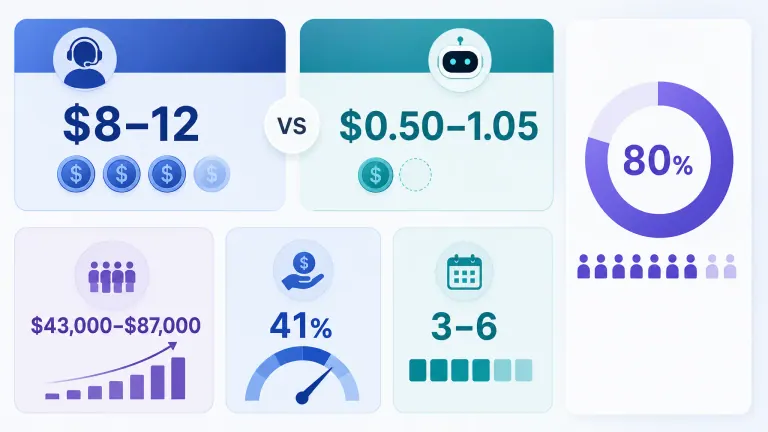
GET FREE AUDITAI customer service typically cuts support costs by 25–35% in the first year, reducing cost-per-interaction from $8–$12 for human agents to $0.50–$1.05 for AI-handled tickets (Deloitte, 2025). For a 5-person support team at $45,000/year average salary, that's $56,000–$79,000 in direct labor savings — with full ROI achieved in 3–6 months.
AI cost-per-ticket: $0.50–$1.05 vs $8–$12 for human agents Year 1 ROI: 41% average; top-quartile deployments hit 53% cost reduction (McKinsey, 2025) Payback period: 3–6 months for most B2B deployments What AI handles: Up to 80% of routine inquiries without human escalation (IBM, 2025) Year 3 projection: 124%+ cumulative ROI as AI resolution rates compound
You've seen too many "AI will transform everything" pitches deliver a strategy deck and nothing else. Before you commit, you need the actual numbers — not industry averages, but a model you can run against your own headcount.
Here's what happens when AI customer service works: ticket volume grows 20% year-over-year, but your support headcount stays flat. AI handles the repeatable 80% — password resets, order status, billing questions, FAQ — while your human agents focus on the cases that actually need judgment. The cost curve inverts. You're not replacing people; you're stopping the need to hire more of them.
The 61% of AI projects that fail to deliver year-one savings (McKinsey, 2025) share one trait: they automate before they measure. Businesses that succeed set a clear KPI baseline and define a ticket scope before launch. That's what this post gives you.
3 implementation slots open this month We audit your current support costs, define your ticket scope, and have AI customer service live in 30 days — with a KPI dashboard tracking ROI from day one. Reserve Your Slot →
Table of Contents
- How Much Do Businesses Actually Save on Salaries?
- The KPIs That Prove AI Customer Service ROI
- What the First 6 Months Look Like
- Who This Is For
- Frequently Asked Questions
How Much Do Businesses Actually Save on Salaries?
The clearest way to model salary savings isn't to look at averages — it's to look at your own cost-per-ticket and project what changes when AI handles the automatable slice.
Here's a benchmark calculation for a 5-person B2B support team handling 2,000 tickets per month:
| Scenario | AI Deflection Rate | Tickets Handled by AI | Monthly Savings | Annual Savings |
|---|---|---|---|---|
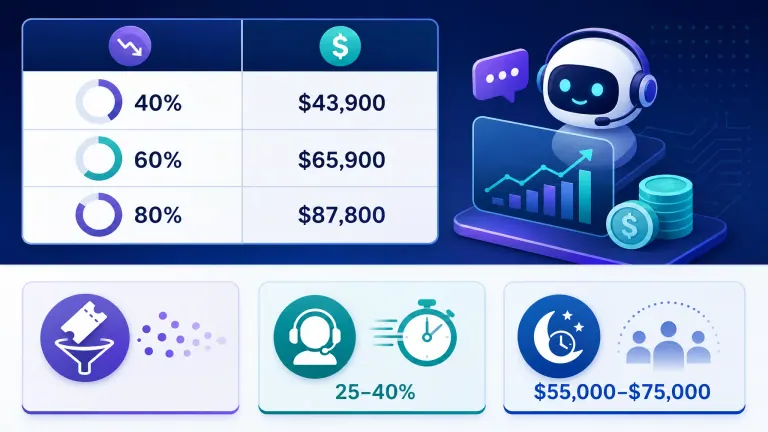
| Conservative | 40% | 800 | $3,660 | $43,900 |
| Moderate | 60% | 1,200 | $5,490 | $65,900 |
| Strong | 80% | 1,600 | $7,320 | $87,800 |
Based on $10.00 human cost-per-ticket vs $0.75 AI cost-per-ticket. Platform cost excluded.
The Salary Math
A B2B support agent costs $45,000–$55,000/year in base salary plus $15,000–$20,000 in benefits, tools, and training — roughly $60,000–$75,000 fully loaded. When AI absorbs 60–80% of ticket volume, that's the equivalent of 3–4 agents worth of work removed from the backlog.
Most businesses don't eliminate headcount in year one. They stop the next two planned hires. That's the same budget impact: $120,000–$150,000 in avoided headcount costs per year, without the management overhead of a reduction in force.
Where the Savings Actually Come From
AI customer service saves money in three concrete ways:
Ticket deflection — AI resolves tickets that previously required a human response: password resets, account lookups, FAQ, refund status checks. These cost $8–$12 each manually. At $0.75 via AI, a business handling 1,000 of these monthly saves $7,250/month immediately.
Agent handle time reduction — Even on escalated tickets, AI pre-populates context, extracts the core issue, and hands the agent a summary. Average handle time drops 25–40% per ticket (Forrester, 2025). For a 5-agent team handling 30 tickets/day each, that's 15–20 hours recovered per week — redirected to complex cases.
After-hours coverage — AI doesn't need a night shift. For B2B businesses with clients across time zones, after-hours AI coverage removes the cost of an overnight support role — typically $55,000–$75,000/year for a single shift position.
The Honest Tradeoff
Not all tickets are automatable. Roughly 75% of customers prefer human agents for complex issues (Statista, 2025) — contract disputes, billing discrepancies, technical failures that need account context. AI that can't escalate cleanly creates frustrated customers and escalating churn.
The businesses that get strong ROI define a clear handoff protocol before launch, not after. Start with structured, high-volume ticket types where the correct answer is unambiguous. Expand into gray-area tickets only once deflection rates are stable and CSAT is holding.
For a broader look at AI investment returns across business functions, see AI Automation ROI: 7 Real Business Cases with Numbers.
Want to run this model against your own support costs? We'll audit your current ticket volume and give you a specific savings projection before you commit to anything. Get Your Cost Estimate →
The KPIs That Prove AI Customer Service ROI
Measuring the ROI of AI customer service isn't complicated — but most businesses don't set up their baseline before launch, which makes it impossible to prove ROI afterward. That's how solid implementations end up looking like failures.
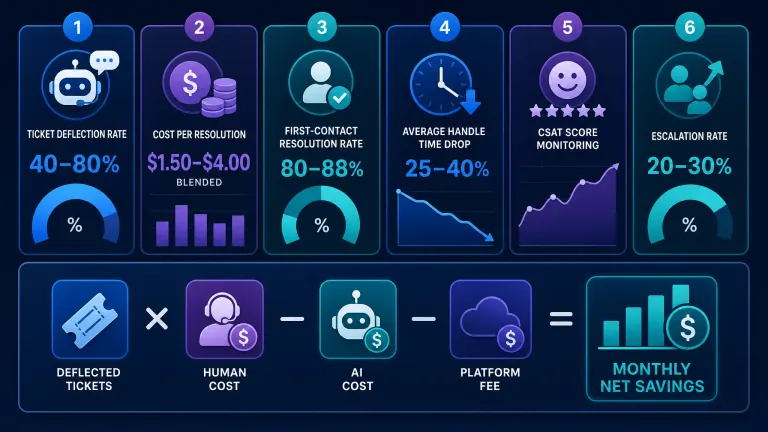
Here are the six KPIs that determine whether your AI customer service investment is working:
| KPI | Baseline (Human-Only) | Target with AI | What It Measures |
|---|---|---|---|
| Ticket deflection rate | 0% | 40–80% | % of tickets AI resolves without human touch |
| Cost per resolution | $8–$12 | $1.50–$4.00 blended | Weighted cost across AI + human tickets |
| First-contact resolution (FCR) | 70–75% | 80–88% | % resolved in one interaction |
| Average handle time (AHT) | 8–12 min | 5–8 min on human tickets | Time per human-handled ticket post-AI assist |
| CSAT score | 3.8–4.2 / 5 | 4.0–4.4 / 5 | Customer satisfaction (watch for drops) |
| Escalation rate | n/a | 20–30% | % of AI tickets routed to human |
How to Track Each KPI
Ticket deflection rate is your primary ROI metric. Calculate it as: (tickets resolved by AI ÷ total tickets received) × 100. Track weekly in the first 90 days — it should increase as the AI learns from escalated cases.
Cost per resolution is the finance proof metric. Take total monthly support spend (salaries + platform + training) and divide by total tickets resolved. Run separate calculations for AI-only and human-touch resolutions. The blended number should drop 20–35% within 6 months.
CSAT score is the risk metric. Expect a neutral or slightly positive result in the first 30 days. If CSAT drops more than 0.3 points, your AI scope is too broad — pull it back to simpler ticket types and re-expand slowly.
Escalation rate tells you if your AI is well-scoped. Under 15% suggests the AI is taking on tickets it shouldn't. Over 40% means it's not solving enough. Target 20–30% in the first 90 days, then reduce as scope expands.
Connecting KPIs to Salary Savings
Once you have 90 days of data, build a straightforward ROI calculation:
Monthly net savings = (Tickets deflected × human cost-per-ticket) − (Tickets deflected × AI cost-per-ticket) − Monthly platform cost
Example with real numbers: 1,500 deflected tickets × $10.00 = $15,000. Minus 1,500 × $0.75 = $1,125. Minus $500/month platform cost. Net monthly savings: $13,375. Annual: $160,500.
That's a realistic figure for a mid-sized B2B support operation running AI customer service at 60–70% deflection. If you want help building this calculation for your specific headcount and ticket volume, our Free AI Revenue + Savings Plan walks through it with your actual numbers.
Want these KPIs applied to your support operation? We set up the measurement framework before implementation — so ROI is visible from day 30, not day 180. Book a 30-Minute Walkthrough →
What the First 6 Months Look Like
Most AI customer service implementations follow a predictable pattern. Knowing what to expect at each stage prevents the two most common failure modes: expanding scope too fast and measuring the wrong things.
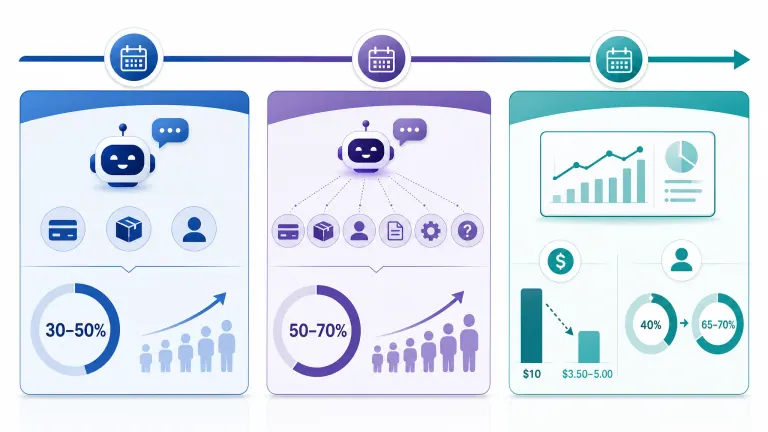
Month 1–2: Pilot on High-Volume Simple Tickets
Start with 3–5 ticket types that are high-volume and have unambiguous correct answers: password resets, order status, basic FAQ, subscription questions.
What to set up: Knowledge base ingestion, escalation routing, CSAT measurement. Don't automate anything requiring account-specific judgment yet.
Typical results: 30–50% of target ticket types deflected. CSAT neutral to slightly positive. Agents notice lighter volume.
Month 3–4: Expand Scope
Based on pilot data, add more ticket types. If escalation rate is under 25% and CSAT held, expand to billing questions, basic troubleshooting, and return requests.
What changes: Deflection rate climbs to 50–70% of all tickets. Handle time drops as AI pre-populates context for human agents.
Measure this: Are agents spending more time on complex tickets? That's the signal AI is working correctly.
Month 5–6: Document ROI
Pull your 90-day baseline comparison and build the ROI case. This is the data you present to justify continued investment and expanded scope.
| Metric | Before AI | After 6 Months |
|---|---|---|
| Tickets handled per agent/day | 30–35 | 45–55 (AI absorbs volume growth) |
| Cost per resolution (blended) | $10.00 | $3.50–$5.00 |
| After-hours inquiries resolved | 0% | 80–90% |
| Agent time on complex tickets | 40% | 65–70% |
| Year 1 ROI | — | 35–50% |
Gartner projects that conversational AI will save $80 billion in contact-center labor costs globally by end of 2026. The businesses capturing that savings share started 6–12 months ago — the ones that haven't moved yet are funding their competitors' next hire.
If you're building AI automation beyond customer service — across operations, sales, and internal workflows — the AI Operating System we build for clients connects all of it so data flows where it needs to automatically.
Slots fill in the first week of each month We start with a 2-hour audit of your current support operation. Implementation typically takes 3–4 weeks from there. Claim Your Implementation Slot →
Who This Is For
This is ideal for:
- B2B businesses handling 500+ support tickets per month with a 3–10 person support team
- Companies where support headcount is growing faster than revenue
- Operations that need AI customer service deployed and producing measurable savings within 60 days
- Budget owners who need documented ROI data before presenting to leadership
Consider alternatives if:
- Your ticket volume is under 200/month — a lighter setup (Zapier + a simple FAQ bot) will cost less
- Most of your tickets require deep account context or open-ended judgment calls — AI handles structured queries best
- You haven't mapped your current ticket types or cost-per-ticket yet — automating without a baseline is what causes the 61% failure rate
Why AI Essentials specifically? We implement AI customer service in 30 days or less, with a KPI measurement framework built before launch — not after. Every implementation includes a 90-day ROI review where we show you the cost-per-ticket delta against the baseline we set on day one. No strategy decks, no multi-month scoping engagements.
Frequently Asked Questions
AI customer service B2B cost savings salaries
Most B2B businesses with 5-agent support teams save $43,000–$87,000 annually in year one, depending on ticket deflection rates (40–80%). This comes from AI handling routine tickets at $0.50–$1.05 each instead of $8–$12 with human agents. Most companies don't cut headcount — they stop their next planned hire, which has the same budget impact without the operational disruption.
AI customer service KPIs ROI B2B
Track six KPIs from day one: ticket deflection rate (target 40–80%), cost per resolution (target $1.50–$4.00 blended), first-contact resolution rate (target 80–88%), average handle time on human tickets (should drop 25–40%), CSAT score (watch for drops exceeding 0.3 points), and escalation rate (target 20–30% in the first 90 days). Measure all six before launch — without a baseline, you can't prove ROI.
AI customer service implementation B2B
Start with a ticket audit: pull 3 months of support data, categorize by ticket type and volume, identify the 3–5 types with the highest volume and clearest resolution paths. Build your knowledge base from those categories, launch the pilot on those ticket types only, and expand after 45 days if deflection rate and CSAT hold. Total setup: 3–4 weeks for a defined scope.
AI customer service mistakes B2B
The three that kill ROI: automating before establishing a ticket baseline (makes measurement impossible), starting with complex tickets instead of high-volume simple ones, and skipping escalation protocol design (AI that can't hand off cleanly destroys CSAT). A fourth common mistake: using a generic AI without company-specific knowledge base training — generic answers to specific questions lower CSAT and increase escalations.
AI customer service case studies B2B
A mid-market SaaS company with 4 support agents handling 1,800 tickets/month implemented AI on password resets, billing FAQ, and feature questions. Result: 62% deflection rate, cost per resolution dropped from $11.20 to $3.40, and 2 planned new hires were avoided in Q3 — $130,000 in headcount costs saved. Full ROI: 4.5 months post-launch.
AI customer service timeline B2B
Pilot launch: 3–4 weeks for defined scope (3–5 ticket types, existing knowledge base). Scope expansion: Month 3–4 after pilot data confirms stability. Full ROI documented: Month 5–6. Complex integrations with custom CRMs or legacy systems add 2–4 weeks. Payback period: 3–6 months post-launch for most B2B deployments.
AI customer service right vs wrong choice B2B
Right choice if: ticket volume exceeds 500/month, at least 40% are structured and repeatable, and support costs are growing faster than revenue. Wrong choice if: tickets require deep account-specific judgment, knowledge base doesn't exist or isn't documented, or business processes aren't defined clearly enough to train AI on correct responses. A 30-minute ticket audit tells you which category you're in before any commitment.
AI customer service industry applications B2B
B2B SaaS sees the highest deflection rates (structured FAQ volume is high). Financial services and professional services businesses with standardized offerings also perform well. Industries with highly customized client relationships — bespoke consulting, legal, complex manufacturing — see lower deflection rates because tickets typically require account judgment. The key variable isn't industry; it's the ratio of structured vs judgment-heavy tickets in your support queue.
How long does it take to implement AI customer service?
For a defined scope (3–5 ticket types, existing knowledge base): 3–4 weeks. For a full integration with existing CRM and ticketing systems: 6–8 weeks. The variable is starting state — businesses with documented processes and an existing knowledge base go faster. Businesses building the knowledge base during implementation add 2–3 weeks. Payback after launch: 3–6 months.
What is the typical ROI of AI customer service for small businesses?
Small B2B businesses (2–4 agent teams, 300–800 tickets/month) typically see 35–50% year-one ROI — slightly lower than enterprise deployments because AI platform costs are a larger share of total support spend. By year two, ROI reaches 80–90% as resolution rates improve and more ticket types are added. Payback period: 3–5 months for small businesses with 40%+ deflection rates.
Conclusion
The numbers on AI customer service are consistent enough to plan against: 30% average cost reduction, $0.50–$1.05 per AI-handled ticket versus $8–$12 for human agents, and full payback in 3–6 months. The businesses that miss that ROI are the ones that automate without a measurement baseline, or expand scope before the pilot data supports it.
Three takeaways before you move:
- Model your own salary savings first — the table in Section 1 gives you the framework
- Set up all 6 KPI baselines before launch, not after. Without a before, there's no after
- Start narrow: 3 ticket types, 45-day pilot, expand only when deflection rate and CSAT hold
3 implementation slots open this month. We audit your support costs, define your ticket scope, and deliver AI customer service live within 30 days — with a KPI dashboard tracking ROI from day one, not after six months of guessing.

Iliyan Ivanov
Founder of AIessentials · AI automation consultant helping B2B businesses save 20+ hours/week and grow without hiring