BPM Software ROI in Sales & Marketing (2026): Real Metrics
[ SUMMARIZE WITH AI ]
Workflow Audit
]99% sure you are not seeing all the spots AI can help you in your business.
Are your workflows optimized with the most up to date solution, or are they costing you and your team time and money?
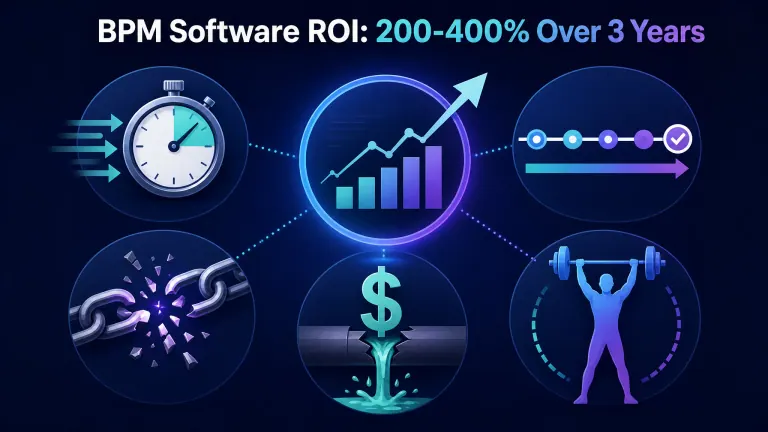
GET FREE AUDITBPM software typically delivers a 200-400% return on investment over three years for sales and marketing teams, with payback in under 12 months when it's tied to one specific high-volume workflow instead of a department-wide rollout. The five metrics that actually prove this — not just imply it — are speed-to-lead, quote-to-close cycle time, rework and error cost, revenue recovered from process leaks, and hours of rep or marketer capacity freed up.
Speed-to-lead reduction: Automated lead routing through BPM workflows typically cuts response time from hours to under 5 minutes, which directly raises the odds a lead actually gets qualified. Quote-to-close cycle time: Automated approval chains shrink quote turnaround from multi-day waits to same-day, recovering deals that would otherwise stall. Rework and error cost: Removing manual double-entry and handoffs between sales and marketing tools eliminates a quiet, recurring cost most teams never formally track. Payback timeline: A 2024 Forrester Total Economic Impact study on workflow automation found a 248% three-year ROI with payback in under six months for a composite deployment. Rep and marketer capacity freed: McKinsey's research on workplace automation found that 60% of occupations have at least 30% of their daily activities that could be automated — for sales and marketing roles, that's mostly data entry, follow-up scheduling, and status updates.
You already know your sales and marketing team is drowning in handoffs, follow-ups, and reporting nobody asked for. The real question isn't whether BPM software helps — it's whether a full BPM platform will actually fix your specific bottleneck, or just become another system your team has to babysit.
That distinction matters because "bpm business management process software" covers a huge range — from a $60,000/year enterprise suite to a scoped automation built around one broken workflow. The ROI numbers above are averages across that whole category, and where your team lands depends on which workflow you automate first, how much of it is truly repetitive versus judgment-based, and whether anyone actually owns the process today.
The rest of this post breaks down which metrics to track for your own situation, how BPM software stacks up against manual processes and point tools like a CRM alone, and what a realistic rollout costs by approach. If you want the ROI math run against your actual sales or marketing process instead of an industry average, we can build the automation directly around the workflow that's costing you the most.
Not sure if BPM software is the right fix for your sales and marketing bottleneck? Take the 2-minute AI Readiness Check and find out which workflow is actually leaking the most time and revenue. Take the Readiness Check →
Table of Contents
- The 5 ROI Metrics That Actually Matter
- BPM Software vs. Manual Process vs. Point Tools
- What a Sales & Marketing BPM Rollout Actually Costs
- Who This Is For
- Frequently Asked Questions
The 5 ROI Metrics That Actually Matter {#the-5-roi-metrics}
Most bpm business management process software vendor pitches lead with generic efficiency claims. The metrics below are the ones that hold up when someone on your finance team asks "so did this actually pay off?"
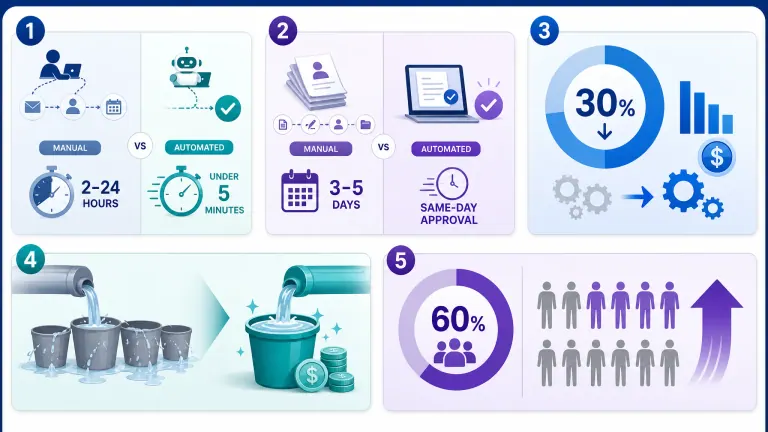
1. Speed-to-lead. This is the time between a lead entering your system and a human (or automated sequence) actually engaging them. Manual routing — someone checking a shared inbox, assigning leads by hand — regularly runs 2-24 hours. BPM-automated routing gets this under 5 minutes. Faster response consistently correlates with higher qualification rates, which is why this is usually the first metric worth measuring before and after.
2. Quote-to-close cycle time. If a quote has to pass through 2-3 people for approval before it reaches the customer, that's days of dead time on every deal. Automating the approval chain — not replacing your CRM, just wiring the handoffs together — typically compresses this from 3-5 days to same-day.
3. Rework and error cost. Every time a rep re-enters data that already exists somewhere else, or a lead falls through a gap between marketing and sales systems, that's a cost that never shows up as a line item. Gartner's research on hyperautomation found that combining automation technology with redesigned processes can cut operational costs by roughly 30% — most of that reduction comes from exactly this kind of eliminated rework, not headcount cuts.
4. Revenue recovered from process leaks. This is the hardest metric to estimate up front and the most important one after the fact: how many deals were lost, delayed, or discounted because a manual step was too slow. Tracking this requires a before/after comparison on the same workflow, which is why a scoped pilot on one process beats a department-wide rollout for proving ROI.
5. Capacity freed per rep or marketer. McKinsey's analysis found that about 60% of occupations have 30% or more of their daily tasks that are technically automatable. For B2B sales and marketing roles specifically, that's usually CRM updates, follow-up scheduling, report assembly, and status emails — the tasks that eat a morning without producing a dollar of revenue.
How AI Essentials helps here: we don't sell BPM licenses — we build the specific automation your process needs, scoped to one workflow, so you're measuring real before/after numbers on your own data instead of an industry benchmark. See real automation ROI numbers from other B2B teams for a sense of what a scoped project typically returns.
Not sure which of these five metrics applies most to your bottleneck? Take the 2-minute AI Readiness Check — it flags which workflow is actually worth automating first. Check Your AI Readiness →
BPM Software vs. Manual Process vs. Point Tools {#bpm-vs-alternatives}
Before you buy anything, it's worth being honest about what each option actually is — because "BPM software" isn't the only way to fix a broken sales or marketing process, and it isn't always the right one.
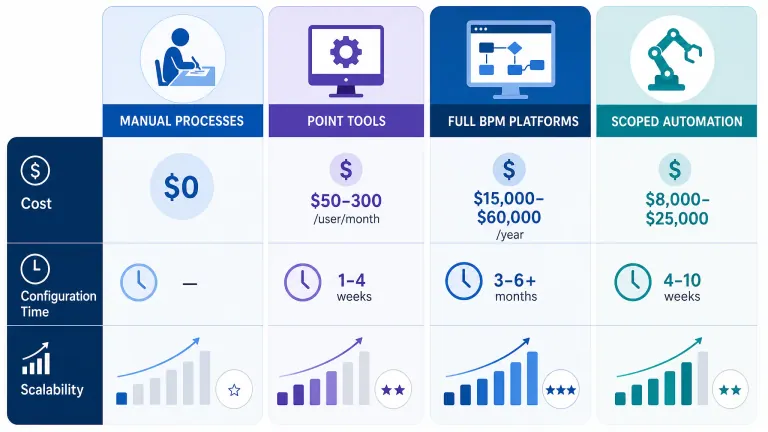
| Approach | Typical cost | Timeline | Best for | Biggest risk |
|---|---|---|---|---|
| Manual process | $0 upfront, ongoing labor cost | N/A | Fewer than 10 leads/month, process still changing weekly | Doesn't scale; errors and delays compound as volume grows |
| Point tools (CRM + Zapier/native automations) | $50-$300/user/month | 1-4 weeks | Simple, single-step handoffs (e.g. lead assignment) | Breaks down once a process needs more than 2-3 conditional steps |
| Full BPM platform (enterprise suite) | $15,000-$60,000+/year for 50 users | 3-6+ months to configure | Multi-department processes with compliance or audit requirements | Expensive and slow for a single-team fix; often over-scoped for sales/marketing alone |
| Scoped automation (AI Essentials, boutique implementers) | $8,000-$25,000 one-time | 4-10 weeks | One specific, well-defined process (lead routing, quote approval, campaign handoff) | Requires a clearly defined process going in — not built for open-ended, judgment-heavy work |
The honest tradeoff: manual processes are free until they aren't, point tools are fast but hit a ceiling fast, full BPM platforms are built for scale you may not need yet, and scoped automation sits in between — narrower than an enterprise suite, but built around your actual workflow instead of a generic one. If your sales and marketing bottleneck is genuinely one process — not five — a full BPM license is usually more platform than the problem requires. Compare that against the workflow management software options built for exactly this size of team before committing to an enterprise contract.
How AI Essentials helps here: we're the fourth category — a fixed-scope build around your specific bottleneck, not a license you have to configure yourself. If you already know it's one workflow (not a department-wide overhaul), that's usually the faster and cheaper path to the ROI numbers above.
Which approach actually fits your situation? Take the 2-minute AI Readiness Check and see whether your process needs a full BPM platform or a scoped fix. Take the Readiness Check →
What a Sales & Marketing BPM Rollout Actually Costs {#what-it-costs}
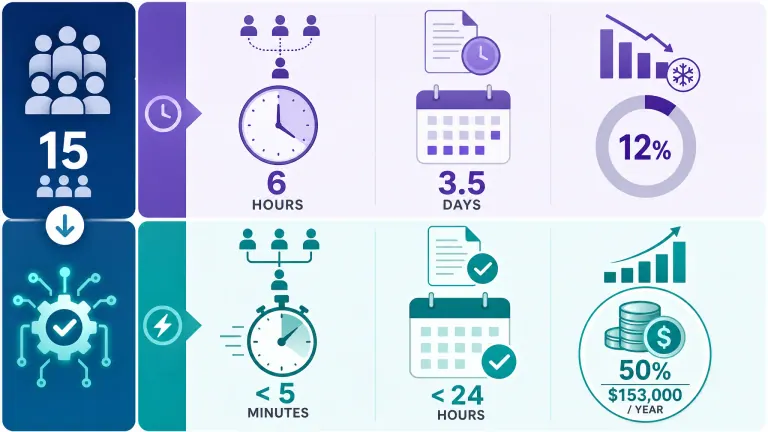
Here's a realistic before/after on the workflow that shows up most often in this conversation: lead routing and quote approval for a 15-person B2B sales team.
Before: Leads sit in a shared inbox for an average of 6 hours before assignment. Quotes require sign-off from a sales manager and, above a discount threshold, a second approval — average turnaround 3.5 days. Roughly 12% of quoted deals go cold during that wait, based on typical B2B pipeline attrition at the quote stage.
After: Leads route automatically based on territory and deal size in under 5 minutes. Quotes under the discount threshold auto-approve; anything above it routes directly to the right approver with a same-day SLA. Quote turnaround drops to under 24 hours.
The ROI math: if that team closes 40 deals a quarter at an average $8,000 contract value, recovering even half of the 12% lost to slow quoting is worth roughly $153,000/year in recovered revenue — against a one-time automation cost of $8,000-$25,000 for a scoped build, or $15,000-$60,000/year for a full BPM license covering the same team. That's the gap between "BPM software is expensive" and "BPM software pays for itself in one quarter," and it comes down entirely to matching the investment to the actual process, not the category of software.
Gartner's hyperautomation research backs the scale of these gains at the operational level too — organizations combining automation with redesigned processes have seen cost reductions of roughly 30%, without adding headcount. That 30% isn't from replacing people; it's from removing the rework, re-entry, and delay that manual handoffs create.
Want this math run against your own pipeline numbers? Take the 2-minute AI Readiness Check — see what a scoped fix would realistically save your team. Check Your AI Readiness →
Who This Is For {#who-this-is-for}
This is ideal for:
- B2B sales and marketing teams handling 50+ leads a month that get routed or assigned manually
- Teams where a quote or proposal passes through 2 or more people before it reaches the customer
- Organizations already using a CRM, but where the process around the CRM (routing, approvals, follow-up) is still manual
Consider alternatives if:
- Your lead or quote volume is under 10/month — the investment won't pay back fast enough to justify it yet
- Your process changes weekly and no one has settled on a "standard" way to handle it — automate a moving target and you'll be rebuilding constantly
- No one internally owns the process end-to-end — automation formalizes a process, it doesn't fix the lack of an owner
Why AI Essentials specifically? We scope a fixed-price project around one workflow — typically $8,000-$25,000 — instead of selling a platform license you have to configure yourself. Most builds go live in 4-10 weeks, versus 3-6+ months for a full enterprise BPM rollout, and we tie the engagement to a measurable outcome like hours saved or deals recovered rather than "process maturity."
Frequently Asked Questions
Is SAP a BPM tool?
SAP itself is an ERP suite, not a dedicated BPM tool, but it includes BPM-adjacent modules (like SAP Business Workflow) for process automation within its ecosystem. Most companies pair SAP with a separate BPM or workflow automation layer for sales and marketing processes that sit outside core ERP functions, like lead routing or quote approvals.
What does BPM software do?
BPM software maps, automates, and monitors repeatable business processes — things like lead assignment, approval chains, and cross-department handoffs. It replaces manual, ad-hoc coordination (email chains, shared spreadsheets, verbal handoffs) with a defined, trackable workflow that runs the same way every time.
What is the best BPM software?
There's no single best option — it depends on scale. Enterprise suites (Appian, Pega, Bizagi) fit multi-department, compliance-heavy processes. Mid-market platforms (Zoho Creator, monday.com, Pipefy) fit smaller teams with simpler needs. For a single sales or marketing workflow, a scoped automation build often outperforms both on cost and speed to value.
What are some examples of BPM software?
Common examples include Bizagi, Appian, Pega, Zoho Creator, Pipefy, and Smartsheet. On the lighter end, tools like Zapier or native CRM automation handle simple, single-step processes without requiring a full BPM platform.
What ROI metrics prove BPM software boosts sales and marketing?
The five that hold up under scrutiny: speed-to-lead, quote-to-close cycle time, rework/error cost eliminated, revenue recovered from process leaks, and hours of rep or marketer capacity freed. Track these on one specific workflow before and after automation rather than estimating department-wide.
How long does it take to see ROI from BPM software in sales and marketing?
Most scoped deployments show measurable ROI within 6-12 months, and often faster — Forrester's 2024 workflow automation study found payback in under six months for a composite enterprise deployment. The timeline shortens further when the automation targets one high-volume, well-defined process instead of an entire department.
How much does BPM software cost for a sales and marketing team?
Full BPM platform licenses typically run $15,000-$60,000+ per year for a 50-person team. A scoped automation build focused on one workflow (lead routing, quote approval) typically costs $8,000-$25,000 as a one-time project — often a faster path to ROI for a single-process fix.
Should I automate lead routing or quote approval first?
Automate whichever process loses you the most measurable revenue first. If leads sit unassigned for hours, speed-to-lead is usually the higher-impact fix. If deals stall waiting on approval sign-off, quote-to-close cycle time is the bigger lever. Most teams see the clearest ROI by fixing one before touching the other.
Does BPM software replace my CRM?
No. BPM software (or a scoped automation) typically sits alongside your CRM, automating the handoffs and approvals that happen around it — not replacing the system of record. The goal is removing the manual steps between your CRM and the rest of your sales and marketing process, not swapping tools.
What's the difference between BPM software and workflow automation?
BPM software is the broader category — it includes process mapping, governance, and monitoring across an organization. Workflow automation is typically narrower and more tactical: automating one specific sequence of steps, like routing a lead or approving a quote. For a single sales or marketing bottleneck, workflow automation usually gets you the same ROI without the overhead of a full BPM implementation.
Conclusion
The ROI case for BPM software in sales and marketing isn't abstract — it comes down to five trackable metrics: speed-to-lead, quote-to-close time, rework cost, revenue recovered, and capacity freed. The businesses that see the 200-400% returns cited by Forrester and the cost reductions Gartner ties to redesigned processes are the ones that scope the investment to one real bottleneck instead of buying a platform and hoping the ROI shows up on its own.
If you already know which process is costing you the most, the fastest way to find out what fixing it is worth is to run the numbers against your own pipeline instead of an industry average.
Not sure which approach fits your business? Take the 2-minute AI Readiness Check and see whether your process needs a full BPM platform or a scoped fix. Take the Readiness Check →

Iliyan Ivanov
Founder of AIessentials · AI automation consultant helping B2B businesses save 20+ hours/week and grow without hiring