Conversational Assistance in B2B CX (2026)
[ SUMMARIZE WITH AI ]
Workflow Audit
]99% sure you are not seeing all the spots AI can help you in your business.
Are your workflows optimized with the most up to date solution, or are they costing you and your team time and money?
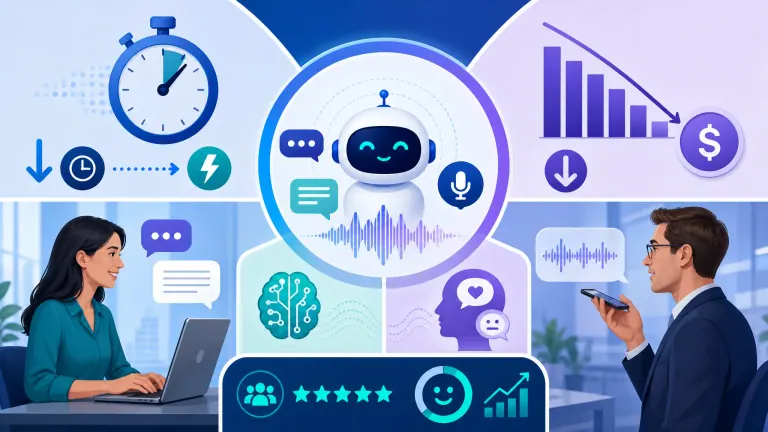
GET FREE AUDITConversational assistance — chat and voice tools built on natural language processing (NLP) — typically cuts B2B response times from hours to under a minute and lowers cost-per-interaction by 70–90% compared to human-only support. It works by reading intent and sentiment in a customer's message, then either resolving the request directly or routing it to the right person with full context attached.
Faster first response: Most B2B teams see response times drop from 2–4 hours (email/ticket queues) to under 60 seconds for routine questions. Lower cost per ticket: NLP-handled tickets typically cost $0.50–$1.50 versus $8–$12 for a human agent to close the same ticket. Better routing accuracy: Intent detection cuts misrouted or reassigned tickets by 20–35% in most B2B support setups. 24/7 coverage without headcount: Complex accounts still get a human, but the routine 60–70% of volume never has to wait for one. Context retention: NLP systems carry account history, prior tickets, and contract details into every conversation — something manual handoffs regularly lose.
You're not scaling customer interactions right now — you're absorbing them. Every new account adds another set of tickets, follow-ups, and status checks, and your team's headcount isn't growing at the same rate your customer base is. That gap is where conversations start slipping through.
This isn't really a technology question. It's a capacity question. The follow-up worth asking isn't "does conversational AI work" — plenty of vendors will tell you it does. It's "which parts of my B2B support load can this actually absorb, and which parts still need a person who understands the account." That's the split this post is built around: what NLP-powered assistance handles well, where it falls short in B2B specifically (longer sales cycles, multi-stakeholder accounts, contract nuance), and what a realistic rollout looks like.
If you want a faster way to see this, our AI Operating System for B2B businesses walks through how this kind of assistant fits alongside the rest of your ops stack — not as a standalone chatbot, but as one layer of a system that removes repetitive work across the business.
Not sure if this approach fits your support setup? Take the 2-minute AI Readiness Check — it tells you which parts of your customer conversations are automatable today and which still need a human. Take the Readiness Check →
Table of Contents
- How NLP-Powered Conversational Assistance Actually Works
- Conversational Assistance vs. Traditional B2B Support: An Honest Comparison
- What This Costs and What It Returns
- Who This Is For
- Frequently Asked Questions
How NLP-Powered Conversational Assistance Actually Works
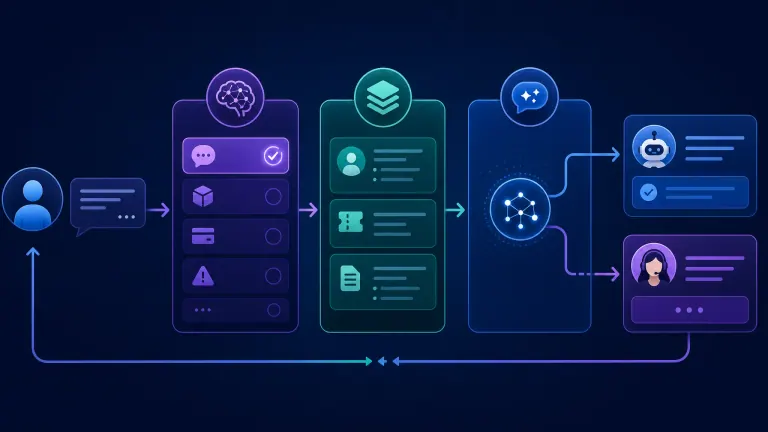
Conversational assistance isn't one tool — it's a pipeline of three things happening in sequence, and understanding the pipeline is what tells you where it'll actually help your team.
Intent detection. The system reads the incoming message (chat, email, or voice-to-text) and classifies what the customer actually wants: a status update, a billing question, a technical issue, an escalation. In B2B, intent detection has to work harder than in B2C — a single message from an enterprise contact might blend a technical question, a billing concern, and a soft complaint about response time, all in three sentences.
Context assembly. Before responding, the system pulls in what it knows: account history, open tickets, contract terms, prior interactions with this specific contact. This is the part that matters most in B2B and gets skipped most often in cheap implementations. A generic FAQ bot answers the question in front of it. A context-aware assistant answers it the way someone who's read the account file would.
Response or routing. For routine, well-defined requests — order status, password resets, standard policy questions — the system responds directly. For anything ambiguous, high-value, or emotionally charged, it routes to a human agent with the full context already attached, so the customer doesn't have to repeat themselves. That handoff is where most conversational AI implementations either earn trust or lose it.
How AI Essentials approaches this: we don't deploy a chatbot and call it done. We map which of your support conversations are actually repeatable (they usually cluster around 5–8 request types) and build the assistant around those first, with a clear, visible handoff to a human for everything else. That's the difference between a bot that frustrates customers and one they don't notice is a bot.
Want to see which conversations in your support queue are automatable? The 2-minute AI Readiness Check maps your ticket types against what conversational assistance can realistically handle. Take the Readiness Check →
Conversational Assistance vs. Traditional B2B Support: An Honest Comparison
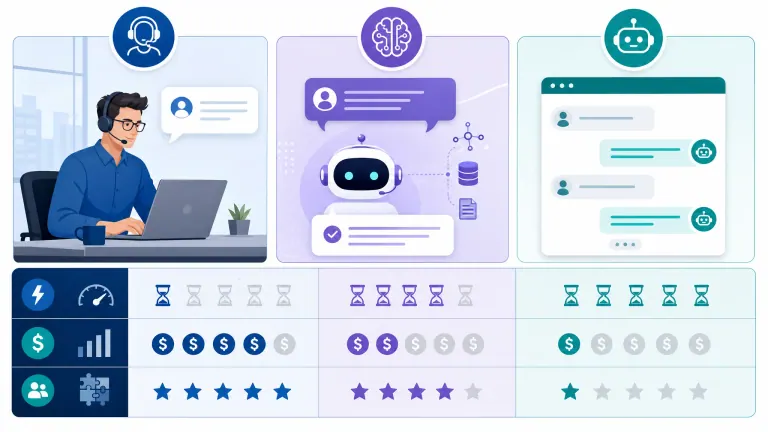
Here's where most vendor content stops being honest. Conversational assistance isn't a strict upgrade over human support — it's a different tool for a different slice of your ticket volume. The table below is how we'd actually score it against the alternatives B2B teams are weighing.
| Factor | Human-only support | Conversational assistance (NLP) | Live chat with scripted bots |
|---|---|---|---|
| First response time | 2–4 hours (queue-dependent) | Under 60 seconds | Under 60 seconds |
| Cost per ticket | $8–$12 | $0.50–$1.50 | $1–$3 |
| Handles account nuance/context | Yes, if agent is briefed | Yes, if context is integrated | No — scripted paths only |
| Multi-stakeholder account handling | Yes | Partial — needs human handoff for complex cases | No |
| 24/7 coverage | Requires shift staffing | Native | Native |
| Setup and maintenance | None (just hiring) | Moderate — needs ticket taxonomy and integration | Low, but brittle |
| Best fit | High-touch enterprise accounts | Repetitive, well-defined request types | Low-stakes, simple FAQs |
The honest read: conversational assistance wins decisively on speed and cost for the 60–70% of B2B tickets that are actually routine — status checks, standard policy questions, basic troubleshooting. It does not replace the person who knows your top accounts by name and remembers the contract renegotiation from last quarter. Teams that get burned by conversational AI are almost always the ones that tried to automate 100% of the queue instead of the repeatable slice.
Which contact center AI features actually reduce agent workload breaks down four more capabilities that compound this effect further.
Where does your support queue actually split between routine and complex? Most B2B teams haven't measured this. Take the 2-minute Readiness Check to get a rough split for your account. Take the Readiness Check →
What This Costs and What It Returns
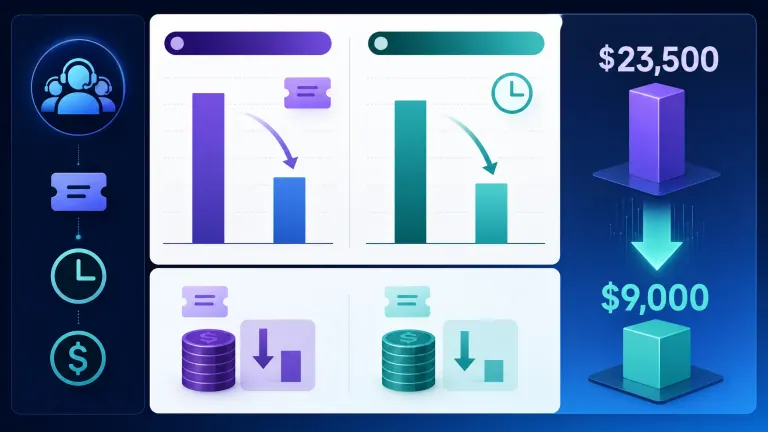
Here's the ROI math for a mid-sized B2B support team — the kind of team fielding 2,000–3,000 tickets a month with 5 agents.
| Metric | Before conversational assistance | After conversational assistance |
|---|---|---|
| Monthly ticket volume | 2,500 | 2,500 |
| Avg. first response time | 3.2 hours | 45 seconds (routine tickets) |
| Tickets handled without a human | 0% | ~62% |
| Cost per ticket (blended) | $9.40 | $3.60 |
| Monthly support cost | $23,500 | $9,000 |
| Agent hours freed for complex accounts | — | ~55 hours/week |
That's roughly $14,500/month in direct cost reduction, before counting the retention effect of faster response times — Zendesk's CX Trends research found 85% of CX leaders say memory-rich, context-aware AI builds measurably deeper customer relationships than generic support. On the consumer research side, Statista data cited by Retell AI found 82% of people would choose a chatbot over waiting, provided it felt human-like — which is the entire argument for context integration over a scripted FAQ bot.
The comparison that matters most for budget conversations: hiring one additional support agent costs $45,000–$60,000/year fully loaded. This kind of setup for a team this size typically costs $8,000–$20,000 to build and integrate, plus $500–$1,500/month to run — meaning it pays for itself against a single hire in 2–5 months, and keeps paying after that hire would have hit their ceiling on ticket volume.
If you want to model your own numbers instead of these benchmarks, our free AI ROI calculator runs the same math against your actual ticket volume and current support costs.
See how we built this for a B2B support team like yours We'll walk through a real implementation — ticket taxonomy, routing logic, and the exact cost breakdown. Book a 30-min Walkthrough →
Who This Is For
This is ideal for:
- B2B support teams fielding 1,000+ tickets/month with a high share of repeat, predictable request types
- Companies whose customer base is growing faster than their support headcount
- Teams losing deals or renewals to slow first-response times, especially outside business hours
Consider alternatives if:
- Your ticket volume is under 200/month — the setup cost won't pay back fast enough to justify it yet
- Nearly every ticket involves a unique, high-stakes account situation that genuinely requires a human's judgment
- Your team doesn't yet have a documented ticket taxonomy — that has to exist (or get built) before automation logic can work
Why AI Essentials specifically? We don't sell a chatbot license and walk away. We map your actual ticket types first, build the assistant around the repeatable slice, and keep the human handoff visible and fast for everything else — so the system earns customer trust instead of frustrating them into asking for a person immediately.
Frequently Asked Questions
What are the benefits of NLP-powered conversational assistance for B2B customer experience?
The main benefits are speed (sub-minute first response vs. hours), cost (70–90% lower cost per ticket), and consistency (no dropped context between shifts or handoffs). In B2B specifically, the biggest benefit is context retention — the assistant carries account history and contract details into every conversation, which manual handoffs regularly lose.
What are the practical steps to implement NLP for B2B customer service?
Start by auditing your last 90 days of tickets to find your 5–8 most repeatable request types. Then integrate the assistant with your CRM and knowledge base so it has real account context, build clear handoff rules for anything ambiguous, and pilot on one ticket category before expanding. Most B2B rollouts take 4–8 weeks from audit to live traffic.
How much does NLP-based conversational assistance cost, and what's the ROI?
For a mid-sized team (2,000–3,000 tickets/month), expect $8,000–$20,000 to build and integrate, plus $500–$1,500/month to run. Most teams see full ROI in 2–5 months, driven by lower cost-per-ticket and freed-up agent hours redirected to complex, high-value accounts.
How does NLP-powered assistance compare to traditional B2B support?
Traditional support wins on nuance and relationship depth for high-touch accounts. Conversational assistance wins on speed, cost, and 24/7 coverage for routine, well-defined requests. The two aren't competitors — the strongest B2B setups use assistance for the repeatable 60–70% of volume and reserve human agents for the rest.
What are the most common mistakes when implementing NLP in B2B customer service?
The biggest one is trying to automate the entire queue instead of the repeatable slice, which frustrates customers on complex issues and erodes trust in the system. Close behind: skipping the ticket taxonomy audit, integrating the assistant without real account context, and hiding the human handoff path instead of making it fast and visible.
Are there real-world examples of NLP improving B2B customer experience?
Yes — B2B teams that deploy conversational assistance on defined ticket types (order status, standard policy questions, basic troubleshooting) typically see first response times drop from hours to under a minute and misrouted tickets fall by 20–35%. The pattern holds across industries because the underlying problem — repetitive, well-defined requests competing with complex ones for the same queue — is universal, not industry-specific.
What's the typical timeline to deploy NLP conversational AI in a B2B environment?
A focused pilot on one or two ticket categories typically takes 2–4 weeks from kickoff to live traffic. A fuller rollout covering most repeatable request types usually takes 6–10 weeks, including CRM integration, testing against real ticket data, and a phased handoff so the team can adjust routing rules before full deployment.
When is NLP conversational assistance the right choice for B2B customer experience?
It's the right choice once your ticket volume is high enough (roughly 500+/month) that a meaningful share is repetitive, and your team is spending time on requests that don't require judgment. It's the wrong choice if your volume is low or nearly every ticket is a unique, high-stakes account conversation — the setup cost won't be worth it yet.
What industries use NLP-powered conversational assistance in B2B customer service?
It's industry-agnostic — SaaS companies use it for account and billing questions, professional services firms use it for status updates and scheduling, distributors use it for order tracking, and agencies use it for client reporting requests. The common thread isn't the industry, it's having a support queue with a repeatable core.
How long does it take to implement conversational assistance?
Most B2B teams go from kickoff to a working pilot in 2–4 weeks, and to a fuller rollout in 6–10 weeks. The timeline depends less on the technology and more on how clean your existing ticket data and CRM integration are — messier data means more time spent mapping request types before the assistant can go live.
Conclusion
This kind of system isn't a wholesale replacement for your support team — it's a way to stop losing hours to the repetitive 60–70% of your ticket volume so your team's time goes to the accounts that actually need a person. The teams that get the most out of it are the ones that map their ticket types honestly first, instead of trying to automate everything at once.
Not sure which slice of your support queue is automatable today? Take the 2-minute AI Readiness Check and get a clear answer before you evaluate any vendor.

Iliyan Ivanov
Founder of AIessentials · AI automation consultant helping B2B businesses save 20+ hours/week and grow without hiring