The Essential Guide to AI Consulting: Choosing a Partner
[ SUMMARIZE WITH AI ]
Workflow Audit
]99% sure you are not seeing all the spots AI can help you in your business.
Are your workflows optimized with the most up to date solution, or are they costing you and your team time and money?
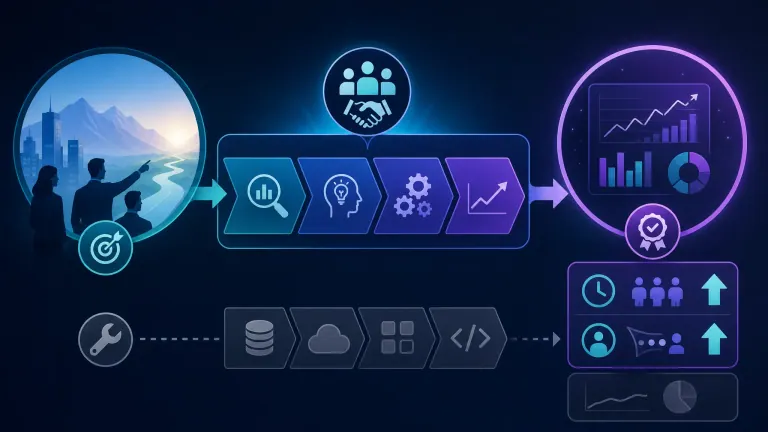
GET FREE AUDITA good AI consulting firm leads with your business outcomes, not their tools — and can point to specific, measurable results from businesses like yours. The right partner will scope a fixed, defined project (usually $5,000–$25,000 for a small or mid-size business), tie the engagement to a measurable outcome like hours saved or leads recovered, and walk away from work that isn't a good fit rather than force it.
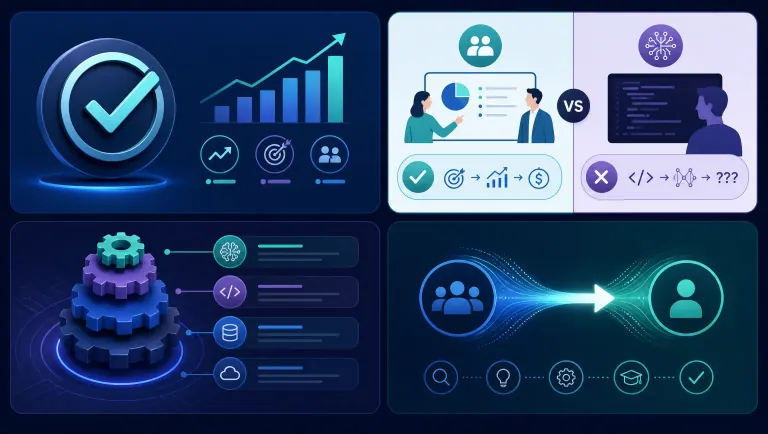
Track record over pitch deck: Ask for two or three specific case studies with numbers, not logos. Fixed scope over open-ended hours: A consultant who can't define a deliverable in the first conversation can't deliver one later. Business fluency over AI jargon: They should ask about your workflow before they mention a model. Training and handoff included: If your team can't run it without them, you haven't bought automation — you've bought a dependency. Honesty about fit: The best partners tell you when AI isn't the answer.
Most businesses that look into AI consulting never pull the trigger. Not because the technology doesn't work — because they can't tell a real partner from a pitch deck with good slides.
That hesitation is reasonable. A 2025 Gallup survey found only 22% of organizations that started adopting AI had a clear strategy behind it — most were just buying tools and hoping. Which raises the real question: what actually separates the businesses that get a working, paid-for-itself result from the ones that end up with a strategy document and nothing built?
The answer isn't "hire the biggest firm" or "hire the cheapest one." It's knowing exactly what to check before you sign anything — and that's what the rest of this guide walks through.
See how we built this for a business like yours AI Essentials scopes fixed-price automation projects for B2B businesses doing $300K+ in revenue, with a 10+ hrs/week time-savings guarantee. Book a 30-Min Walkthrough →
Table of Contents
- What Is AI Consulting?
- What to Look for in an AI Consulting Firm
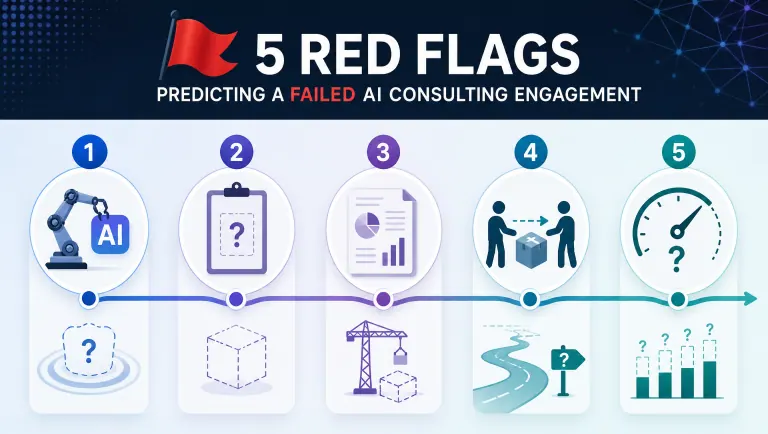
- Red Flags That Predict a Failed Engagement
- Questions to Ask Before You Sign
- What Working With a Real Partner Actually Looks Like
- Who This Is For
- Frequently Asked Questions
What Is AI Consulting?
AI consulting for small businesses is a paid engagement where an outside specialist identifies a specific manual, repetitive workflow — like lead follow-up, scheduling, or data entry — and builds an automated system to run it, typically for a fixed price and a 4–6 week timeline. It's not strategy advice or a slide deck: a real AI consulting engagement ends with something running in your business, not a report telling you what you could build.
Small businesses hire AI consultants instead of building in-house because the tooling and integration work (connecting a CRM, an inbox, and a scheduling tool into one automated flow) takes specialized setup time most teams don't have — and a fixed-price consultant absorbs that setup cost once instead of the business carrying it as an ongoing hire.
What to Look for in an AI Consulting Firm
Most AI consulting comparisons focus on credentials — years in business, team size, certifications. Those matter less than three things: can they show you a specific result, can they scope a defined deliverable, and do they understand your business before they mention a tool.
Proof, not promises. Ask for two or three case studies with real numbers — hours saved per week, leads recovered per month, response time cut from hours to minutes. A firm that can only offer "we've worked with 50+ clients" without a single specific number hasn't measured its own results, which means it won't measure yours either.
Business-first framing. Harvard Business Review has repeatedly found that AI projects fail more often from unclear business alignment than from bad models. A consultant who opens with "which AI model should we use" instead of "what's costing you the most time right now" is optimizing for the wrong problem. Deloitte's 2023 survey found 83% of high-performing companies used third-party vendors for AI — but the ones that got value picked vendors who diagnosed the workflow first.
Deep enough technical bench. You don't need a data science team, but you do need someone who can integrate with your actual stack — your CRM, your inbox, your scheduling tool — not just demo a chatbot in isolation. If a consultant can't answer a specific integration question about HubSpot or Salesforce in the first call, that's worth noting.
Training built in, not sold separately. The goal of hiring an AI consultant is to stop doing manual work — not to trade one dependency for another. A partner should train your team to run and adjust what they build, or hand off documentation clear enough that you're not calling them for every small change.
For a full breakdown of what different consultant types typically charge and why rates vary, see our guide on AI consultant pricing. If your team should have this built for you rather than evaluated on paper, we scope fixed-price projects around a specific workflow bottleneck.
Not sure which approach fits your business? Take the 2-minute AI Readiness Check and see whether a full engagement or a smaller pilot makes more sense. Check Your AI Readiness →
Red Flags That Predict a Failed Engagement
Gartner predicts that by 2025, about 30% of generative AI projects will be abandoned after proof of concept. Almost all of those failures trace back to a handful of avoidable signals that show up before the contract is signed.
They lead with the tool, not the problem. If the sales conversation starts with "we use GPT-5 and custom agents" before anyone asks what's actually broken in your business, that's a firm selling technology, not solving a problem.
No fixed deliverable. "We'll explore what AI can do for you" is not a scope. It's an open invoice. A real engagement has a named outcome: this workflow gets automated, this task drops from 3 hours to 15 minutes, this lead response time goes from a day to 5 minutes.
Strategy document, no build. Some consultants deliver a slide deck of recommendations and call it done. That's a $10,000 PDF. Ask directly: "Does this engagement end with something running in my business, or with a report?"
No mention of what happens after handoff. If training, documentation, and a support window aren't part of the conversation, you're buying a black box that breaks the day the consultant leaves.
Vague or unmeasurable success criteria. If you can't agree in the first call on what "success" looks like in a number — hours, dollars, response time — you won't be able to tell afterward whether it worked.
AI Automation vs. the Alternatives
| Approach | Typical Cost | Timeline | Ongoing Effort |
|---|---|---|---|
| Hire a full-time ops hire | $55,000–$75,000/yr salary + benefits | 6–10 weeks to hire and ramp | Manages their own output; still manual work |
| DIY with off-the-shelf tools (Zapier, Airtable) | $50–$300/mo in tool fees + your own time | 20–40 hours of setup, ongoing tinkering | High — breaks when workflows change |
| Fixed-price AI consulting project | $5,000–$25,000 one-time | 4–6 weeks | Low — built to run without you |
| Open-ended hourly AI consulting | $150–$350/hr, no cap | Undefined | Depends entirely on scope discipline |
The honest tradeoff: DIY tools are cheapest up front but cost the most in your own hours, and they tend to break quietly. A full-time hire solves headcount but not the underlying manual process — you've just added a person to run it. Fixed-price consulting front-loads cost but removes both the ongoing labor and the maintenance burden, provided the scope was defined tightly in the first place.
See how we built this for a business like yours Real project examples with hours-saved numbers, not hypotheticals. Book a 30-Min Walkthrough →
Questions to Ask Before You Sign
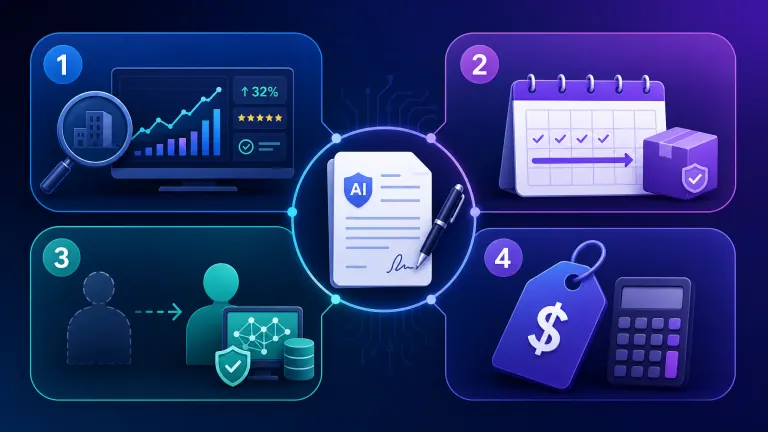
These five questions separate a consultant who can actually deliver from one who's still figuring it out on your dime.
- "Can you show me a project with a similar scope, and what was the measured result?" Not a client logo — a number.
- "What exactly gets delivered, and by when?" If the answer is vague on either the deliverable or the date, the scope isn't real yet.
- "What happens if this doesn't work the way we expect?" A confident answer here (revision process, guarantee, defined checkpoint) beats a vague "we'll figure it out."
- "Who owns this after you leave?" You want your team trained and documentation handed off — not permanent dependency on the consultant.
- "What's the fixed price, and what would make it change?" Scope creep is normal in consulting. What matters is whether the firm names the triggers for a price change up front instead of surprising you with an invoice.
A Quick ROI Gut-Check
Before you sign anything, run a rough number: if a workflow currently costs your team 10 hours a week at a blended $40/hr rate, that's $20,800/year in labor. A $12,000 fixed-price automation project that eliminates 8 of those hours pays for itself in about 7 months and keeps saving after that. Our free AI ROI calculator does this math for your specific numbers in under two minutes, and our guide on calculating AI automation ROI walks through the full method if you want to build the case internally first.
Not sure which approach fits your business? Take the 2-minute AI Readiness Check before you take a sales call. Check Your AI Readiness →
What Working With a Real Partner Actually Looks Like
A real engagement follows a predictable shape: a short discovery call to find the highest-cost manual workflow, a fixed quote tied to that specific outcome, a 4–6 week build, and a handoff that includes training and documentation — not a support ticket queue you're stuck in forever.
Compare that to the failure pattern Gartner's data points to: broad "AI strategy" engagements with no single defined workflow, month after month of hourly billing, and a deliverable that's a slide deck instead of something running. The difference isn't the technology — it's scope discipline.
If you're earlier in the process and just trying to figure out whether AI is even worth pursuing yet, our AI automation for B2B businesses page is a lower-commitment starting point than a sales call.
See how we built this for a business like yours Book a 30-minute walkthrough — we'll show you a real project, not a slide deck. Book a 30-Min Walkthrough →
Who This Is For
This is ideal for:
- B2B business owners or operators (roughly 5–200 staff) with a manual, repetitive process costing real time or money
- Teams that have already tried DIY tools like Zapier and found them break or need constant babysitting
- Businesses that want a defined, priced project — not an open-ended retainer
Consider alternatives if:
- Your process changes so often that a fixed automation would be outdated within weeks — a flexible internal hire may fit better
- You're pre-revenue or testing an idea with no established workflow yet to automate
- You want to learn to build AI systems yourself as a skill, not outsource the outcome
Why AI Essentials specifically? We scope every project as a fixed price tied to a measurable outcome — typically $10,000–$15,000 for a 4–6 week build — with a guarantee of 10+ hours saved per week or your money back. We turn away projects that aren't a good automation fit rather than force a bad scope.
Frequently Asked Questions
What should I look for when choosing an AI consulting firm?
Look for a firm that leads with your business problem, not their tools; can show specific measured results from past projects; scopes a fixed deliverable with a defined date; and includes training so your team isn't dependent on them after handoff.
How much does an AI consulting engagement typically cost?
Most small and mid-size businesses pay $5,000–$25,000 for a fixed-price project, or $150–$350/hr for hourly work. A full breakdown by consultant type is in our AI consultant pricing guide.
What's the difference between an AI consultant and a freelance developer?
A freelance developer typically builds to spec on your instructions. An AI consultant diagnoses which workflow to automate in the first place, then builds and trains your team on it — the scoping work is part of what you're paying for.
Should I hire an AI consultant or do it myself with tools like Zapier?
DIY tools work for simple, stable workflows and cost very little up front, but they take 20–40 hours of your own time to set up and tend to break when your process changes. A consultant costs more up front but removes both the setup time and the ongoing maintenance.
How long does a typical AI consulting project take?
Most fixed-scope automation projects run 4–6 weeks from kickoff to a working, trained handoff. Broader "AI strategy" engagements without a defined deliverable can run indefinitely — which is itself a red flag.
What are common mistakes businesses make when hiring an AI consultant?
The most common mistake is signing an open-ended hourly engagement with no fixed deliverable. Others include picking a firm based on team size instead of measured results, and skipping the question of who owns the system after the consultant leaves.
Are there real-world case studies of AI consulting working for small businesses?
Yes — results vary by workflow, but common outcomes include cutting lead response time from hours to minutes and eliminating 8–10 hours a week of manual data entry or follow-up. Ask any firm you're evaluating for specific numbers from a comparable project.
When is it the right time to hire an AI consulting firm?
It's the right time when you can name a specific, recurring manual task that's costing measurable time or money, and you've confirmed it's stable enough not to change dramatically in the next few months. Vague interest in "doing something with AI" is a sign you're not ready to hire yet — you're ready to define the problem first.
Does AI consulting work the same way across industries?
The evaluation criteria don't change by industry — proof, fixed scope, and training apply everywhere. What changes is the specific workflow: agencies often automate lead qualification and reporting, service businesses automate scheduling and follow-up, and B2B sales teams automate outbound and CRM data entry.
What data governance or security questions should I ask an AI consulting firm?
Ask where your data is processed and stored, whether it's used to train any third-party model, who has access during and after the project, and what happens to your data and access credentials once the engagement ends.
Conclusion
Choosing an AI consulting firm comes down to three checks: can they prove a specific result, will they commit to a fixed deliverable and date, and do they hand off something your team can run without them. Skip any firm that fails even one of those.
If you've got a manual process you're ready to fix, book a 30-minute walkthrough — we'll show you exactly what we'd build and what it would cost, no strategy deck required.

Iliyan Ivanov
Founder of AIessentials · AI automation consultant helping B2B businesses save 20+ hours/week and grow without hiring