Best After-Hours Answering Systems for Law Firms, Compared
[ SUMMARIZE WITH AI ]
The best after-hours answering service for most solo and small law firms is Answering Legal, Smith.ai, or Ruby if you want a recurring subscription with no setup work — but the option that actually costs less over time for firms getting a steady flow of after-hours calls is usually a one-time-build AI intake system, since subscriptions run $79-$650+ every single month forever while a built system runs $300-$4,200 once plus $50-$300/month. Every comparison of these services stops at "which vendor is cheapest per month" — the more useful question is which structure costs less over the 24-36 months you'll actually be using it.
The three things that determine your answer:
- Call volume: a flat-fee subscription is fine at low volume; at higher volume the per-minute overages on most plans add up fast
- Time horizon: a subscription is cheaper in month one, a built system is usually cheaper by month 12-18
- What you need answered: general reception is different from legal-specific intake — screening, conflict checks, and routing questions before a human gets involved
A free Lead-to-Consult System Map shows which structure actually costs less for your firm's real call volume, not a generic assumption.
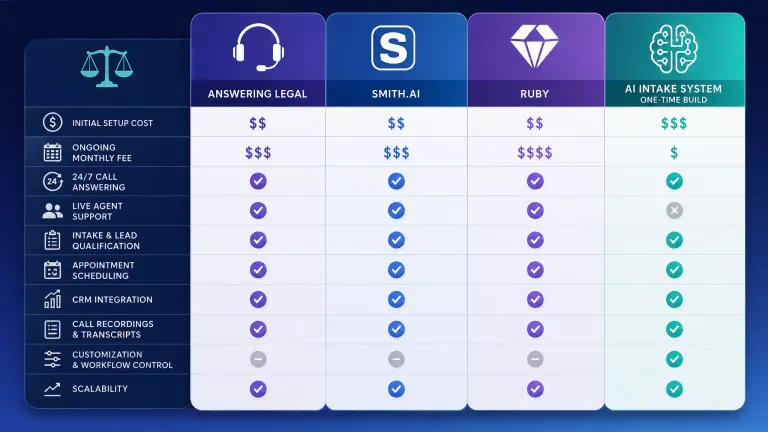
How this comparison was built: the three highest-ranking articles on this exact query (Bland AI's 12-service roundup, MyCase's 4-service comparison, and Nextiva's answering-service guide) each list vendors and per-month pricing, but none of them puts the total 3-year cost of a subscription next to the cost of building your own AI intake system, none runs a breakeven calculation by call volume, and none quantifies what a missed after-hours call actually costs in lost case value. That's the gap this page fills — not a longer vendor list, but the comparison none of them make.
Table of Contents
- The Two Structures You're Actually Choosing Between
- Subscription Answering Services, Compared
- The Real Cost Comparison: Subscription vs. Built System
- Which One Fits Your Firm
- What Neither Option Fixes
- Frequently Asked Questions
The Two Structures You're Actually Choosing Between
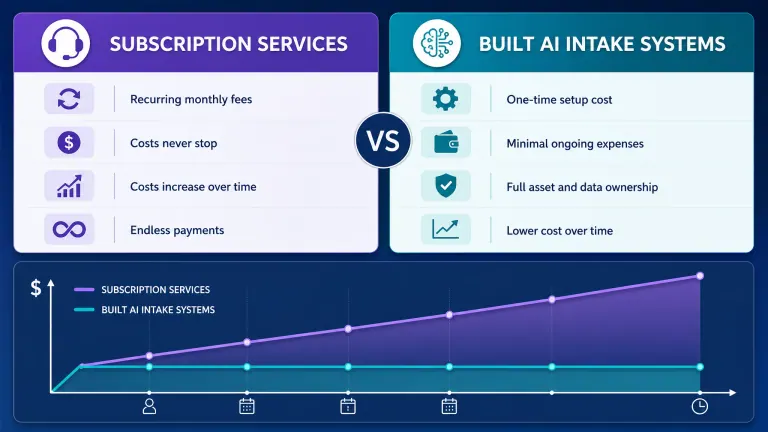
Every "best answering service" list compares vendors against each other — Answering Legal versus Smith.ai versus Ruby — as if the only decision is which subscription to pick. That's one real option. The other, rarely put on the same page, is a built AI intake system: a one-time setup that answers, screens, and routes after-hours calls without a recurring per-agent or per-minute bill.
Both solve the same problem — a call comes in at 9pm and someone (or something) needs to answer it, ask the right questions, and get it in front of the firm by morning. They just have different cost shapes: a subscription is a small monthly number that repeats forever, a build is a bigger one-time number that shrinks to almost nothing afterward.
How AIessentials helps here: the free mapping call runs both structures against your actual after-hours call volume so you see which one is genuinely cheaper for your firm, not which one has better marketing.
Not sure which structure fits your call volume? We run the real numbers before you commit to either one. Book a Free Intake Mapping Call →
Subscription Answering Services, Compared
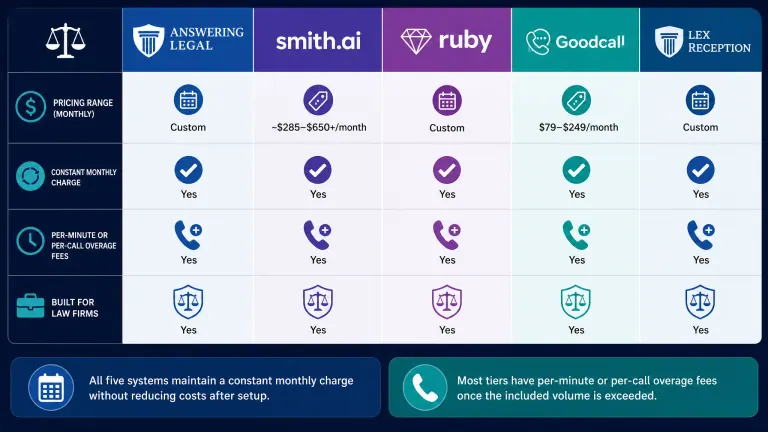
These are the services that show up across every roundup of this query, with real pricing where publishers list it:
| Service | Starting price | Structure | Best fit |
|---|---|---|---|
| Answering Legal | Quote-based | 24/7 U.S.-based legal-specific receptionists | Firms wanting a legal-trained human on every call |
| Smith.ai | ~$285-$650+/month | AI-first, escalates to human receptionists | Firms wanting structured intake workflows |
| Ruby | Quote-based | Live receptionists, add-on services | Solo/small firms wanting a simple live answer |
| Goodcall | $79-$249/month | AI voice agent, flat per-agent pricing | Firms wanting unlimited minutes without overage risk |
| LEX Reception | Quote-based | Live reception, inbound/outbound | Firms needing outbound follow-up too |
What all five have in common: the bill doesn't shrink once your system is set up — it's the same monthly charge in year three as it was in month one, and most tiers add per-minute or per-call overage once you exceed the included volume.
The Real Cost Comparison: Subscription vs. Built System
Run the actual math instead of comparing sticker prices:
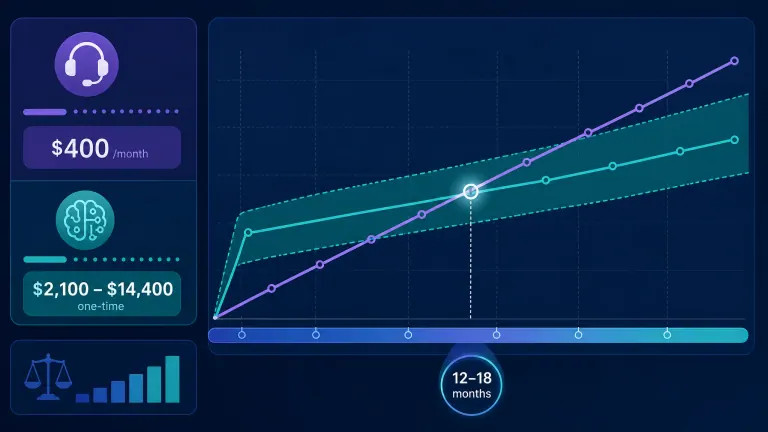
Subscription path (Smith.ai as a mid-range example): $400/month average once you account for typical overage → $14,400 over 3 years, and the bill is identical in year three.
Built AI intake system: a full system runs $300-$4,200 one-time plus $50-$300/month → roughly $2,100-$14,400 over 3 years depending on tier, but the low and mid tiers land well under the subscription total, and even the top tier is a wash rather than a loss.
Where the subscription wins: month one, and any firm not sure yet whether after-hours volume justifies a permanent fix — a subscription has no setup cost and can be cancelled anytime.
Where the build wins: any firm already confident it wants after-hours coverage long-term, since the monthly cost after setup ($50-$300) is a fraction of even the cheapest subscription tier, and the gap compounds every month you keep it.
How AIessentials helps here: the mapping call calculates this crossover point using your real call volume and expected timeline, so you're comparing your actual numbers, not a generic 3-year estimate.
Want your specific crossover point? We calculate exactly when a built system beats your current or considered subscription. Get My Free Lead-to-Consult System Map →
Which One Fits Your Firm
A subscription answering service fits if:
- You're not yet sure how much after-hours volume you actually get, and want to test the value before committing to a build
- You want a live human voice on every call regardless of cost, particularly for high-stakes practice areas (criminal defense, family law)
- You need outbound calling or callback follow-up, not just inbound answering
A built AI intake system fits if:
- You already know after-hours calls are a regular occurrence, not an edge case
- You've compared whether automation is worth it for your volume and cleared the 15-20 inquiries/month threshold
- You want the intake logic — screening questions, conflict flags, routing rules — built around your specific practice, not a generic script a receptionist reads from
This mirrors the build-your-own-process guidance in how to automate client intake without hiring more staff — the same "start with what's actually missed" logic applies whether you're choosing a subscription or a build.
What Neither Option Fixes
Neither a subscription answering service nor a built intake system fixes a firm that isn't generating enough after-hours calls to begin with. If your website and referral traffic aren't producing inquiries outside business hours, the fix is marketing, not answering infrastructure — paying $400/month or $4,200 upfront to answer calls that aren't coming in yet is money spent on the wrong problem.
How AIessentials helps here: the mapping call checks your actual after-hours call pattern first, so you're not solving a volume problem with an answering-infrastructure budget.
Frequently Asked Questions
What is the best after-hours answering service for a small law firm?
For most solo and small firms, Answering Legal, Smith.ai, and Ruby are the most commonly recommended subscription options — but if your firm already has steady after-hours call volume, a built AI intake system usually costs less over 2-3 years than any of them.
Is a subscription answering service cheaper than building an AI intake system?
Only in the short term. A subscription has no setup cost, so it wins in month one. Past roughly the 12-18 month mark, a built system's lower ongoing cost ($50-$300/month versus $79-$650+/month) typically overtakes the subscription's total spend.
How much do law firm answering services cost per month?
Published pricing ranges from about $79/month (Goodcall, flat-rate) to $650+/month (Smith.ai, higher tiers), with several providers (Answering Legal, Ruby, LEX Reception) requiring a custom quote based on call volume.
Should I get a live receptionist or an AI answering system?
A live receptionist costs more per month but handles nuanced or emotionally sensitive calls (family law, criminal defense) with a human voice. An AI system costs less to run long-term and works well for structured intake — screening, scheduling, and routing — once the questions are predictable.
When does a built AI intake system pay off compared to a subscription?
Most firms see the crossover between 12 and 18 months, depending on which subscription tier they'd otherwise pay for and which build tier fits their needs — a free mapping call can calculate the exact month for your specific numbers.
Conclusion
The "best" after-hours answering service depends on a question none of the standard roundups ask: are you paying for this once or paying for it forever? Subscriptions win on simplicity and no setup cost. A built AI intake system wins on total cost once your firm has enough steady after-hours volume to justify it — usually somewhere between 12 and 18 months in.
The three things to take from this post:
- Comparing vendors is only half the decision — comparing subscription-forever versus build-once is the other half
- A subscription is cheaper in month one; a built system is usually cheaper by month 12-18
- Neither option matters if after-hours calls aren't coming in yet — fix lead volume first
Ready to see which structure actually costs less for your firm? Get a free Lead-to-Consult System Map comparing your real call volume against both options. Get My Free Lead-to-Consult System Map →
Workflow Audit
]99% sure you are not seeing all the spots AI can help you in your business.
Are your workflows optimized with the most up to date solution, or are they costing you and your team time and money?
GET FREE AUDIT
Iliyan Ivanov
Founder of AIessentials · AI automation consultant helping B2B businesses save 20+ hours/week and grow without hiring