Where Should Small B2B Businesses Start with AI Automation?
[ SUMMARIZE WITH AI ]
Artificial intelligence (AI) and business automation are transforming how companies manage customers, coordinate employees, and make decisions. Once considered enterprise-level investments, these technologies are now accessible to small and medium-sized businesses through affordable software, cloud platforms, and custom development.
However, adopting technology without clear objectives can increase costs and complexity. Small businesses often have limited budgets and smaller teams, making it important to choose solutions that address genuine operational challenges.
Three key areas offer opportunities for automation: customer retention, operational efficiency, and customer engagement. Loyalty applications, field management software, and AI-powered visualization tools can help businesses improve these areas and support sustainable growth.
This guide explores how these solutions work, which options businesses can consider, their estimated costs, and how to measure return on investment (ROI).
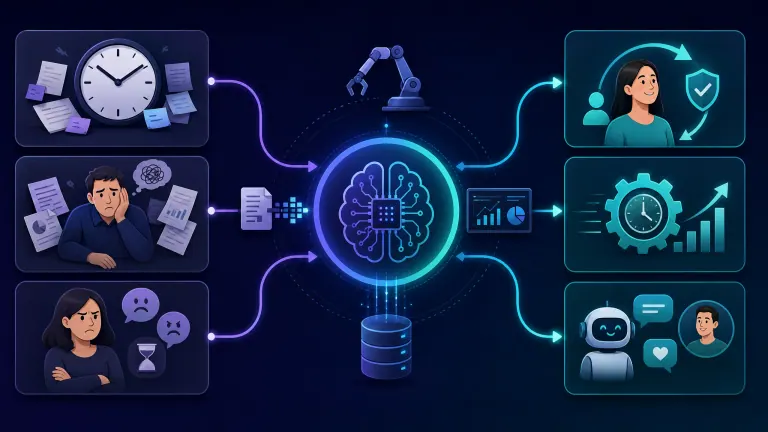
Before investing in automation software, business owners should identify the processes that consume the most time and resources.
Some businesses struggle to generate repeat purchases, while others spend too much time managing employees, scheduling appointments, tracking jobs, and updating customers. Companies offering design or visual services may also find it challenging to communicate proposed outcomes clearly.
A practical assessment should consider three questions:
- Which repetitive activities consume the most employee time?
- Where do customers experience delays or inconsistent communication?
- Which business decisions are difficult because information is scattered or outcomes are unclear?
The answers will help determine whether to prioritize customer loyalty, field operations, or AI visualization. Understanding AI strategy consulting can help businesses identify opportunities that deliver measurable value.
Importantly, not every automation project requires advanced AI. Automated notifications, scheduling rules, reward calculations, and workflow triggers can deliver considerable value without complex AI models.
The best solution is the one that solves a genuine business problem efficiently.
2. Strengthen Customer Relationships with Loyalty App Development
Acquiring new customers requires time, marketing, and sales effort. Retaining existing customers supports sustainable growth, especially for businesses relying on repeat purchases, subscriptions, or ongoing services.
Digital loyalty apps help businesses strengthen customer relationships through membership benefits, rewards, personalized offers, and targeted communication.
Common loyalty application features include:
- Customer registration and membership management.
- Reward point calculations and redemption.
- Automated promotional notifications.
- Purchase history and engagement tracking.
- Customer segmentation and targeted campaigns.
- Loyalty programme performance reporting.
For example, a multi-location retail business can use a loyalty application to recognize returning customers and provide relevant offers. A B2B supplier can introduce membership benefits or volume-based rewards to encourage repeat orders.
Businesses with standard requirements can consider established platforms such as Smile.io and Yotpo. However, companies requiring specific branding, integrations, or customized reward structures may benefit from custom loyalty app development.
Development providers such as LoyaltyPass and LoyaltyPlus offer relevant solutions in this area. LoyaltyPass focuses on developing digital loyalty programmes around brand requirements, while LoyaltyPlus provides loyalty programme design, implementation, management, and custom software development.
AI can further improve loyalty programmes by analysing customer behaviour, identifying purchasing patterns, and supporting personalized recommendations. However, reliable customer data and a clear engagement strategy should come before advanced personalization.
3. Improve Service Delivery with Field Management Software
Plumbing, electrical, HVAC, and other home service businesses often struggle to coordinate technicians, manage appointments, and track daily jobs as workloads grow.
Many still rely on spreadsheets, phone calls, and messaging apps, which can lead to scheduling conflicts, scattered information, and delayed updates.
Field service management software helps address these challenges by centralizing technician scheduling, job assignments, work order tracking, and customer communication.
Its common features include:
- Employee scheduling and job allocation.
- Work order and assignment tracking.
- Route planning and location coordination.
- Digital forms, checklists, and service reports.
- Customer appointment notifications.
- Invoicing and payment management.
- Workforce performance monitoring.
Several platforms offer solutions for different operational requirements.
Praxedo supports scheduling, dispatching, technician coordination, and work order tracking. Jobber provides tools for managing quotes, appointments, jobs, and payments. ServiceTitan offers a broader operational platform for service businesses, including dispatching, technician management, customer communication, and reporting.
StrikeHoney takes a more focused approach for Canadian trades and service professionals, combining leads, quotes, job management, invoicing, and payments.
The right choice depends on team size, industry, operational complexity, and budget. Small contractors may need a simple mobile-first application, while larger companies may require advanced scheduling and integrations.
AI can further improve efficiency through schedule optimization, route recommendations, demand forecasting, and automated information processing. Intelligent scheduling, for example, can consider employee availability, job requirements, and travel distances when assigning tasks.
By centralizing information, businesses can reduce coordination delays, improve service consistency, and provide customers with timely updates.
4. Improve Customer Decisions with AI Visualization Software
Customers sometimes struggle to understand a product, design, or service when they cannot visualize the expected outcome. Traditional descriptions and reference images may not communicate a proposed transformation clearly.
AI-powered visualization software addresses this challenge by generating visual previews of potential results.
For example, an interior design company can demonstrate how a room might look after renovation. A dental practice can present a visual preview of a proposed smile transformation, while a landscaping business can show customers how their outdoor space might look after redesign.
These experiences make consultations more engaging and help customers evaluate proposals with greater confidence.
Depending on the industry, AI visualization software can include:
- AI-generated before-and-after previews.
- Image processing and visual transformations.
- Interactive product and design visualization.
- Integration with business applications and workflows.
Companies such as Lumi AI, Makeover, and DataVision provide relevant examples in AI software development and visual technology.
Lumi AI offers AI products and software services, including AI integration into existing applications. Makeover focuses on industry-specific AI visualization software that generates before-and-after previews. DataVision specializes in computer vision, visual AI, image processing, and custom software solutions.
For small businesses, the value extends beyond producing attractive images. These tools can simplify complex explanations, improve customer consultations, reduce uncertainty, and support purchasing decisions.
5. How These Three Solutions Work Together
Loyalty applications, field management systems, and AI visualization tools serve different purposes but can work together to improve business operations.
For example, a home improvement company needs to attract customers, prepare proposals, coordinate employees, complete projects, and encourage repeat bookings. Each technology supports a different stage of this process:
- Customer engagement through loyalty applications
- Service coordination through field management software
- Customer confidence through AI visualization
Connecting these systems can reveal useful insights, such as whether visual previews improve proposal approvals or which services generate more repeat bookings.
Gradual integration helps businesses better understand customer preferences and improve operational performance.
6. How Much Does Business Automation Cost?
Cost is an important consideration for small businesses. However, there is no universal price for automation or custom software development. Expenses depend on application complexity, integrations, security requirements, user numbers, and customization.
The following figures are indicative planning estimates rather than fixed vendor quotations.
| Software or service | Approximate cost |
|---|---|
| Basic workflow automation tools | 10- 100/month |
| CRM and customer engagement software | 20- 300/month |
| Custom loyalty application development | 2000- 15,000+ |
| Field management software subscriptions | 30- 300+ per user/month |
| Custom field management development | 5000- 30,000+ |
| AI visualization software development | 5000- 40,000+ |
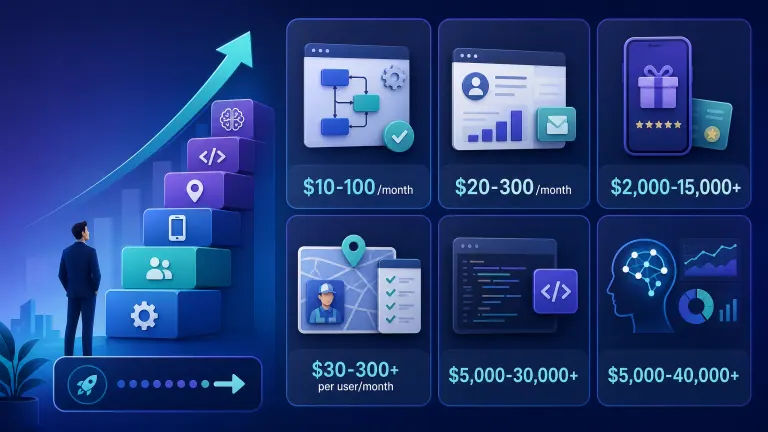
Costs vary depending on project requirements. Basic loyalty apps are generally cheaper than customized platforms, while field management systems with GPS tracking and automated dispatching require greater investment.
Businesses should also consider ongoing expenses such as hosting, maintenance, and technical support.
Starting with essential features and expanding as needs grow helps keep costs manageable.
7. How to Measure the ROI of Automation
The purpose of adopting new software should be measurable business improvement. Return on investment helps determine whether an implementation justifies its cost.
The commonly used formula is:
ROI = (Financial Benefits − Total Investment) ÷ Total Investment × 100
Consider a small service company that spends 20 employee hours every week on administrative activities such as appointment coordination, customer updates, and report preparation.
After introducing automation, the company reduces this workload by 10 hours weekly.
Assuming an employee cost of $20 per hour:
- Weekly time saved: 10 hours.
- Weekly value of time saved: $200.
- Annual value: approximately $10,400.
If the initial implementation costs $4,000, the illustrative first-year ROI is 160%, before additional running expenses.
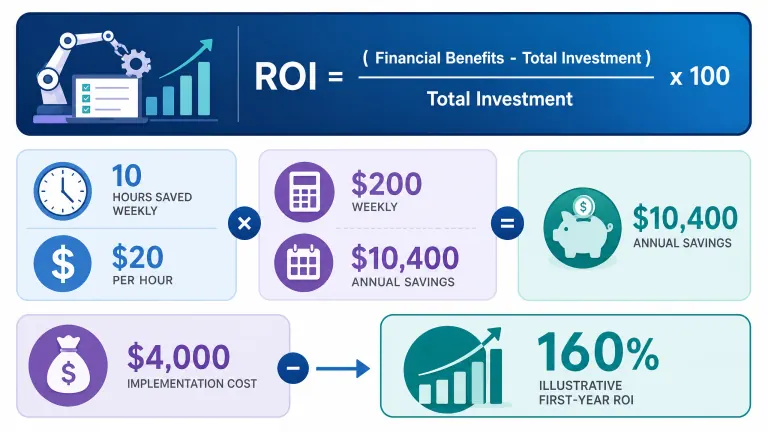
This calculation assumes the saved time can be used productively or helps avoid additional hiring.
Businesses should track relevant metrics such as customer retention, job completion time, scheduling efficiency, and proposal conversion rates to evaluate each solution's impact.
8. A Practical Roadmap for Getting Started
Adopting multiple technologies simultaneously can overwhelm smaller teams. A phased implementation strategy is generally more effective.
Step 1: Identify the biggest bottleneck: Determine whether customer retention, operational efficiency, or customer engagement needs improvement.
Step 2: Select one high-impact solution: Focus on the most pressing business problem rather than unnecessary features.
Step 3: Compare existing platforms and custom development: Evaluate integration requirements, scalability, security, usability and total ownership costs.
Step 4: Introduce a pilot project.: Test the solution with one team, location, or customer segment.
Step 5: Measure performance: Track time savings, customer engagement, and operational improvements.
Step 6: Expand gradually: Once the first solution demonstrates measurable value, consider connecting additional applications and automating other processes.
This approach helps businesses control costs while building technology systems that can grow with their operations.
Conclusion
AI automation is not about purchasing the most advanced software available. It is about identifying where technology can make a meaningful difference to everyday business activities.
For small B2B businesses, customer retention, operational efficiency, and customer decision-making are three important areas to consider. Loyalty applications strengthen customer relationships, field management software improves service coordination, and AI visualization solutions help customers understand proposed outcomes.
Not every business needs all three technologies immediately. The right starting point is to identify one recurring problem, choose an appropriate solution, and measure its impact before making further investments.
As businesses grow, integrating these systems and exploring AI automation solutions for B2B businesses can help streamline workflows, reduce repetitive tasks, and improve operational performance.
Ultimately, the goal is to build a more efficient business that serves customers better, makes informed decisions, and supports sustainable growth without continually increasing administrative workloads.
Find where AI fits in your business.
Every day your team doesn't use AI, your competitors pull further ahead. We look at your team's day-to-day work and show you the AI wins they can start using from day one.
Book a Free Intro30 minutes. No pitch, no contracts.

Iliyan Ivanov
Founder of AIessentials · AI automation consultant helping B2B businesses save 20+ hours/week and grow without hiring