What Is an AI SDR and How Does It Work?
[ SUMMARIZE WITH AI ]
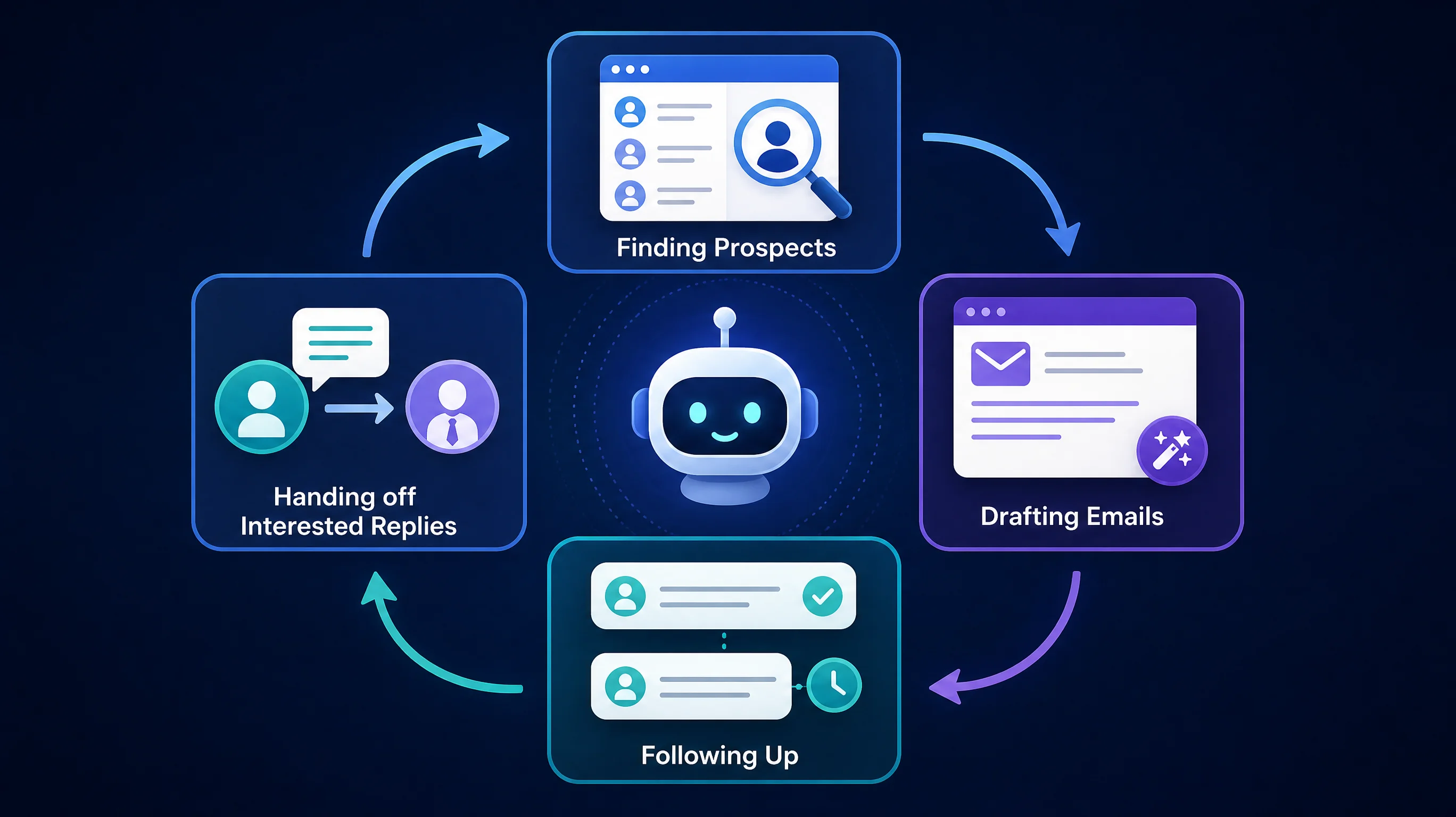
An AI SDR is software that does the early-stage work of a sales development rep: it finds prospects, researches them, writes a first message, follows up, and hands interested replies to a human to close. It works as a repeating loop of data lookup, drafting and sending, and reply sorting, running on a sequencer and an email domain you control. It does not close deals, and it only performs as well as the list and offer you give it.
Prospecting: It builds a list from filters such as industry, headcount and job title, then pulls emails from data providers.
Research: It reads each prospect's site, LinkedIn or news for one usable detail to mention.
Drafting: A language model writes the first email and each follow-up from that detail and your offer.
Sending and follow-up: A sequencer sends from your inboxes on a schedule and stops when someone replies.
Reply handling: It sorts replies into interested, not now, and unsubscribe, then books a meeting or alerts a human.
If your outbound runs on one person's spare hours, the limit isn't talent. It's that a day only has so many hours, and most of them go to list-building and copy-pasting rather than talking to buyers.
That's the problem an AI SDR goes after. It takes the repeatable 80% of outbound off one person's plate so they can spend their time on the replies. This guide explains what's inside one, where it breaks, what it takes to run one safely, and whether you should buy a platform, build your own, or skip it. If you want the price side, we cover that separately in How Much Does an AI SDR Cost in 2026?. This post is about how the thing works.
Table of Contents
- The five parts of an AI SDR
- AI SDR vs human SDR vs plain automation
- Where an AI SDR breaks
- What it changes in a real week
- Who This Is For
- Frequently Asked Questions
- Conclusion
The five parts of an AI SDR
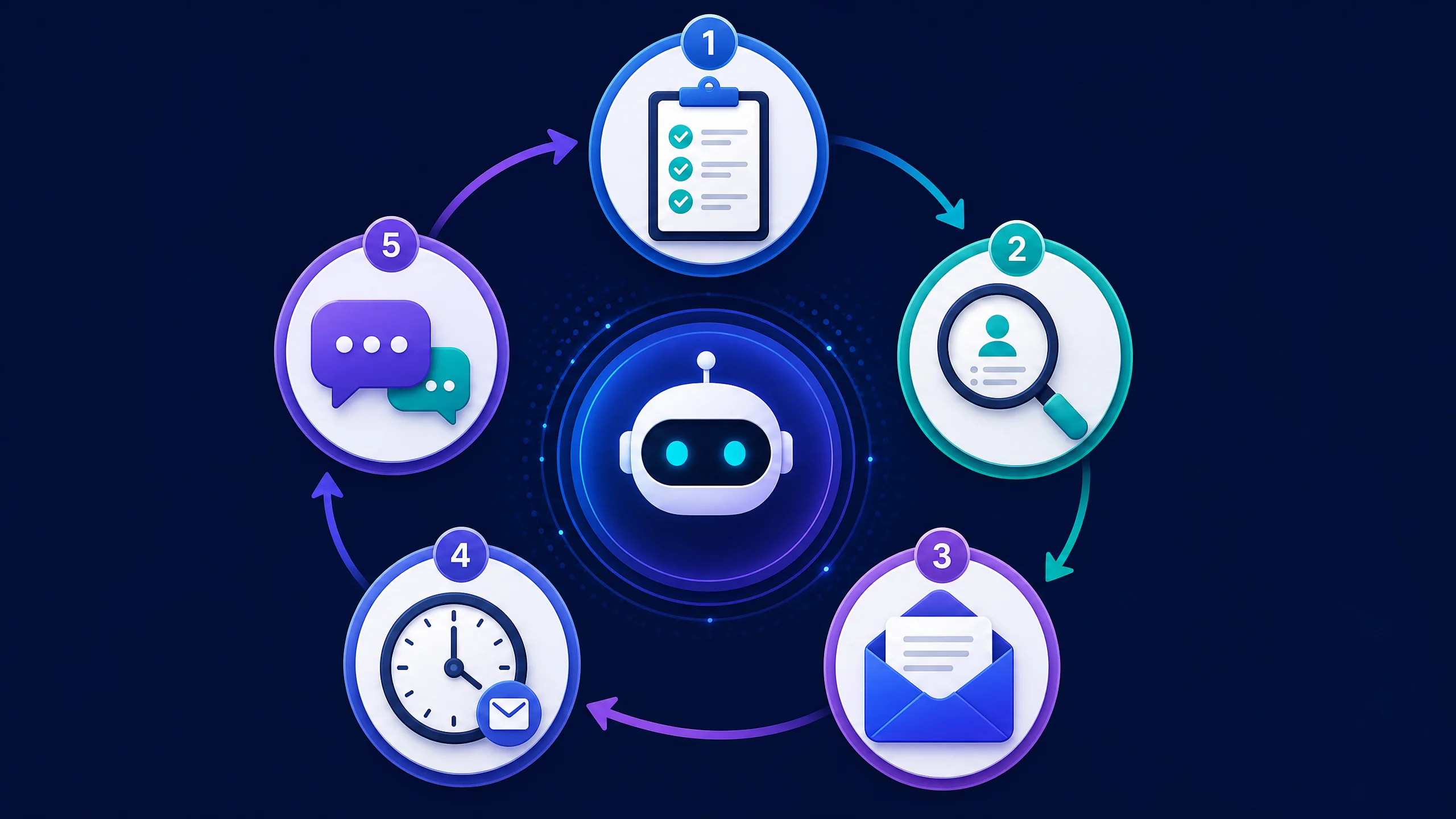
Every AI SDR, whether it's a $50 DIY stack or a $3,750-a-month platform, is the same five parts wired together. Vendors bundle them differently. The parts don't change.
1. A target list
Everything starts with who you contact. The AI SDR takes your filters (say, US logistics firms with 20 to 200 staff, owner or operations lead) and pulls matching contacts from a database. Then it verifies each email so you don't bounce your way to a damaged domain.
This is the step most people underestimate. A weak list produces weak results no matter how good the writing is.
2. Research
For each contact, the system looks for something real to say: a recent hire, a new location, a post, a pricing page change. Better tools read the company's website; cheaper ones only use fields from the database.
3. Drafting
A language model combines the research with your offer and writes the email. The best setups keep the offer fixed and let the AI vary only the opening line. That keeps messages on-brand and avoids invented claims.
4. Sending and follow-up
A sequencer sends from your inboxes, spaces the emails out, and stops the sequence when someone replies. Typical sequences run three to four touches over two weeks. We compare the common sequencers in Best Software for Cold Emailing in 2026.
5. Reply handling
When replies come in, the system tags them. "Yes, send details" goes to a human or a booking link. "Not now" gets scheduled for later. "Remove me" is suppressed immediately. This last part matters legally, which we get to below.
AI SDR vs human SDR vs plain automation
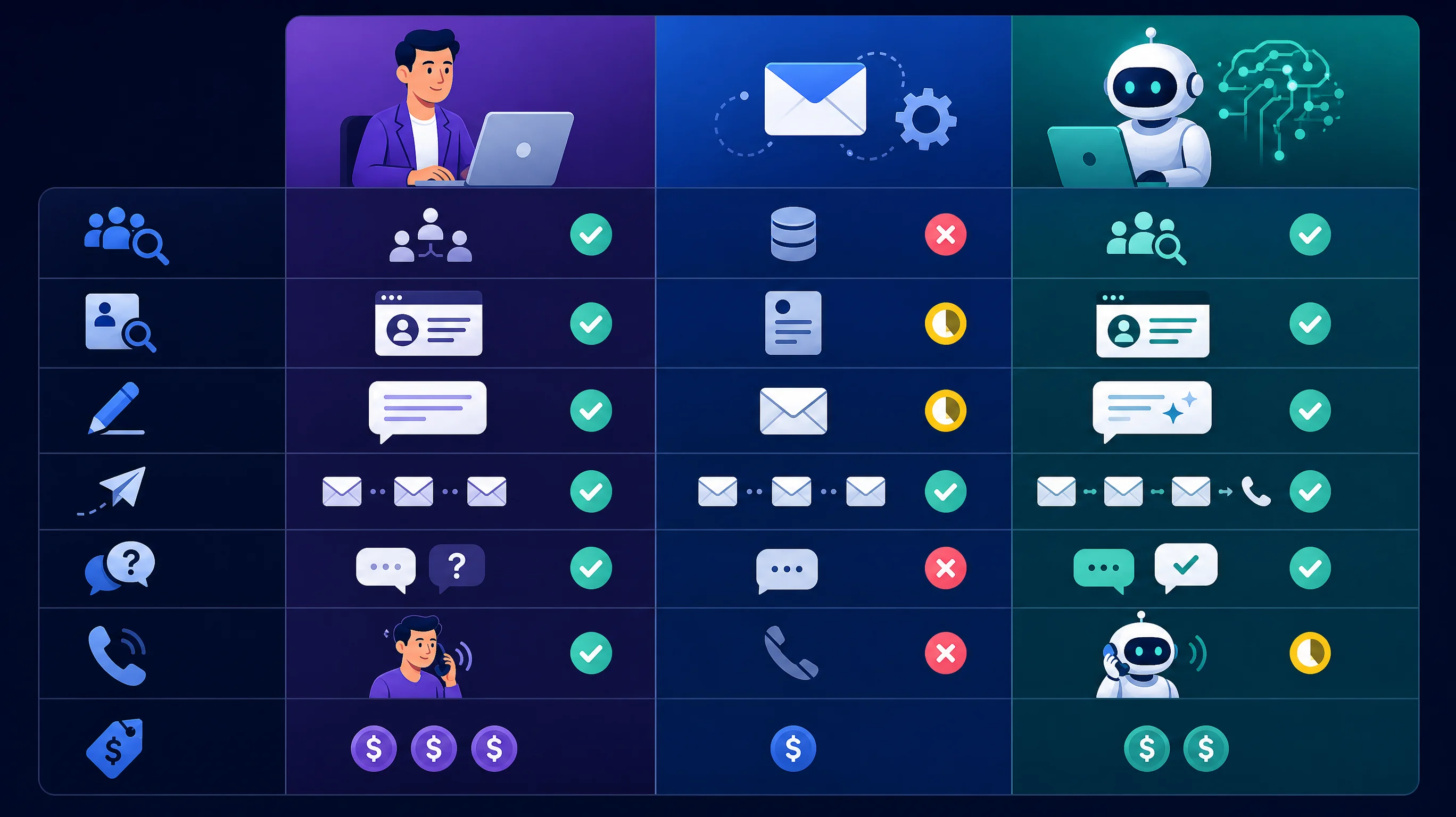
People use "AI SDR" for three different things, which is why vendor claims are hard to compare. Here is how they differ.
| Human SDR | Plain email automation | AI SDR | |
|---|---|---|---|
| Builds the list | Yes, slowly | No | Yes |
| Researches each prospect | Yes, 5 to 10 min each | No | Yes, in seconds |
| Writes the message | Yes | Template only | Yes, drafted per contact |
| Follows up | Yes, if they remember | Yes, fixed schedule | Yes, adjusts on replies |
| Handles a tricky reply | Yes | No | Poorly |
| Builds trust on a call | Yes | No | No |
| Typical cost | About $80,000 a year median pay | $50 to $400 a month | $600 to $3,750 a month for platforms |
Sources for the human figure: the Bridge Group's 2025 SDR report puts median SDR on-target earnings at $80,000, with average tenure of 1.9 years and a 3.0-month ramp. That means about three months of ramp before a new hire is fully productive, and a replacement search roughly every two years.
The same report says only 60% of SDRs hit quota, the lowest in the study's history. That's worth remembering when you compare an AI SDR to a human one. The bar isn't perfection. It's whether the system produces more qualified conversations per dollar than the alternative you'd realistically hire.
Where an AI SDR breaks
Vendors will tell you what an AI SDR can do. This is what goes wrong, and it is almost always one of these.
Bad data in, bad email out. If the database says someone is "VP Sales" at a company they left eight months ago, the AI will cheerfully write them a personalized email. Verification catches dead addresses but not stale job titles.
Deliverability. This is the one that ends campaigns. Google's email sender guidelines say to keep spam rates in Postmaster Tools below 0.10% and avoid ever reaching 0.30%. Senders of more than 5,000 messages a day to Gmail also need SPF, DKIM and DMARC authentication and one-click unsubscribe. A system that blasts a thousand mediocre emails a day can push a new domain past those limits within weeks, and then even your real replies land in spam.
Made-up details. A language model can state something false about a prospect with total confidence. If your emails say "congrats on the Series B" and there was no Series B, you lose the reply and the reputation. Good setups restrict the AI to facts pulled from a source.
Compliance. In the US, the FTC's CAN-SPAM guide requires accurate headers and subject lines, a physical postal address, a clear opt-out, and honoring opt-outs within 10 business days. It also says you can't contract away responsibility, so if a vendor sends on your behalf, you're still liable. Penalties run up to $53,088 per email according to the FTC page. This guide is general information, not legal advice.
Reply handling. Straightforward replies are fine. A prospect who writes "we tried something like this last year and it was a mess" needs a person.
What it changes in a real week
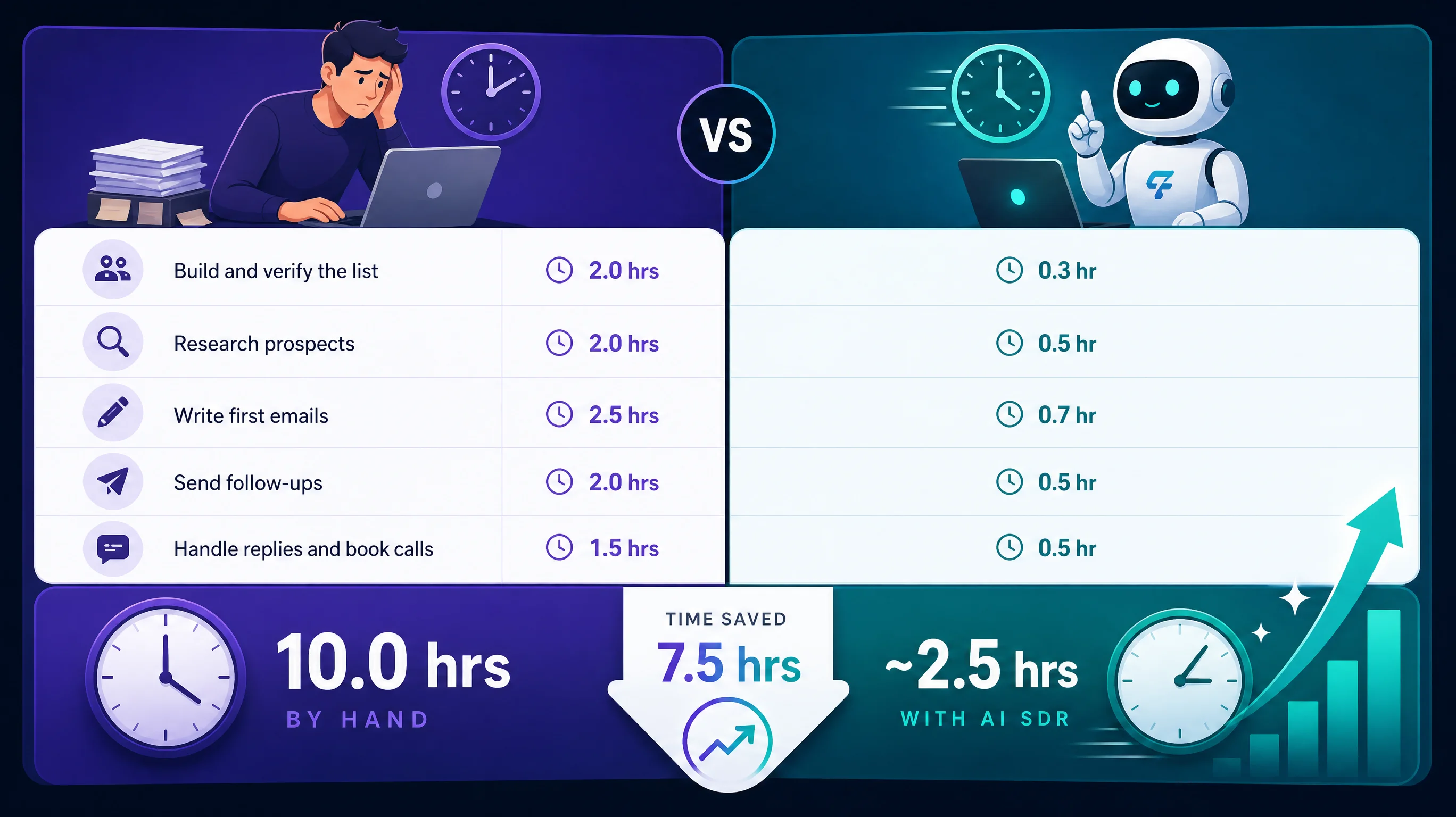
Here is an illustrative before-and-after for a founder who runs outbound alone for about 10 hours a week. These are planning estimates, not measured results.
| Task | Founder, by hand | With an AI SDR (founder's time) |
|---|---|---|
| Build and verify the list | 3 hrs | 0.5 hr (review) |
| Research prospects | 3 hrs | 0 hrs |
| Write first emails | 2 hrs | 0.5 hr (approve the offer and angles) |
| Send follow-ups | 1.5 hrs | 0 hrs |
| Handle replies and book calls | 0.5 hr | 1.5 hrs (more volume) |
| Total | 10 hrs | About 2.5 hrs |
The point isn't that you save 7.5 hours. It's that the hours that remain are the ones that need you, and the reply row gets bigger because the system reaches more people. If replies pile up unanswered, you've just moved the bottleneck.
How we'd build it
When we scope one of these at AIessentials (aiessentials.us), the first thing we check is whether the offer is clear enough to survive a cold email, because no tool fixes a vague offer. After that the build is: a lead source with verified emails, a research step that only records facts it can link to, a fixed-offer template where the AI varies the opener, a sequencer on separate sending domains, and a reply classifier that routes "interested" to you the same day. If you want to see the whole workflow laid out, how to build an automated lead pipeline walks through it step by step.
Build, buy, or have it built
| Route | Typical cost | You handle |
|---|---|---|
| DIY (sequencer plus AI tools) | $50 to $400 a month | Everything: list, offer, inboxes, replies |
| AI SDR platform | $600 to $3,750 a month, often billed annually | Targeting, tuning, inbox setup |
| Built for you | Our 24/7 Pipeline Engine is $2,579 setup plus $325 a month | Approving the offer and taking the meetings |
None of these is always right. DIY is cheapest if you have the time and some technical comfort. A platform suits a team with a sales leader to tune it. If you'd rather have the system built and run for you, have an AI SDR system built for your business. To work out whether any option pays back for your numbers, the ROI calculator takes about two minutes.
Who This Is For
This is ideal for:
- Founders whose outbound happens only when they find a free hour
- Small teams with a clear offer and a defined buyer who want more first conversations
- Owners comparing a platform, a DIY stack and a hire, and wanting to understand the mechanism first
Consider alternatives if:
- Your offer isn't proven yet. Fix that with a handful of manual conversations first
- Your deals are large, rare and relationship-driven, where a personal introduction beats any sequence
- Your buyers are in a market where cold email is restricted or heavily regulated
- You have no one to answer replies within a day
Why AIessentials specifically? We build and run outbound systems, so we can explain each part from experience rather than from a vendor brochure. Our pricing is published on the service page. Every build comes with a 60-day money-back guarantee: if you don't get the outcomes we agree on upfront within 60 days of kickoff, we refund your service fee.
Frequently Asked Questions
How does an AI SDR work?
It runs a loop. It builds a list from your filters, checks each email, researches each contact, drafts a message around your fixed offer, sends it through a sequencer, and follows up on a schedule. Replies are sorted into interested, not now, and unsubscribe. Interested replies go to a human or a booking link. The human still decides what to say and who to meet.
What are the benefits and limitations of an AI SDR?
The benefits are volume and consistency: it researches and follows up on every lead, every day, without forgetting. The limits are real. It needs a clean list and a clear offer, can state false details if unconstrained, can damage your sending domain if volume outruns quality, and handles unusual replies badly. It supports a salesperson. It doesn't replace one.
What are the best AI SDR platforms in 2026?
There isn't one best platform. Artisan and 11x are the better-known hosted options, at roughly $600 and $3,750 a month respectively on listed pricing, while sequencers like Instantly, Smartlead and Lemlist cost far less but need more setup. Prices change and often sit behind a sales call, so confirm with each vendor. Pick based on who will run it day to day.
Conclusion
- An AI SDR is five parts in a loop: list, research, drafting, sending, and reply handling. Know which part you're buying.
- It takes over the repeatable work. It doesn't replace conversations, and it breaks on bad data, weak offers and careless sending.
- Deliverability and CAN-SPAM compliance are not optional extras. Treat them as part of the build.
If you want the idea tested against your own customer before spending anything, we'll build a free pipeline strategy around your ideal customer's buying signals. It's yours to keep whether or not we ever work together.
See what this would look like for your business Tell us your ideal customer and we'll send a free pipeline strategy built around their buying signals. Get My Free Report
Free Pipeline Intelligence Report
Every day your pipeline runs without buying signals, you're losing clients to whoever reaches them first. Get a free pipeline strategy built around the buying signals of your ideal customer.
Limited to 10 reports per week
Sent to your inbox within 24–48 hours. Yours to keep.

Iliyan Ivanov
Founder of AIessentials · AI automation consultant helping B2B businesses save 20+ hours/week and grow without hiring