How to Generate B2B Leads With AI for Free
[ SUMMARIZE WITH AI ]
You can generate B2B leads with AI for free by combining the free tiers of a prospect database, a general AI assistant, a spreadsheet or free CRM, and a regular mailbox. Expect 20 to 40 well-researched prospects a week and about 5 hours of your own time. Expect a handful of replies a month, not a flood. The tools cost nothing. The time is the price.
What's free: A prospect database with a free plan (Hunter gives 50 credits a month), ChatGPT or Claude for research and drafting, Google Sheets or HubSpot's free CRM, and the mailbox you already use. Realistic output: The 2026 platform-wide average cold email reply rate is 3.43%, so 100 prospects contacted a month means about 3 to 4 replies (Instantly benchmark report). Real cost: Roughly 5 to 6 hours a week of your time. Over a year that is about 300 hours. Legal floor: Cold email to businesses is legal in the US if it follows CAN-SPAM. Each violating email can cost up to $53,088 (FTC). Where free breaks: Credit caps, mailbox sending limits and your own calendar. Past roughly 100 to 200 prospects a month, the setup stops scaling.
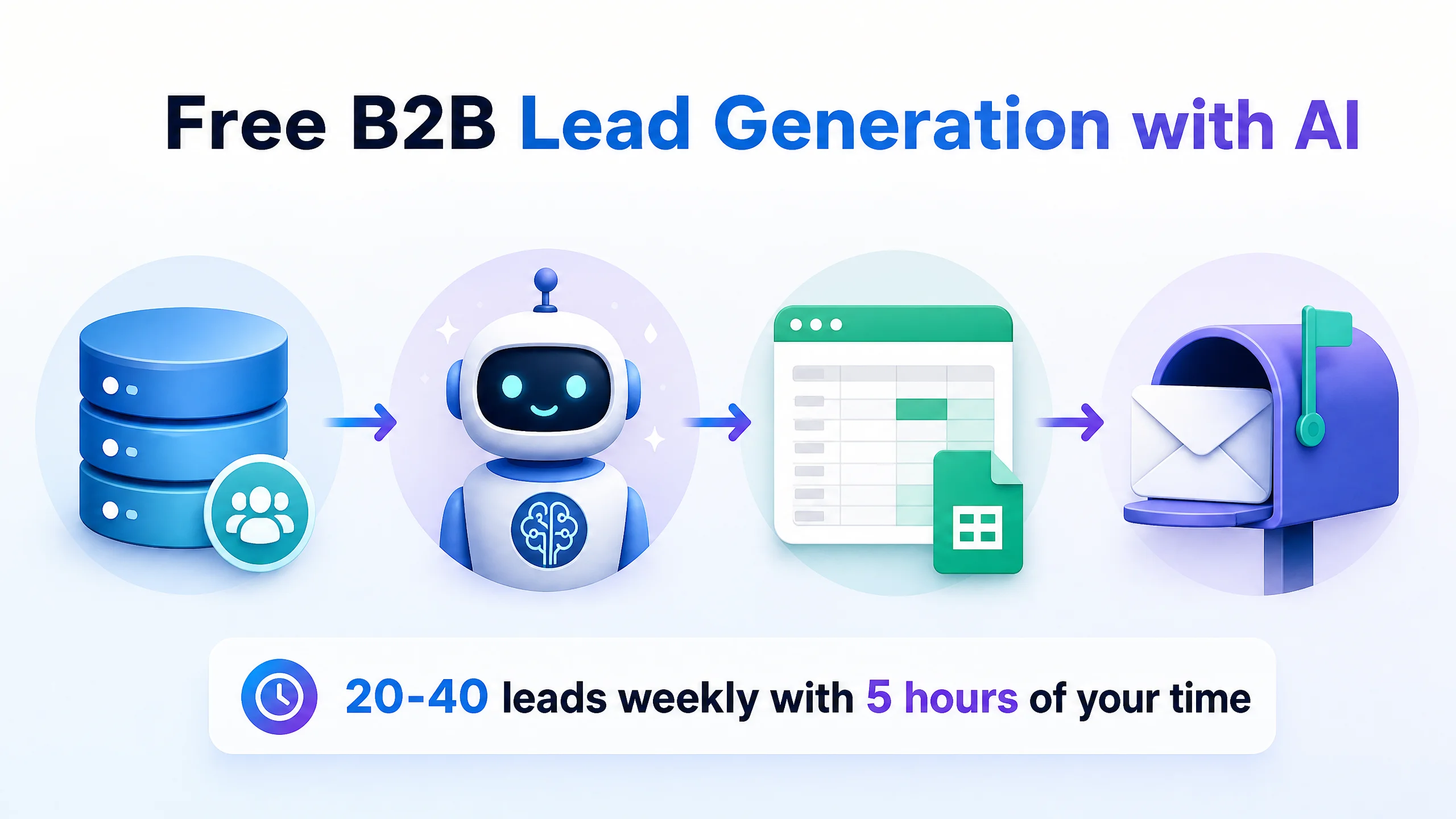
If there's no outbound budget and you need pipeline this quarter, "free" sounds like the only door. It is a real door. It just opens onto a job, not a machine.
This guide gives you the whole setup: the tools, the weekly routine, a prompt you can paste today, and the math on what it returns. We'll also be straight about where free stops working, so you can decide whether to keep going or hand it off.
This post is about the free, do-it-yourself route. If you want the full picture of how a paid, automated system works, read our guide to AI lead generation automation. If you want to capture leads who come to you, see how to build an automated lead pipeline. And if you're weighing paid tools, our post on what an AI SDR costs in 2026 has the prices.
Table of Contents
- The free stack and what each tool really gives you
- The 5-hour weekly routine
- What free costs, and when to stop
- Who This Is For
- Frequently Asked Questions
- Conclusion
The free stack and what each tool really gives you
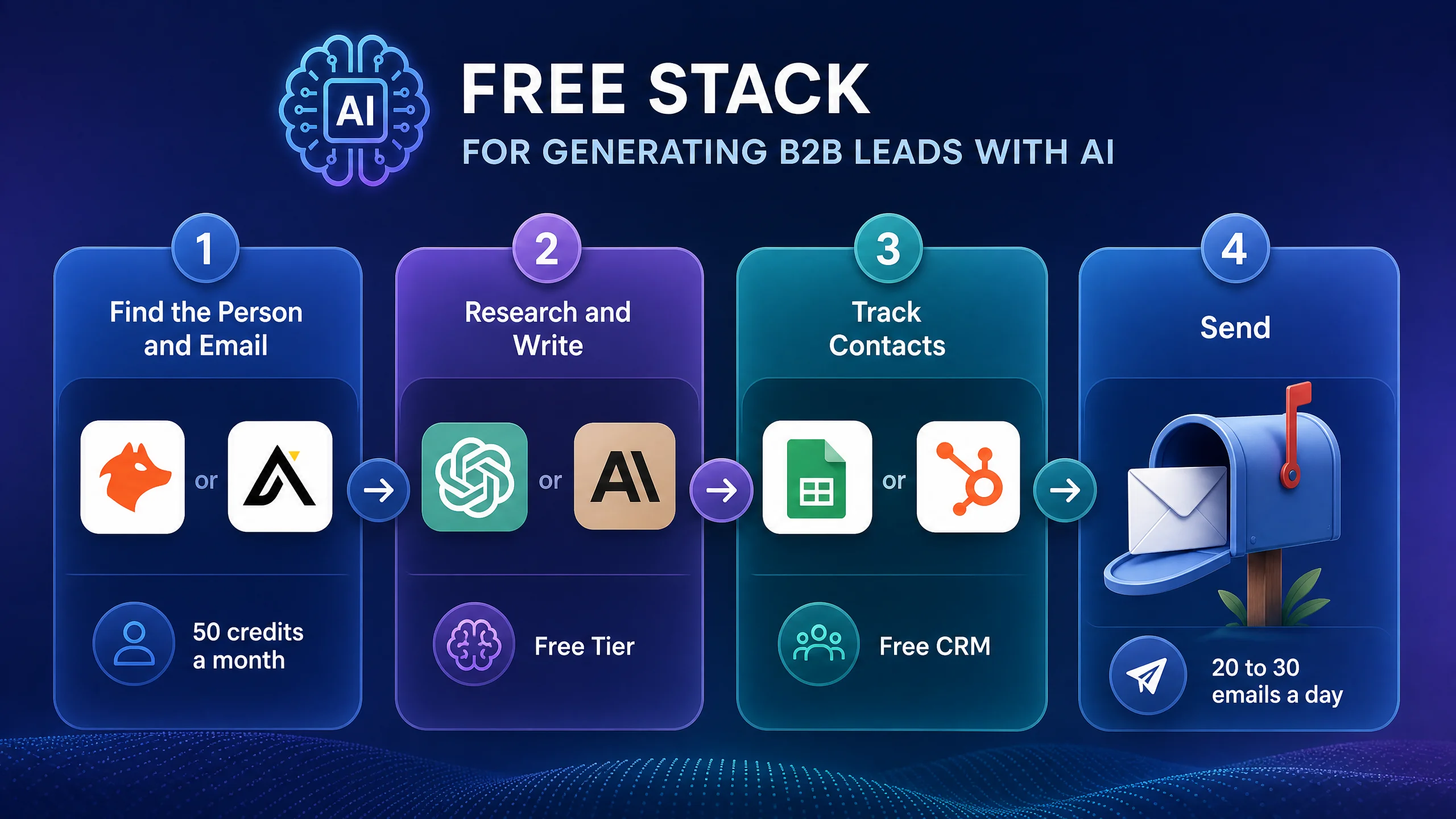
Think of lead generation as four jobs: find companies, find the right person, write something worth reading, and send it. Each job has a free tool. None of them does the job for you.
| Job | Free option | The real limit | Where it ends |
|---|---|---|---|
| Find the person and email | Hunter free plan, Apollo free plan | Hunter: 50 credits a month. One credit finds one email, half a credit verifies one (Hunter pricing) | About 40 to 50 contacts a month per tool |
| Research and write | ChatGPT or Claude free tier | Daily message caps change often | Fine for 20 to 30 emails a day |
| Track who you contacted | Google Sheets or HubSpot free CRM | None that matter at this size | Gets messy past a few hundred rows |
| Send | Your Gmail or Workspace mailbox | Gmail rate-limits fast sending, and weak engagement can throttle you | Stay at 20 to 30 a day |
Two notes on that table.
Stack tools, don't pick one. Each free plan gives you a small number of lookups. Using two databases gives you roughly double the contacts. Apollo's free plan lets you connect Gmail only, which is enough here (Apollo pricing). Check each plan's current limits before you build around them, because free tiers change.
Use a separate sending domain once you pass about 20 emails a day. A cold campaign sent from your main domain can hurt the mailbox your customers reach you on. A cheap second domain costs around $12 a year. It isn't free, but it's the one spend worth making.
Where the AI actually earns its place
AI is not the lead source. It's the researcher and the first-draft writer. It is good at three things:
- Turning a company website into one useful sentence. What do they sell, who to, and what changed recently?
- Drafting a short first email in your voice. Under 80 words, one idea, one question.
- Sorting replies. Interested, not now, wrong person, unsubscribe.
It is bad at deciding who your best customer is. That part is yours, and it matters more than any tool.
The 5-hour weekly routine
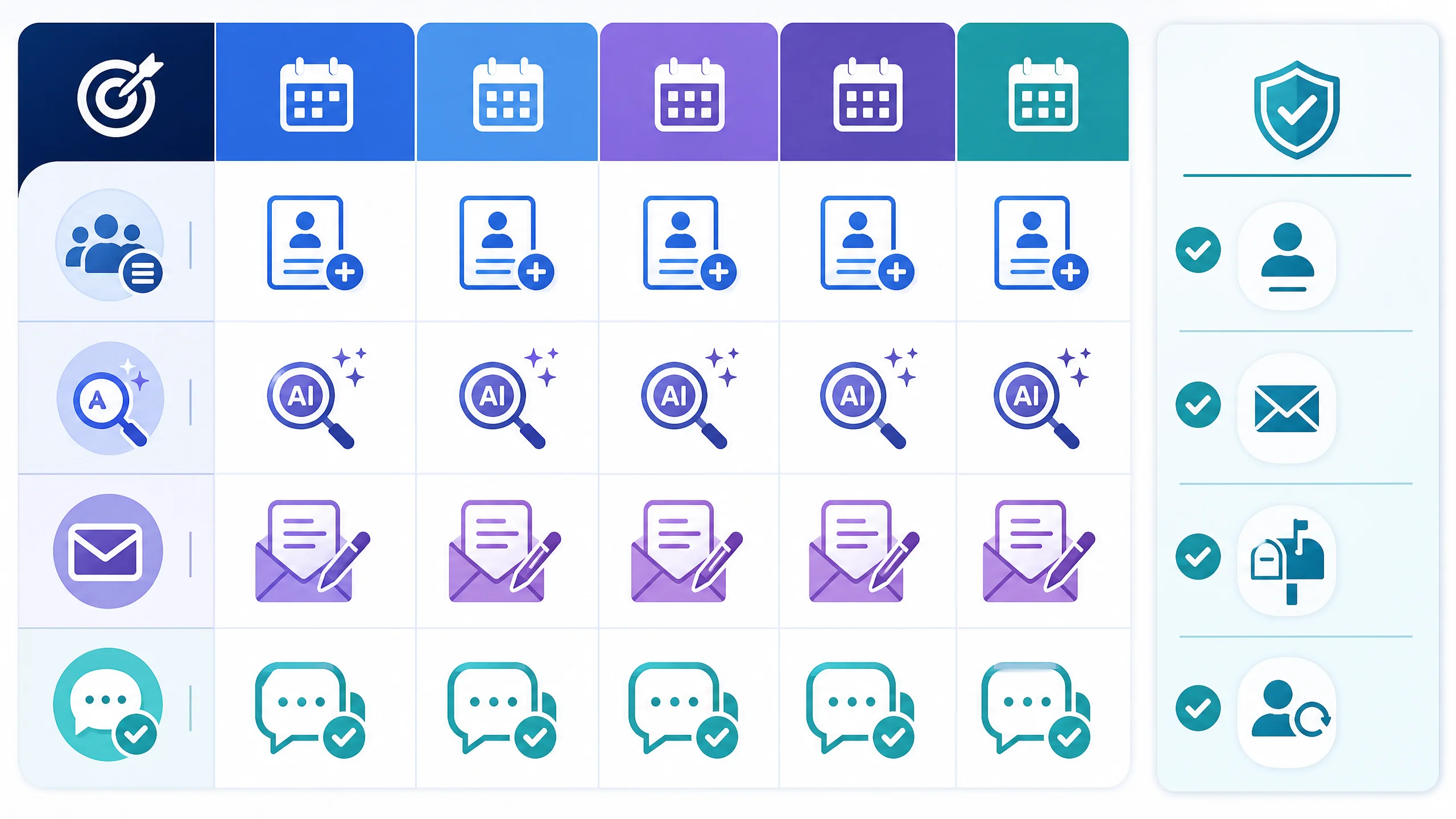
Here is the routine we'd give someone who has to do this by hand. It assumes one offer and one type of buyer. If you have three offers, pick one for the next 30 days.
Monday, 90 minutes: build the list. Write your ideal customer in one sentence: "Operations managers at logistics firms with 20 to 100 staff in the US." Use the free database filters to pull 30 to 40 contacts. Paste them into a sheet with columns for name, company, email, website, status and last contact.
Tuesday, 90 minutes: research with AI. For each company, paste the homepage text into ChatGPT or Claude and use a prompt like this:
You are helping me write a short cold email to [name], [title] at [company]. Here is their homepage text: [paste]. In one sentence, tell me what they sell and who to. Then give me one specific, recent or visible detail I could mention that is true and verifiable from this text. If there is nothing specific, say "nothing specific." Do not invent anything.
The last line matters. If the AI has nothing real to say, skip that prospect. A made-up compliment is worse than none.
Wednesday to Thursday, 60 minutes each: write and send. Ask the AI for a first draft, then rewrite it in your own words. Keep it under 80 words. State what you do, who for, and ask one low-pressure question. Send 20 to 30 emails a day from your own mailbox, one at a time, not as a blast.
Friday, 60 minutes: follow up and sort. Send a short follow-up to anyone who hasn't replied after 3 to 4 days. Most replies come from the first email (58%, per the same Instantly report), but the rest come from follow-ups, so don't skip them. Paste replies into the AI to sort them, then answer the interested ones yourself, quickly.
The compliance checklist (do not skip)
Cold email to a business address is allowed in the US. It still has rules, and the FTC lists them (CAN-SPAM guide):
- Your "From" name and address must be accurate.
- The subject line can't mislead.
- Include a valid postal address.
- Give an easy way to opt out, and honor it within 10 business days.
Keep spam complaints low too. Google requires senders to stay under a 0.3% spam rate and recommends staying below 0.10% (Google). On a small list, one angry recipient can move that number. Write to people who plausibly need what you sell, and remove anyone who says no.
Honest comparison: free DIY, paid sequencer, built system
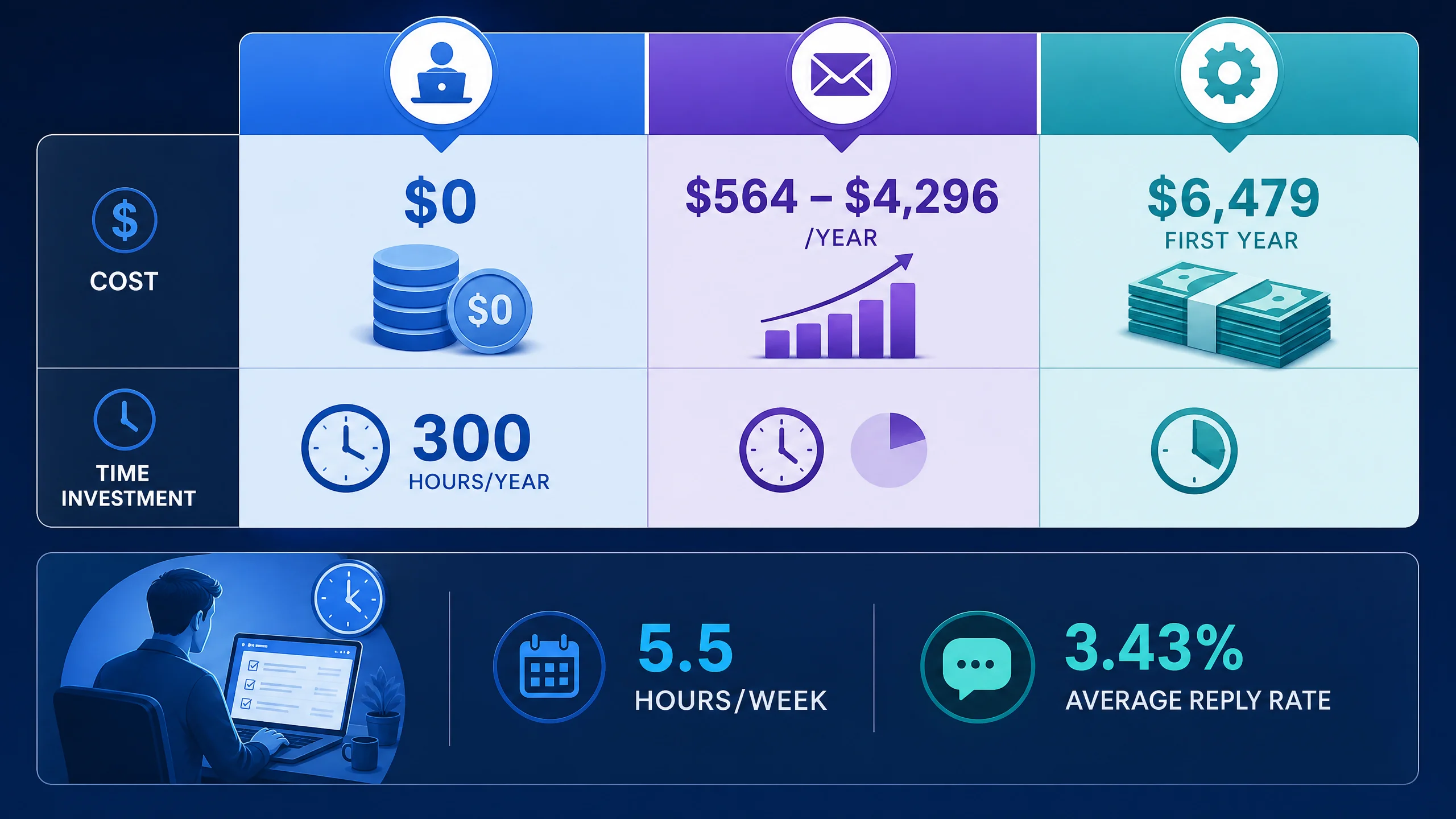
| Free DIY | Paid sequencer | Built-for-you system | |
|---|---|---|---|
| Cash cost, year one | $0 to $12 | $564 to $4,296 | $6,479 (Pipeline Engine) |
| Your time | About 5 to 6 hours a week | 3 to 5 hours a week | Review and approve |
| Prospects a month | 80 to 150 | 500 to thousands | Scoped to your offer |
| Biggest risk | You stop doing it | Deliverability and bad lists | Picking the wrong offer |
| Best for | Testing an offer | Owners who like running outbound | Owners who want meetings, not a tool |
The sequencer range comes from Instantly's published plans, covered in our AI SDR cost guide.
What free costs, and when to stop
Here's the part most "free tools" lists skip. Free isn't zero. It moves the cost from your card to your calendar.
The math, with your own numbers
Take the weekly routine above and run it for a month:
| Step | Number |
|---|---|
| Hours per week | 5.5 |
| Hours per month | About 24 |
| Value of your time at $100/hour | About $2,400 |
| Prospects contacted per month | 100 |
| Replies at the 3.43% average | About 3 to 4 |
| Cost per reply (your time only) | About $600 to $800 |
These are illustrations, not promises. If your time is worth $50 an hour, halve the cost. If your offer is sharp and your list is tight, replies should beat the average. Replace each number with yours, or run them through our free ROI calculator.
The question to ask isn't "is it free?" It's "is a reply worth more than $600 of my time?" If one customer is worth $5,000 or more, the free route can still pay off, because it takes only one or two to cover months of effort. If a customer is worth $300, it won't.
A stop-or-continue test
Run the free routine for four weeks. Then check three numbers:
- Reply rate. Under 2% means the offer or the list is wrong, not the tools.
- Positive replies. At least 1 in 4 replies should be interested.
- Meetings booked. Two or more in the month means the offer works and is worth scaling.
If the offer works but you can't keep up the 5 hours, that's the signal to automate. Not before.
How this would be built for you
When we scope outbound work, the first thing we check is the list and the offer, not the tool. A weak list kills a good tool, and a sharp list makes a free one look good. So the free route is also a cheap way to test your offer before you pay anyone.
When the offer is proven and the weekly hours are the problem, the same steps can run without you. Here's how that looks as a build:
- Trigger: a new account matching your ideal customer appears in the target list.
- Steps: enrich the contact, check the email, write a first line from the company's own site, queue the send, sort replies, book the call.
- Tools: a sequencer, a data source, an AI model, and your calendar.
- Hours: from about 5 a week to a quick daily review.
That's what our 24/7 Pipeline Engine does, at $2,579 setup plus $325 a month. If you'd rather have this outbound system built for you, it has a 60-day money-back guarantee: if you don't get the outcomes we agree on upfront within 60 days of kickoff, we refund your service fee. It's the wrong choice if you haven't tested your offer yet. Do the free version first.
Who This Is For
This is ideal for:
- Owners with no outbound budget who need to test whether an offer gets replies.
- Founders selling something worth at least a few thousand dollars per customer.
- Solo operators who can reliably block 5 hours a week.
Consider alternatives if:
- Your average customer is worth under about $500. The hours won't pay back.
- You can't block the time every week. Outbound needs a steady rhythm, and an erratic sender gets worse results.
- You need hundreds of leads a month. Free credit caps won't get you there.
Why AIessentials specifically? AIessentials (aiessentials.us) builds outbound systems at fixed, published prices, and we'd rather you run the free version first than buy something you haven't proven. Our pricing is on the Pipeline Engine page, and our guarantee is plain: 60 days, outcomes agreed upfront, service fee refunded if we miss.
Frequently Asked Questions
Which AI tools let you generate sales leads for free?
Hunter, Apollo and Clay have free plans that find contacts, and ChatGPT or Claude's free tiers handle research and drafts. HubSpot's free CRM tracks the results. Each free plan caps lookups, for example Hunter's 50 credits a month, so stack two or three tools rather than relying on one. Check current limits before you commit to any of them.
What practical strategies work to generate leads with AI for free?
Pick one offer and one buyer, then build a list of 30 to 40 contacts a week. Use AI to summarize each company's site and draft a short first email, then edit it yourself. Send 20 to 30 emails a day from your own mailbox and follow up after 3 to 4 days. Narrow, personal outreach beats volume at this size.
What are the best AI lead generation tools in 2026?
For free use, the best combination is a prospect database (Hunter or Apollo), an AI assistant (ChatGPT or Claude), and a free CRM. For paid outbound, sequencers like Instantly, Smartlead and Lemlist run about $47 to $358 a month. The best tool depends on volume. Under 150 prospects a month, free is enough.
Conclusion
Three things to take away:
- Free works for testing, not scaling. Four free tools and 5 hours a week can tell you whether your offer gets replies.
- The cost is your time. About 24 hours a month, so check that a customer is worth more than the hours.
- Follow the rules and keep it small. CAN-SPAM and Google's spam limits matter most when your list is short.
If you'd like a second pair of eyes on who to target first, we'll put together a free pipeline report around your ideal customer. It's yours to keep, whether or not you ever work with us.
Want a starting list and angle for your ideal customer? We'll build a free report on who to target and what to say, so your first four weeks of outreach start from a plan. Get My Free Report
Free Pipeline Intelligence Report
Every day your pipeline runs without buying signals, you're losing clients to whoever reaches them first. Get a free pipeline strategy built around the buying signals of your ideal customer.
Limited to 10 reports per week
Sent to your inbox within 24–48 hours. Yours to keep.

Iliyan Ivanov
Founder of AIessentials · AI automation consultant helping B2B businesses save 20+ hours/week and grow without hiring