How Is AI Used in Business? 7 Practical Ways
[ SUMMARIZE WITH AI ]
AI is used in business to automate repetitive tasks like data entry and customer support, analyze large datasets for better decisions, and personalize customer experiences. Most companies use AI to save time, cut costs by 30-50%, and scale operations without hiring more staff.

Businesses across every industry are adopting AI, but not in the flashy sci-fi way you might expect. Instead, they're using it for practical, day-to-day operations. Think chatbots handling customer questions, software that predicts when equipment needs maintenance, or tools that write first-draft marketing emails.
The real benefit isn't just doing things faster. It's about freeing up your team to focus on work that actually requires human judgment. When AI handles the boring, repetitive stuff, your people can spend time on strategy, relationships, and creative problem-solving.
Here's the thing: you don't need a massive budget or a tech team to get started. Many businesses begin with one or two simple AI tools and expand from there. The key is knowing where AI fits into your specific operations.
Want to see how much time AI could save you? Most businesses find 20-40 hours per week of tasks that AI can handle right now. Book a Free Strategy Call →
Table of Contents
- 7 Ways Businesses Actually Use AI
- Which Industries Benefit Most from AI
- What AI Implementation Actually Costs
- Common Mistakes to Avoid
- Who This Is For (And Who Should Look Elsewhere)
- Frequently Asked Questions
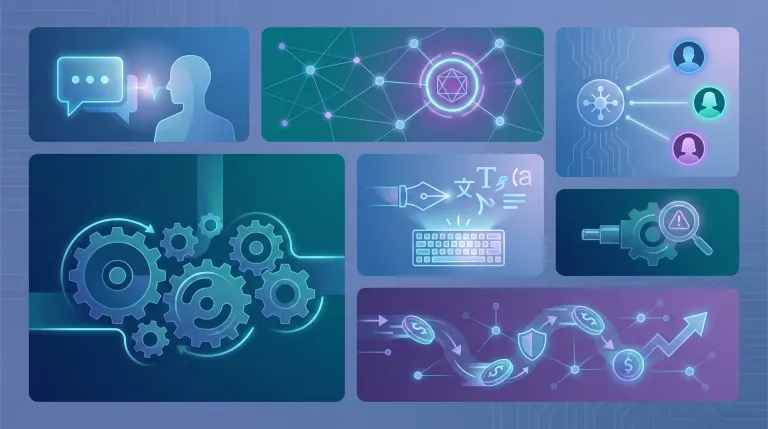
7 Ways Businesses Actually Use AI
Let's talk about what companies are really doing with AI today—not the future stuff, but what's working right now.
1. Customer Service Automation
Chatbots and AI assistants handle basic customer questions 24/7. They answer FAQs, help customers track orders, and route complex issues to the right person. Companies using AI customer service see response times drop from hours to seconds.
The best part? These tools get smarter over time. They learn from every interaction, which means they handle more questions without human help as months go by. For a detailed cost breakdown and ROI model, see AI customer service pricing: what to expect in 2026.
2. Data Analysis and Insights
AI can process thousands of spreadsheets in minutes and spot patterns humans would miss. Businesses use this for sales forecasting, inventory management, and identifying which marketing campaigns actually work.
For example, an e-commerce store might use AI to predict which products will sell out next month based on historical data, seasonal trends, and current market conditions. That's the kind of insight that used to require a full analytics team. The underlying technique is machine learning — see how machine learning helps businesses improve decision-making for a plain-English breakdown of how it works.
3. Marketing Personalization
AI analyzes customer behavior to send the right message at the right time. It personalizes email subject lines, recommends products, and determines the best time to send a marketing message based on when each customer is most likely to engage.
Companies like HubSpot and Salesforce have built AI features directly into their platforms, making this accessible even for small marketing teams.
4. Process Automation
This is where businesses save the most time. AI handles data entry, document processing, invoice management, and scheduling. It can pull information from emails, update CRM systems, and generate reports without anyone touching a keyboard.
One AIessentials client automated their lead qualification process using our AI Operating System—AI now scores incoming leads, updates their CRM, and triggers follow-up sequences. That saved their sales team 15 hours per week.
5. Content Creation
AI assists with writing blog posts, social media captions, product descriptions, and email copy. It's not replacing human writers, but it's giving them a head start. Instead of staring at a blank page, writers start with an AI-generated draft and refine it.
Tools like ChatGPT, Jasper, and Copy.ai are popular here, though the key is using them as assistants, not replacements.
6. Predictive Maintenance
Manufacturing and equipment-heavy businesses use AI to predict when machinery will break down. Sensors collect data, AI analyzes it, and the system alerts teams before something fails. This prevents costly downtime.
A logistics company using predictive maintenance reduced equipment failures by 40% and saved thousands in emergency repair costs.
7. Financial Operations
AI handles expense categorization, fraud detection, and cash flow forecasting. It flags unusual transactions, identifies cost-saving opportunities, and helps businesses stay on top of their finances without hiring a full-time CFO.
How AIessentials helps here: We identify which of these seven use cases will save you the most time and money, then implement the solution in 14-30 days with clear training and handoff.
Ready to automate your business processes? See which tasks in your business are costing you the most time. Get Your Free Assessment →
Which Industries Benefit Most from AI
AI works across industries, but some see results faster than others. Here's where we see the biggest impact.
Professional Services
Consulting, legal, and accounting firms use AI to automate client onboarding, document review, and scheduling. Law firms use AI to scan contracts and highlight key clauses. Accounting firms use it to categorize expenses and flag potential audit issues.
The time savings here are huge—tasks that took hours now take minutes.
E-commerce and Retail
Online stores use AI for inventory forecasting, personalized product recommendations, and automated customer support. AI analyzes buying patterns to suggest which products to stock up on and which to discount.
Retail businesses also use AI for dynamic pricing—adjusting prices based on demand, competition, and inventory levels in real time.
Healthcare and Wellness
Healthcare providers use AI for appointment scheduling, patient follow-ups, and medical record organization. Wellness businesses use it to create personalized treatment plans and send automated reminders.
AI doesn't replace doctors or therapists, but it handles the administrative burden so they can focus on patient care.
Real Estate
Real estate agents use AI to qualify leads, schedule property tours, and analyze market trends. AI tools can predict which neighborhoods will see price increases based on development plans, school ratings, and economic data.
Some agents use AI to write property descriptions and generate marketing materials, saving hours each week.
Marketing Agencies
Agencies use AI for campaign analysis, content creation, and client reporting. Instead of spending hours compiling data, AI generates reports automatically and highlights what's working.
AI also helps agencies scale—they can manage more clients without increasing headcount proportionally.
Comparison to alternatives: Hiring an assistant to handle these tasks costs $30,000-$50,000 per year plus benefits. Traditional software can help, but it still requires manual input. AI automation combines the best of both—software that thinks and acts like an assistant but costs a fraction of the price.
How AIessentials helps here: We focus on businesses doing $500K-$10M in annual revenue that don't have a full IT team. We implement AI solutions that work with your existing tools (no tech overhaul required).
Curious what this would look like for your industry? Every business is different—let's map out the specific tasks AI can handle for you. Book Your Free Call →
What AI Implementation Actually Costs
Let's talk numbers. AI implementation isn't free, but it's also not as expensive as you might think.
DIY Approach: $50-$500/month
If you have someone technical on your team, you can subscribe to tools like ChatGPT Plus ($20/month), Zapier ($20-$250/month), and no-code automation platforms. Total monthly cost: $50-$500 depending on usage.
Tradeoff: You save money, but implementation takes longer. Your team spends time learning tools, troubleshooting issues, and connecting systems. This works if you have 10-20 hours per month to dedicate to setup and maintenance.
Done-for-You Services: $3,000-$15,000 one-time + ongoing costs
Hiring an AI consultant or agency to build custom solutions typically costs $3,000-$15,000 upfront, plus $200-$1,000/month for software subscriptions and maintenance.
Tradeoff: Faster implementation and professional setup, but higher upfront cost. Best for businesses ready to invest in a solution that's tailored to their specific needs.
Enterprise Solutions: $50,000+ per year
Large companies using platforms like Salesforce Einstein or custom-built AI systems spend $50,000+ annually. These systems handle complex operations across multiple departments and locations.
Tradeoff: Maximum customization and support, but requires significant budget and often a dedicated IT team.
ROI Timeline
Most businesses see a return on investment within 3-6 months. Here's a simple example:
| Scenario | Manual Cost | AI Solution Cost | Monthly Savings |
|---|---|---|---|
| Customer support (20 hrs/week @ $25/hr) | $2,000/month | $200/month (chatbot + automation) | $1,800/month |
| Data entry (15 hrs/week @ $20/hr) | $1,200/month | $100/month (AI tools) | $1,100/month |
| Lead qualification (10 hrs/week @ $30/hr) | $1,200/month | $150/month (AI + CRM integration) | $1,050/month |
| Total | $4,400/month | $450/month | $3,950/month |
In this example, a $5,000 upfront implementation cost pays for itself in 1.3 months.
How AIessentials helps here: Most builds go live in 14-30 days at a fixed price, with a 60-day money-back guarantee: if you don't get the outcomes we agree on upfront within 60 days of kickoff, we refund your service fee.
Want a custom ROI estimate for your business? We'll map out exactly which tasks to automate and what you'll save. Start Your AI Journey →

Common Mistakes to Avoid
Businesses make the same AI mistakes over and over. Here's what to watch out for.
Mistake 1: Starting too big
Don't try to automate everything at once. Pick one painful process—like lead follow-up or invoice processing—and automate that first. Once it's working, move to the next one.
Mistake 2: Ignoring data quality
AI is only as good as the data you feed it. If your CRM is full of duplicates and outdated information, AI will amplify the mess. Clean your data first.
Mistake 3: Skipping training
Your team needs to understand how to use AI tools and when to step in. Without training, people either over-rely on AI or ignore it completely.
Mistake 4: Choosing tools that don't integrate
If your AI solution doesn't connect with your existing software (CRM, email, accounting), you'll end up with more manual work, not less.
Mistake 5: No clear success metrics
Before implementing AI, decide how you'll measure success. Is it hours saved? Cost reduction? Faster response times? Without metrics, you won't know if it's working.
How AIessentials helps here: We start every project with a clear success plan—specific metrics, timelines, and what "done" looks like. No guessing, no surprises.
Who This Is For (And Who Should Look Elsewhere)
This approach is ideal for:
- Small to mid-sized businesses ($500K-$10M revenue) with repetitive operational tasks
- Companies spending 10+ hours per week on manual data entry, customer follow-ups, or reporting
- Teams ready to invest 2-4 weeks in implementation and training
You might want to consider alternatives if:
- You need a custom enterprise solution with complex compliance requirements (you'd be better served by a full IT consulting firm)
- Your processes change constantly and aren't predictable (AI works best when there's a pattern)
- You're looking for a "set it and forget it" solution with zero human oversight (AI still requires monitoring)
Why AIessentials specifically?
We focus on speed and clarity. Most consultants take 3-6 months to deliver results. We implement working solutions in 14-30 days with a 60-day money-back guarantee tied to outcomes we agree on upfront. Our pricing is simple—no hidden fees, no endless hourly billing. And we specialize in businesses without dedicated IT teams, so everything we build is designed for non-technical users.
Frequently Asked Questions
How is AI used in business for small business owners?
Small business owners use AI for customer service chatbots, automated email marketing, data entry, and scheduling. AI helps small teams do more without hiring additional staff. The most common use cases are automating repetitive tasks and improving customer response times. If you're a solo owner, we've also broken down how much of an LLC AI can actually run.
What is the ROI of AI implementation for small business?
Most small businesses see a 200-400% ROI within the first year. For example, a business spending $2,000/month on manual tasks can reduce that to $400/month with AI tools, saving $1,600/month or $19,200 annually. With implementation costs around $3,000-$8,000, payback happens in 2-5 months.
What are the best AI tools for small businesses?
The best AI tools depend on your needs, but popular options include ChatGPT for content and customer service, Zapier for workflow automation, HubSpot AI for marketing, and tools like Otter.ai for meeting transcription. Start with one tool that solves your biggest pain point before expanding.
What are common AI mistakes small businesses make?
The biggest mistakes are starting too big (trying to automate everything at once), using AI without cleaning data first, choosing tools that don't integrate with existing software, and not training staff on how to use AI properly. Start small, measure results, then expand.
What are the AI trends for small business in 2026?
In 2026, expect more affordable AI tools with no-code interfaces, better integration between AI platforms and small business software like QuickBooks and Shopify, and increased focus on AI for personalized customer experiences. Voice AI and automated video content are also becoming more accessible.
How does AI compare to traditional automation for small business?
Traditional automation follows fixed rules (if X happens, do Y). AI adapts and learns from patterns. For example, traditional automation can send an email when someone fills out a form, but AI can personalize that email based on the person's behavior and preferences. AI is more flexible but requires better data.
What is a step-by-step AI implementation guide for small business?
Step 1: Identify your most time-consuming repetitive task. Step 2: Research AI tools that solve that problem (start with free trials). Step 3: Clean and organize your data. Step 4: Implement one tool and train your team. Step 5: Measure results for 30 days. Step 6: Refine and optimize. Step 7: Move to the next task. Don't rush—good implementation takes 2-4 weeks per process.
Are there AI case studies showing small business success?
Yes. A real estate agency automated lead qualification and saved 15 hours per week. An e-commerce store used AI for customer support and reduced response times from 4 hours to 5 minutes. A consulting firm automated proposal generation and cut turnaround time by 60%. Results vary, but time savings of 20-40 hours per week are common.
What is the cost of AI solutions for small business?
Small business AI solutions range from $50/month (DIY using tools like ChatGPT and Zapier) to $3,000-$15,000 upfront for done-for-you implementation plus $200-$500/month in software costs. The investment typically pays for itself in 2-5 months through time and cost savings.
What are the main benefits of AI for small business?
The top benefits are saving time on repetitive tasks (20-40 hours per week), cutting operational costs by 30-50%, improving customer response times, making better data-driven decisions, and scaling operations without hiring proportionally. AI lets small teams compete with larger companies.
Conclusion
AI is no longer a "nice to have" for businesses—it's becoming essential for staying competitive. Companies using AI save time, cut costs, and scale faster than those relying on manual processes. The key is starting with one high-impact area, implementing it well, and expanding from there.
The businesses winning with AI aren't necessarily the biggest or most tech-savvy. They're the ones willing to test, learn, and adapt. If you're spending hours each week on repetitive tasks, AI can handle that work while you focus on growing your business.
Ready to see which tasks in your business AI can automate? Book a free 30-minute strategy call to get a custom implementation plan with clear time and cost savings. No fluff, no sales pitch—just a practical roadmap for your business.
Workflow Audit
]99% sure you are not seeing all the spots AI can help you in your business.
Are your workflows optimized with the most up to date solution, or are they costing you and your team time and money?
GET FREE AUDIT
Iliyan Ivanov
Founder of AIessentials · AI automation consultant helping B2B businesses save 20+ hours/week and grow without hiring