AI Customer Service vs Hiring More Staff: Which Wins?
[ SUMMARIZE WITH AI ]
For most small businesses, AI customer service software is the better first move. It handles 60–80% of routine questions instantly, costs a fraction of a new hire, and works around the clock. But it's not a full replacement for human agents — the smartest approach combines both.
This page focuses on the staffing decision itself — software budget vs. headcount budget, across any AI customer service category (chatbots, ticket routing, triage). If you've already ruled out hiring and want a narrower comparison of chatbot tools specifically against keeping your current human team, see AI chatbots vs. human support instead.

Here's why this matters right now. Customer expectations have shifted. People expect fast responses — Salesforce research shows 83% of customers expect to interact with someone immediately when contacting a company. If you're a small business with a three-person support team, meeting that standard is tough. You're either paying overtime, losing customers during off-hours, or burning out your staff.
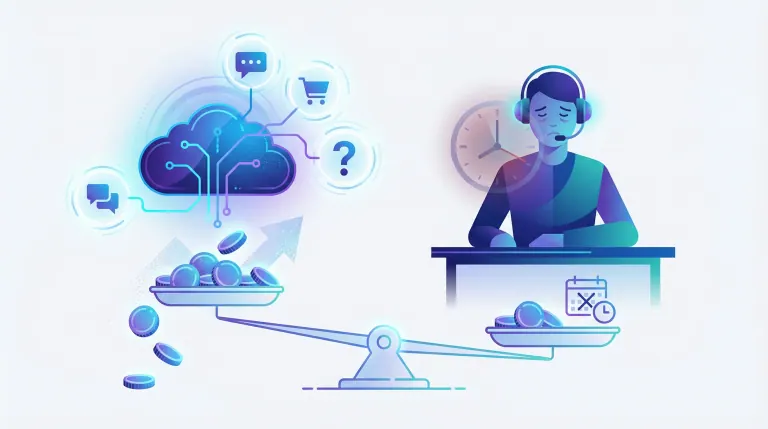
AI customer service tools like Zendesk AI, Intercom, and Freshdesk's Freddy handle the repetitive stuff — password resets, order tracking, basic FAQs — so your team can focus on the problems that actually need a human touch. The average small business spends $35,000–$50,000 per year on a single customer service hire (salary, benefits, training). Most AI tools cost $200–$1,500 per month. That math alone makes the case, but there's more to it than dollars. How AIessentials helps here: we map your specific support volume and question types to figure out exactly which approach saves you the most money and delivers the best customer experience — and our AI Operating System handles the behind-the-scenes automation that keeps your team focused on high-value interactions.
Want to see how much you could save on customer service? We'll analyze your support volume, question types, and response times to build a custom savings projection. Book a Free Strategy Call →
Table of Contents
- What AI Customer Service Software Actually Does
- The Real Cost Comparison: AI Software vs New Hires
- When to Use Each Approach (Decision Framework)
- Who This Is For (And Who Should Look Elsewhere)
- Frequently Asked Questions
What AI Customer Service Software Actually Does
Before picking a side, it helps to understand what AI customer service tools can and can't do — because the marketing from software companies tends to oversell things.
What AI Handles Well
AI-powered customer service tools are built for volume and speed. They excel at:
- Answering repetitive questions — Shipping status, return policies, pricing info, and account changes. These make up 60–80% of most support tickets.
- 24/7 availability — No shifts, no overtime, no sick days. Your customers in different time zones get instant answers at 2 AM.
- Multilingual support — Tools like ChatGPT-powered chatbots and Intercom's Fin can respond in dozens of languages without hiring multilingual agents.
- Routing and triage — AI can sort incoming tickets by urgency, topic, and customer value, then send them to the right person.
Most small businesses using AI automation save 20+ hours per week on tasks exactly like these. That's time your team can spend on complex problems and relationship building.
What AI Can't Do (Yet)
AI falls short with:
- Emotionally charged situations — An angry customer who's been billed incorrectly wants empathy, not a chatbot loop.
- Complex, multi-step issues — Problems that require accessing multiple systems, making judgment calls, or bending the rules.
- Relationship building — Your best customers expect personal attention. AI can support that, but it can't replace the human connection.
- Edge cases — Unusual requests or situations the AI wasn't trained on lead to frustration.
How AIessentials helps here: we identify exactly which customer interactions should stay human and which can be safely automated, so you don't lose the personal touch that keeps customers coming back.
Curious what your ideal AI + human support split looks like? We'll audit your support tickets and show you which ones AI can handle today. Get Your Free Assessment →

The Real Cost Comparison: AI Software vs New Hires
This section breaks down the actual numbers so you can make a clear financial decision — not a gut-feeling one.
Side-by-Side Cost Breakdown
| Factor | AI Software | New Customer Service Hire |
|---|---|---|
| Monthly cost | $200–$1,500/mo | $2,900–$4,200/mo (salary + benefits) |
| Annual cost | $2,400–$18,000 | $35,000–$50,000 |
| Setup/training time | 1–4 weeks | 2–8 weeks |
| Availability | 24/7/365 | 40 hrs/week (typical) |
| Scalability | Handles unlimited conversations | One person = limited capacity |
| Language support | 30+ languages | Usually 1–2 |
| Empathy/judgment | Limited | Strong |
Quick ROI Example
Let's say your business gets 500 support tickets per month. About 350 of those (70%) are routine questions — order status, pricing, returns.
- Hiring route: One full-time agent handles about 400 tickets/month. Cost: ~$42,000/year.
- AI route: AI handles 350 routine tickets. One part-time agent handles the remaining 150 complex ones. Cost: ~$600/month (AI) + ~$18,000/year (part-time) = $25,200/year.
Savings: $16,800/year — and your customers get faster responses on the simple stuff.
That's not a hypothetical. Businesses implementing the 30% rule in AI — starting with the easiest 30% of tasks first — see these kinds of returns within 60–90 days.
The Hidden Costs People Miss
AI hidden costs:
- Integration with your existing CRM or helpdesk ($500–$2,000 one-time)
- Ongoing training and prompt tuning (2–4 hours/month)
- Occasional escalation failures that frustrate customers
Hiring hidden costs:
- Recruiting and onboarding ($3,000–$5,000)
- Turnover — customer service has one of the highest turnover rates across industries, averaging 30–45% annually
- Benefits, PTO, sick days, and management overhead
How AIessentials helps here: we build a custom cost model for your specific business, including the hidden costs most people forget about. No guessing, no generic calculators.
Ready to see the real numbers for your business? We'll build you a custom AI vs hiring cost comparison based on your actual support volume. Book Your Free Call →
When to Use Each Approach (Decision Framework)
This section gives you a clear framework for deciding which path fits your business right now — because the right answer depends on where you are, not just what's cheaper.
Choose AI Software First If:
- Your support volume is growing but your budget isn't
- Most of your tickets are repetitive (tracking, FAQs, account updates)
- You need after-hours coverage but can't afford night shifts
- You're getting customer complaints about slow response times
- You serve customers in multiple languages
Hire More Staff First If:
- Your product or service is complex and highly customized
- Most customer interactions require nuanced judgment
- Your brand identity depends heavily on personal relationships
- You're in a regulated industry where AI responses could create compliance risk (legal, healthcare, financial advising)
- You already have AI handling the basics and need deeper human expertise
The Hybrid Approach (What Most Smart Businesses Do)
The best results come from combining both. Here's what that looks like in practice:
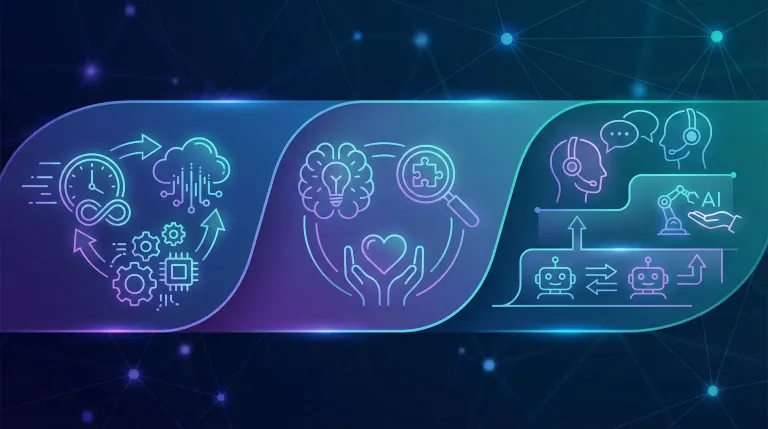
- AI handles tier 1 — All routine questions, order tracking, basic troubleshooting. Instant responses, 24/7.
- Humans handle tier 2 and 3 — Escalated issues, upset customers, complex problems, and relationship-building conversations.
- AI assists human agents — Even when a human takes over, AI provides suggested responses, pulls up customer history, and summarizes the conversation so far.
Tools like Zendesk AI, Freshdesk Freddy, and HubSpot's AI chatbot already support this hybrid model out of the box. The key is setting up the handoff properly — when AI should escalate, what context it passes to the human, and how to avoid making the customer repeat themselves.
How AIessentials helps here: we set up the hybrid model end-to-end, including the escalation rules, handoff protocols, and agent training so your team actually uses the tools instead of fighting them. This is how businesses see the biggest impact of AI in their operations.
Want a custom implementation plan for your support team? We'll design a hybrid AI + human support system tailored to your business in 14–30 days. Start Your AI Journey →
Who This Is For (And Who Should Look Elsewhere)
This approach is ideal for:
- Small businesses getting 100+ support tickets per month with mostly repetitive questions
- E-commerce stores, SaaS companies, and service businesses that need 24/7 response coverage
- Business owners spending more than $3,000/month on customer service who want to reduce costs without reducing quality
You might want to consider alternatives if:
- You serve fewer than 50 tickets per month — the ROI on AI tooling may not justify the setup cost at that scale
- Your customer interactions are almost entirely high-touch, relationship-driven (luxury consulting, high-end real estate)
- You're in a heavily regulated industry where every customer interaction must be reviewed by a licensed professional
Why AIessentials specifically? We don't just sell you a chatbot and walk away. We audit your actual support tickets, design the automation rules, integrate with your existing tools (Zendesk, HubSpot, Freshdesk, Intercom — whatever you use), and train your team on the hybrid model. Implementation takes 14–30 days, we offer a 60-day money-back guarantee tied to outcomes we agree on upfront, and our pricing is straightforward — no surprise add-ons or long-term contracts.
Frequently Asked Questions
AI customer service software vs human customer service small business
AI customer service software handles repetitive, high-volume questions faster and cheaper than human agents. But humans are still better at complex problems, emotional situations, and building relationships. For most small businesses, the best approach is a hybrid: AI handles the routine 60–80% while humans focus on the rest. This gives you speed and personal touch without doubling your headcount.
AI customer service software for small business ROI
Most small businesses see positive ROI within 60–90 days of implementing AI customer service software. The typical savings range from $12,000–$20,000 per year compared to hiring an additional full-time support agent. Beyond cost savings, you also get faster response times (seconds vs minutes), 24/7 availability, and the ability to handle volume spikes without scrambling to hire temporary staff.
Cost of AI customer service software vs human agents small business
AI customer service tools cost $200–$1,500 per month depending on features and ticket volume. A full-time customer service agent costs $35,000–$50,000 per year (including benefits and training). That's roughly a 3–10x cost difference. But AI can't handle everything, so most businesses end up spending on both — the key is getting the ratio right so you're not overpaying for humans to answer questions a bot could handle.
Implementing AI customer service small business best practices
Start with your top 10 most-asked questions and build AI responses for those first. Then expand gradually. Use real customer language in your AI training data, not corporate-speak. Set clear escalation rules — any mention of frustration, billing disputes, or requests to "speak to a manager" should go to a human immediately. Test your AI with internal staff before launching it to customers. And always give customers a clear way to reach a human.
Expanding customer service team small business challenges
The biggest challenges are cost, speed, and consistency. Hiring takes 4–8 weeks from posting to productive employee. Training adds another 2–4 weeks. Customer service turnover runs 30–45% annually, which means you're constantly repeating this cycle. And quality is inconsistent — new hires take months to match the knowledge level of experienced agents. AI doesn't have these problems, but it has its own limitations around empathy and complex problem-solving.
AI customer service trends small business
The biggest trends right now are conversational AI that sounds natural (not robotic), AI-assisted agent tools that help human reps respond faster, and proactive support where AI reaches out to customers before they contact you. Platforms like Intercom, Zendesk, and Freshdesk are all building these features in. For small businesses, the most impactful trend is hybrid support — combining AI and humans — which is becoming the standard rather than the exception.
AI customer service software alternatives small business
If you're not ready for full AI customer service software, there are simpler options. Shared inbox tools like Help Scout or Front organize your support without AI. Pre-written templates and macros in Gmail or Outlook speed up responses manually. FAQ pages and knowledge bases reduce ticket volume by helping customers self-serve. And platforms like Tidio or Crisp offer lightweight chatbots that are cheaper and easier to set up than enterprise AI tools.
Small business customer service case studies AI vs human
A 15-person e-commerce company switched to AI-first support and cut average response time from 4 hours to 12 seconds for routine questions. Their customer satisfaction score went up 18% because people got answers faster. A local accounting firm tried the same approach but found that 80% of client questions required nuanced tax advice — they went back to human-only support. The lesson: AI works best when your questions are repetitive and predictable. When they're complex, humans win.
Step-by-step guide AI customer service implementation small business
Here's the process: (1) Audit your last 90 days of support tickets and categorize them by type and complexity. (2) Identify the 60–80% that are repetitive. (3) Choose an AI tool that integrates with your existing helpdesk. (4) Build responses for your top 20 questions. (5) Set up escalation rules for everything else. (6) Test internally for two weeks. (7) Launch to 20% of customers first, then expand. (8) Review and tune weekly for the first month, monthly after that.
Common mistakes implementing AI customer service small business
The biggest mistake is going all-in too fast. Don't automate everything on day one — start with your simplest, most repetitive tickets. Second mistake: not giving customers a way to reach a human. Nothing frustrates people more than being trapped in a chatbot loop. Third: using generic, impersonal AI responses that don't match your brand voice. Fourth: ignoring the data — AI tools generate insights about what customers ask most, but many businesses never review those reports. And fifth: skipping the escalation rules, which leads to AI trying to handle problems it can't solve.
Conclusion
AI customer service software is the better first move for most small businesses — it's cheaper, faster, and handles the bulk of routine questions that eat up your team's time. But it's not a replacement for human agents on complex or emotional issues. The smartest approach is hybrid: let AI handle the easy 60–80%, and let your people focus on the conversations that matter most.
Ready to find your ideal AI-to-human support ratio? Book a free 30-minute strategy call to get a custom cost comparison and implementation plan for your business.
Workflow Audit
]99% sure you are not seeing all the spots AI can help you in your business.
Are your workflows optimized with the most up to date solution, or are they costing you and your team time and money?
GET FREE AUDIT
Iliyan Ivanov
Founder of AIessentials · AI automation consultant helping B2B businesses save 20+ hours/week and grow without hiring