AI Chatbots vs. Human Support: Which Is Better?
[ SUMMARIZE WITH AI ]
Workflow Audit
]99% sure you are not seeing all the spots AI can help you in your business.
Are your workflows optimized with the most up to date solution, or are they costing you and your team time and money?
GET FREE AUDITFor most small businesses, the answer is a combination — but if you're choosing where to start, AI chatbots win on cost and availability while human agents win on complex issues and relationship-building. The right balance depends on how many repetitive questions you handle daily.
This page focuses specifically on chatbots as a tool layered on top of your existing team — not the broader question of whether to hire at all. If you're still deciding between adding software budget or headcount budget in the first place, see AI customer service software vs. hiring more staff for that comparison.
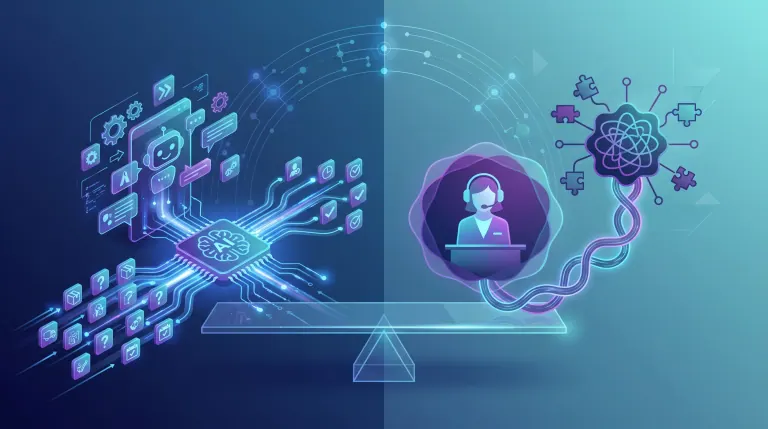
The business of AI in customer service has changed fast. AI-powered chatbots built on platforms like Intercom, Tidio, or Zendesk can now resolve 60–80% of common customer questions without a human ever touching them — tracking orders, answering FAQs, booking appointments, handling returns. All of it, around the clock, at a fraction of what you'd pay an employee.
But AI chatbots aren't a magic fix. They struggle with nuanced complaints, emotional customers, and situations that need judgment. A customer who's panicking about a damaged order for tomorrow's event doesn't want to chat with a bot — they want a real person who gets it.
The smart play for most small businesses isn't either/or. It's building a system where AI handles the predictable stuff and your human team focuses on conversations that actually need them.
Want to see how much time AI could save your support team? Most small businesses waste 15+ hours a week answering the same questions. We'll map exactly what can be automated. Book a Free Strategy Call →
Table of Contents
- The Cost Breakdown: AI Chatbots vs. Human Support
- What AI Chatbots Do Well (and Where They Fail)
- When Human Support Still Wins
- The Hybrid Approach: Getting the Best of Both
- Who This Is For (And Who Should Look Elsewhere)
- Frequently Asked Questions
The Cost Breakdown: AI Chatbots vs. Human Support
Here's the direct comparison most small business owners need before making a decision. The numbers tell a clear story — but they're only part of it.
What AI Chatbots Actually Cost
Most small business chatbot platforms fall in the $50–$500/month range depending on features and volume. Here's a realistic look:
| Platform | Starting Price | What You Get |
|---|---|---|
| Tidio | $29/month | Live chat + basic AI, solid for e-commerce |
| Freshdesk Freddy | $79/month | AI agent with ticket routing |
| Intercom | $74/month | Conversational AI, strong integrations |
| Zendesk AI | $115/month | Enterprise-grade AI with analytics |
Add setup time (typically 10–30 hours the first time), training the AI on your FAQs, and monthly maintenance — your realistic first-year cost lands at $1,500–$8,000.
What a Human Support Agent Costs
A part-time customer service agent (20 hours/week) runs $18,000–$28,000/year. Full-time: $35,000–$55,000/year — plus employer taxes, benefits, PTO, and training. Factor those in at roughly 25% on top and the real numbers look like this:
| Cost Type | Part-Time Agent | Full-Time Agent |
|---|---|---|
| Salary | $18,000–$28,000 | $35,000–$55,000 |
| Benefits + taxes (~25%) | $4,500–$7,000 | $8,750–$13,750 |
| Total annual cost | $22,500–$35,000 | $43,750–$68,750 |
Quick ROI Example
Say your business gets 200 support queries per week and an AI chatbot resolves 65% of them automatically (130 tickets). At a typical 6-minute handling time, that's 13 hours of staff time reclaimed every week. At $18/hour fully loaded, that's roughly $12,168/year in recovered labor — often more than the chatbot costs in year one.
The business of AI makes this math work. But only if your query volume justifies the setup investment.
Ready to run these numbers for your specific business? We build a custom AI audit showing exactly how much time and money automation could recover — no guesswork required. Get Your Free Assessment →
What AI Chatbots Do Well (and Where They Fail)
Understanding what the technology actually handles — and doesn't — saves you from an expensive mistake. This is where the business of AI gets nuanced.
Where AI Chatbots Excel
High-volume, repetitive questions. "What are your hours?" "Where's my order?" "How do I return this?" These are perfect chatbot territory. They answer instantly, at 3 AM, without frustration or error.
First-response speed. Response time is a major satisfaction driver. AI responds in seconds. The average small business without automation takes 12+ hours to reply to support emails.
Lead qualification. AI can ask screening questions, collect contact info, and route warm leads directly to your calendar. HubSpot's AI chat and ChatGPT-based integrations do this well without adding headcount — and a dedicated 24/7 Pipeline Engine takes that further by running outbound and booking meetings on autopilot.
Ticket triage. Instead of a chaotic inbox, AI categorizes and prioritizes incoming issues before a human sees them. This alone can cut your team's effective response time in half.
Where AI Chatbots Struggle
Complex or emotional situations. A customer who received a broken product and is stressed about an upcoming event needs empathy and flexibility — not a script. Chatbots in these scenarios often make things worse.
Highly specific or unusual requests. When a situation doesn't fit a pattern the AI was trained on, it either gives a wrong answer or loops in confusion. That erodes trust fast.
Relationship-driven industries. If your business runs on deep trust — legal, medical, high-value B2B services — customers often expect a human. Routing them to a bot can feel dismissive.
Poorly trained bots. An AI chatbot with a weak knowledge base is worse than no chatbot at all. It gives bad answers confidently. This is a setup problem, not an AI problem — but it's extremely common.
Just like AI handles marketing campaign distribution better than creative strategy, AI customer service handles volume better than nuance. If you're curious how this applies more broadly, AI automation can save your business 20+ hours per week — but only when applied to the right tasks.
Not sure which of your support queries are safe to automate? We map your customer service workflow and identify exactly which questions AI can handle reliably. Book Your Free Call →
When Human Support Still Wins
Some businesses shouldn't move fast on AI customer service — and knowing which side you're on saves time and money.
Situations Where Human Support Has a Clear Edge
Your customers are older or less tech-comfortable. Not everyone wants to type into a chat window. If your customer base skews 55+, expects phone calls, or lives in regions with lower digital adoption, forcing them through a chatbot creates friction and lost business.
Your industry involves vulnerability. Mental health services, legal advice, medical queries, financial decisions — these need trained humans who can exercise judgment. AI can assist your team here, but it shouldn't be the front line.
Your complaint volume is low but high-stakes. If you get 20 support requests a week but each one represents a $10,000 client relationship, a human touch is worth every cent. Volume matters. Low-volume, high-value businesses often don't have enough repetitive queries to justify chatbot costs.
You're in early growth and still learning. Every customer conversation with a real human teaches you something — what objections people have, what language they use, what they're confused about. Automating too early can cut you off from insights that fuel growth.
That said, even businesses that rely on human support benefit from AI assisting those humans. Tools like ChatGPT for business tasks help your support team draft replies faster, look up information, and stay consistent.
The Hidden Cost of Expanding Human Support
Adding headcount isn't just a salary line. It's 3–6 weeks of recruiting, 30–90 days of onboarding before full productivity, management overhead, and real culture-fit risk. During peak periods or staff turnover, your customer experience suffers. AI doesn't call in sick, doesn't need PTO, and doesn't have a bad day.
The Hybrid Approach: Getting the Best of Both
Most small businesses that implement AI chatbots don't replace their support staff — they free them to do more meaningful work. Here's what a practical hybrid model looks like:
Tier 1 — AI handles everything repetitive: FAQs, order status, appointment booking, basic troubleshooting, lead qualification. Resolves 60–80% of queries automatically without a human touching them.
Tier 2 — AI routes and preps: For queries the AI can't resolve confidently, it collects context, categorizes the issue, and escalates to the right human with a summary. Your agent doesn't start from scratch.
Tier 3 — Human closes the loop: Complex problems, upset customers, and high-value account management all go to your team. They have more capacity because AI handled the volume below.
This mirrors how the business of AI improves operations across functions like marketing and sales — you're not removing humans, you're removing the parts of their job that are lowest-value and most draining. If you saw how AI marketing automation compares to hiring a marketing team, the same logic applies here.
At AI Essentials, we build these hybrid systems for small businesses in 14–30 days. We train the chatbot on your actual data, integrate it with your existing tools (HubSpot, Shopify, Slack, or whatever you already use), and build escalation logic so nothing falls through the cracks.
The difference between a chatbot that frustrates customers and one that helps them is configuration. Off-the-shelf bots with generic training fail. Custom-trained bots built around your real support data win. We've seen this play out across dozens of implementations — the setup determines the outcome.
Who This Is For (And Who Should Look Elsewhere)
This approach is ideal for:
- E-commerce businesses handling 100+ support queries per week
- Service businesses with repetitive FAQ-style questions around pricing, availability, and process
- Growing small businesses that want to scale customer support without proportionally scaling headcount
- Teams currently drowning in email where the same 10 questions show up constantly
You might want to consider alternatives if:
- You get fewer than 30 support queries per week (the ROI math often doesn't pencil out)
- Your customers are strongly phone-first and resistant to chat interfaces
- Every support interaction requires significant judgment, legal knowledge, or emotional sensitivity
- You haven't documented your FAQ answers yet — AI needs a solid knowledge base to train on
Why AI Essentials specifically? Most chatbot vendors sell you the software and leave you to figure out training, integration, and escalation logic on your own. We handle the full setup — mapping your support workflow, training the bot on your actual data, building handoff rules that make the transition seamless. We also monitor the first 30 days so the AI doesn't quietly give bad answers while nobody's watching. You get a working system, not just a subscription.
Frequently Asked Questions
AI customer service chatbots vs human support small business
For most small businesses, AI chatbots handle repetitive, high-volume queries better — faster, cheaper, and around the clock. Human agents outperform on complex, emotional, or relationship-critical situations. The practical answer for most small businesses is a hybrid: AI handles tier-1 volume, humans handle anything that needs judgment or real empathy.
Cost ROI AI chatbots small business
A basic AI chatbot costs $50–$500/month. If it resolves 60–70% of your queries automatically, time savings typically exceed the tool cost within 3–6 months. A business handling 200 queries per week at 6 minutes each saves roughly 12 hours/week — worth $800–$1,200/month at typical labor rates. ROI depends heavily on query volume and how well the bot is trained on your content.
Expand human support team small business
Expanding a human team makes sense when your support volume is growing, queries are complex and judgment-heavy, or customers prefer phone over chat. A full-time support agent runs $43,000–$68,000/year including salary, benefits, and employer taxes — a meaningful fixed cost. That commitment is much harder to scale down than a software subscription if your volume drops.
AI chatbot implementation small business
Implementation takes 1–4 weeks depending on complexity. Key steps: document your most common support questions and answers, choose a platform that integrates with your existing tools, train the AI on that content, and set up escalation rules for queries it can't resolve. Don't cut the training phase short — this is where most implementations fail.
Best practices AI customer service small business
Train the bot on real customer questions, not what you assume they ask. Set clear escalation rules so complex queries reach a human quickly. Always give customers an easy path to a real person if they want one. Review AI chat transcripts weekly for the first 60 days to catch bad answers early. Update the knowledge base whenever your pricing, policies, or products change.
Common mistakes AI chatbot implementation small business
The biggest mistake is launching with minimal training data. A bot that doesn't know your products gives wrong answers with total confidence — which destroys trust. Other common mistakes: no escalation path to a human, no monitoring after launch, and choosing a platform that doesn't connect to your existing CRM, creating double data entry and missed context.
Recent trends AI customer service
Generative AI — powered by large language models like those behind ChatGPT — is replacing rigid rule-based chatbots. The newer generation handles varied phrasing, generates natural responses, and apologizes when appropriate. Voice AI is growing for phone support. AI that pulls real-time data from integrated systems (order status, account info) is now accessible to small businesses, not just enterprise.
Alternatives to AI chatbots and human support
Options include email-only support with template replies, community forums where customers help each other (great for software products), self-service knowledge bases with good search, and outsourced support teams ($8–$15/hour offshore, $18–$25/hour domestic). Each comes with tradeoffs. Outsourced teams can undercut domestic hiring costs but require significant ongoing management and quality control.
Step-by-step guide AI chatbot small business
- Audit your inbox — identify the 10–20 most common support questions. 2. Write clear answers to each (this becomes your knowledge base). 3. Choose a platform that integrates with your tools. 4. Build and train — most platforms have drag-and-drop flows or AI training interfaces. 5. Test thoroughly using real customer queries before going live. 6. Set up escalation — queries the bot can't resolve confidently should route to a human automatically. 7. Monitor and refine for the first 60 days.
Case studies AI chatbot small business customer service
A local HVAC company implemented an AI chatbot for appointment scheduling and FAQ queries. Within 60 days, 68% of inbound inquiries resolved without staff involvement, freeing their two-person office team to focus on dispatch and complex service issues. A Shopify e-commerce store saw average first response time drop from 14 hours to under 2 minutes after adding an AI chatbot trained on product and shipping FAQs — customer satisfaction scores improved 22%.
Conclusion
AI chatbots and human support aren't opponents — they're a team. For most small businesses, the right move is letting AI handle the predictable volume while your people focus on conversations that actually need a human behind them.
The business of AI in customer service is practical and accessible today. Start by documenting your most common support questions, then build from there.
Ready to set up a system that handles 60–80% of customer queries automatically? Book a free 30-minute strategy call to see how AI automation can cut your support workload without cutting your service quality.

Iliyan Ivanov
Founder of AIessentials · AI automation consultant helping B2B businesses save 20+ hours/week and grow without hiring