Common Ethical Considerations When Using AI in Business
[ SUMMARIZE WITH AI ]
Workflow Audit
]99% sure you are not seeing all the spots AI can help you in your business.
Are your workflows optimized with the most up to date solution, or are they costing you and your team time and money?
GET FREE AUDITThe most common ethical considerations when using AI in your business are data privacy (how you collect and store customer information), algorithmic bias (AI making unfair decisions based on flawed training data), transparency (being honest when customers interact with AI instead of a human), and employee impact (how automation affects your team). Most small business owners aren't trying to cause harm — but these issues can quietly create real problems if you adopt AI without thinking them through first.
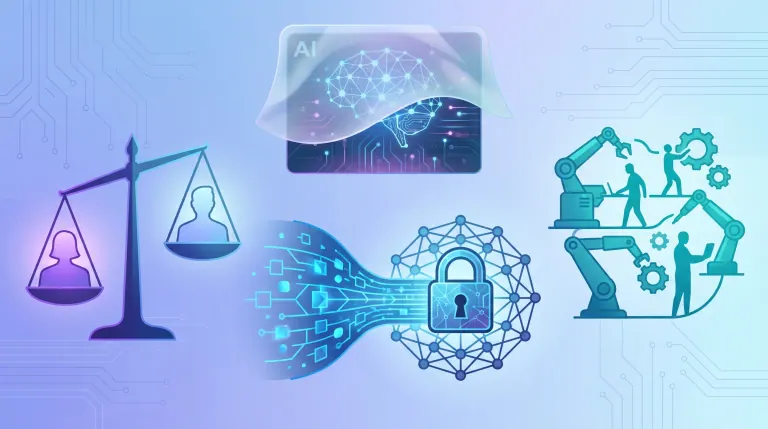
AI tools are moving fast, and the pressure to use them is real. But "move fast" doesn't have to mean "ignore the rules." Understanding the ethical side of AI isn't about becoming a philosopher — it's about protecting your customers, your business, and your reputation.
The good news? Most ethical AI use comes down to common sense: don't collect data you don't need, be honest about how automation works, and check that your tools aren't making decisions that disadvantage specific groups. That's 80% of it right there. If you want a structured starting point, our free AI Revenue and Savings Plan maps out how AI can work in your business responsibly before you commit to anything.
If you're still figuring out what AI actually is and how it applies to your business, start with our guide to what AI is and how it can benefit small businesses before diving into the ethical side of things.
Want to see how AI automation could work ethically in your business? We help small businesses implement AI the right way — with transparency, data safeguards, and no shortcuts that put you at legal risk. Book a Free Strategy Call →
Table of Contents
- Data Privacy: What You're Actually Responsible For
- AI Bias: How It Happens and Why Small Businesses Aren't Immune
- Transparency, Customer Trust, and Employee Impact
- Who This Is For (And Who Should Look Elsewhere)
- Frequently Asked Questions
Data Privacy: What You're Actually Responsible For
When you use AI tools in your business, you're often feeding them customer data — emails, purchase history, support tickets, behavioral data from your website. This creates real privacy obligations, whether you've thought about them or not.
What "data privacy" actually means for a small business
If you're using a tool like ChatGPT, Zapier, or any AI-powered CRM, you're sharing data with a third party. That third party has their own privacy policies, and you're trusting them to handle your customers' information responsibly. The question is: do you actually know what's happening to that data after you send it?
In the US, regulations like CCPA (California Consumer Privacy Act) require businesses to disclose what data they collect and give consumers the right to opt out or request deletion. If you have European customers, GDPR applies too — and the fines for violations aren't small.
What to do about it
A few practical steps go a long way:
- Read the privacy policy of any AI tool before using it to process customer data. Focus on data retention and third-party sharing sections.
- Use data minimization. Only give AI tools the information they actually need. You don't need to share a customer's full name and address with an AI email tool.
- Tell your customers when you're using AI to process their data. A line in your privacy policy is often enough.
- Know where your data lives. If you're using cloud-based AI, find out where the servers are located — this matters for GDPR compliance.
One useful reference point: according to IBM's Cost of a Data Breach Report, the average breach costs nearly $5 million globally. Small businesses often face disproportionate reputational damage because customers trust them more personally. The cost of prevention is almost always less than the cost of a breach.
Ready to check whether your current AI stack handles data responsibly? We audit existing AI setups and flag compliance risks before they become expensive problems. Get Your Free AI Audit →

AI Bias: How It Happens and Why Small Businesses Aren't Immune
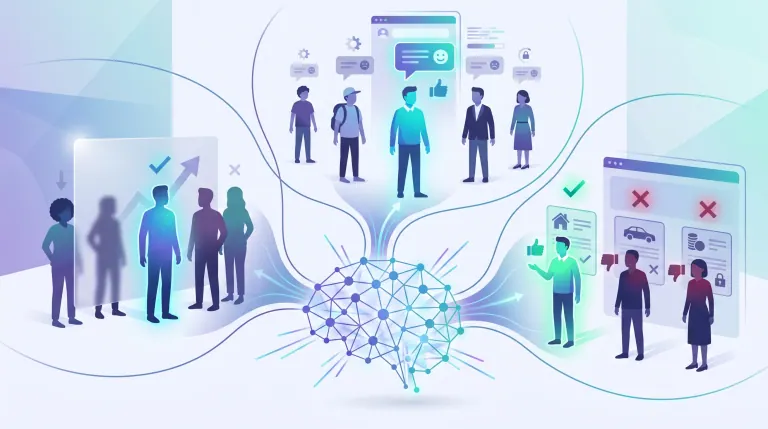
Algorithmic bias sounds like a problem for big tech companies. But if you're using AI to screen job applicants, approve applications, or personalize offers to customers, bias can show up in your business too.
Where bias comes from
AI learns from data. If the training data reflects historical patterns of discrimination — even unintentionally — the AI replicates those patterns. A hiring tool trained mostly on successful candidates from one demographic might downrank candidates from another. A customer-scoring tool trained on data from affluent zip codes might treat lower-income customers differently.
You probably didn't build the AI causing the bias. But if you're using it and your decisions are affecting people, you share some responsibility for the outcomes.
How to reduce bias in your tools
The first step is asking vendors the right questions before you sign up:
- How was this model trained?
- Has it been tested for fairness across demographic groups?
- What's the process for flagging and correcting biased outputs?
Reputable AI companies — including tools in the OpenAI ecosystem and Google's Vertex AI suite — publish information about their safety testing and bias mitigation approaches. Smaller niche tools often don't.
Practically: if you're using AI to make decisions that affect people (hiring, pricing, credit, access), build in a human review step. AI should inform the decision, not make it unilaterally. This isn't just ethical — it reduces the risk of systematic mistakes that are hard to spot until they've already caused harm.
Curious whether the AI tools you're already using carry bias risks? We help businesses evaluate their AI stack before problems compound. Start With a Free Consultation →
Transparency, Customer Trust, and Employee Impact
Two other ethical areas often get less attention than privacy and bias — but they matter just as much in a small business context: being transparent about AI use, and being thoughtful about how automation affects your team.
When to tell customers they're talking to AI
There's a growing expectation — and in some regions, a legal requirement — to disclose when customers are interacting with AI rather than a human. If you use an AI chatbot for customer service, say so. If AI generates personalized emails, you don't necessarily need to flag that in every message, but it should be in your privacy policy.
Why does this matter beyond compliance? Because customers who feel deceived about AI use don't come back. A simple "This chat is powered by AI, but a human can step in anytime" builds more trust than pretending it's a person named "Alex." Authenticity is a competitive advantage for small businesses — don't throw it away to look slightly more seamless.
The employee side of automation
This one's uncomfortable, but worth addressing. If you're automating work that people currently do, what happens to those people?
For most small businesses, AI automation doesn't eliminate jobs outright — it changes what those jobs look like. An employee who used to spend 3 hours a day on data entry can now spend those hours on customer relationships, strategy, or creative work that AI genuinely can't do. That's a good outcome. But it takes intentional communication.
Talk to your team before rolling out significant automation. Explain what's changing and why. Involve them in the process — they often have the best insight into which tasks are genuinely automatable and which need human judgment.
If you're curious how AI automation can save 20+ hours per week without replacing people, the shift is almost always about reassignment, not elimination. But "almost always" requires that you manage it intentionally.

Who This Is For (And Who Should Look Elsewhere)
This approach to ethical AI is ideal for:
- Small business owners already using AI tools who want to do it responsibly
- Any business that handles customer data (which is most businesses)
- Teams using AI in hiring, pricing, or customer service decisions
- Business owners who want to avoid compliance headaches before they start
You might want to consider alternatives if:
- You're not using any AI tools yet and don't have plans to — no ethical framework needed yet
- Your industry is heavily regulated (healthcare, finance, legal) — ethical AI in those sectors goes beyond this guide and typically requires specialized compliance counsel
- You need a full enterprise AI governance program — that's a different scope than what most small businesses need
Why AI Essentials specifically?
Most AI consultants focus on what's possible. We focus on what's practical and responsible. We help small businesses implement AI that actually works without creating compliance risk, customer trust issues, or team friction. Our process includes reviewing the tools you're already using — not just building new ones from scratch. If you're also evaluating whether to use ChatGPT in your business, we can fold that into the same conversation and give you a clear, honest answer rather than a sales pitch for a specific tool.
Frequently Asked Questions
What are the ethical considerations of AI in business for small business owners?
The main ethical considerations are data privacy, algorithmic bias, transparency, and employee impact. Small business owners often assume these are "big company" problems — they're not. Using customer data to power AI tools creates privacy obligations at any scale, and using AI to influence decisions about people creates bias risks. The good news: basic ethical AI practice is mostly common sense with a few clear rules you can implement in a single afternoon.
What are the AI ethics concerns around data privacy for small businesses?
When you use AI tools, you're typically sharing customer data with third-party software, which triggers obligations under laws like CCPA and GDPR. This means disclosing data use in your privacy policy, reading the data retention policies of your AI tools, only sharing the data each tool actually needs, and making sure vendors don't sell or share customer data without consent. Most compliance problems come from not reading the fine print — not from intentional wrongdoing.
What is AI bias and how can it affect a small business?
AI bias happens when a system makes decisions that systematically disadvantage certain groups, usually because its training data reflected historical inequalities. For small businesses, this matters most when using AI for hiring, credit decisions, or personalized pricing. Even if you didn't build the tool, using a biased system can expose you to discrimination complaints. The practical fix: ask vendors about bias testing, and keep humans in the loop for any AI-assisted decision that affects people's opportunities.
What does transparency mean when using AI in a small business?
Transparency means being honest with customers and employees about when and how AI is being used. If a chatbot handles customer support, say so. If AI personalizes your emails, mention it in your privacy policy. In some jurisdictions, disclosure is legally required when AI is used in consequential decisions. Beyond the legal side, customers who feel deceived about AI use lose trust — and small businesses depend on trust more than most.
How much does ethical AI implementation cost for a small business?
Ethical AI doesn't require expensive consultants or complicated compliance programs at the small business level. The core steps — reviewing tool privacy policies, updating your privacy policy, building in human review for sensitive decisions — cost mostly time, not money. For a business already using a few AI tools, a basic ethical review typically takes 2-4 hours. Ongoing costs are minimal: staying current with tool policies and checking in on how AI-assisted decisions are working in practice.
What are best practices for ethical AI in small business?
Start simple: only use AI tools with clear privacy policies, tell customers when they're interacting with AI in service contexts, keep humans in the loop for decisions that affect people, minimize the data you share with AI tools, and communicate with your team before rolling out significant automation. Beyond that, document your AI use — knowing what tools you use and what decisions they influence makes it much easier to course-correct if something goes wrong.
What are the common mistakes in ethical AI for small businesses?
The most common mistake is assuming AI ethics doesn't apply at small scale — it does. Other frequent errors: using AI tools without reading their data policies, assuming AI outputs are neutral and unbiased by default, hiding AI use from customers in service contexts, and rolling out automation without talking to employees first. Another big one: treating AI as infallible. Ethical AI use means building in ways to catch and correct errors, not just trusting the output.
What are the recent trends in AI ethics for business?
AI regulation is accelerating. The EU AI Act classifies certain AI uses as "high risk" and requires documentation, testing, and human oversight. In the US, the FTC has been increasingly active in regulating deceptive AI use. Sector-specific rules are emerging in healthcare, finance, and hiring. For small businesses, the practical takeaway: the transparency and documentation habits you build now are exactly what regulators will expect later. Starting early is much cheaper than retrofitting.
What are the alternatives to AI with strong ethical frameworks?
If you're concerned about specific AI ethics risks, you have real options. You can use tools from vendors with published ethics commitments — OpenAI, Google, and Microsoft all publish AI principles and safety frameworks. For sensitive decisions, rules-based automation (which follows explicit logic you set) is more predictable and auditable than AI. And for anything that feels genuinely uncertain, staying with human-led processes is still a completely valid choice — AI should add value, not create anxiety.
What is a step-by-step guide to ethical AI implementation for a small business?
- Audit your current AI use — list every tool that uses AI or processes customer data
- Review each tool's privacy policy — especially data retention and third-party sharing
- Update your privacy policy — disclose what AI tools you use and what data they process
- Identify high-risk uses — any AI influencing hiring, pricing, credit, or customer decisions
- Build in human review for those high-risk uses
- Talk to your team before rolling out automation changes
- Tell customers when they're interacting with AI in service contexts
- Review annually — AI tools and regulations change quickly, and your review should keep pace
Conclusion
Ethical AI in a small business isn't complicated. It comes down to a few clear commitments: protect your customers' data, watch for bias in decisions that affect people, be honest about how AI is involved in your business, and treat your team as partners in the process — not afterthoughts.
The businesses that run into problems aren't usually trying to do something wrong. They skipped a step: they didn't read the tool's privacy policy, or they forgot to mention AI use to customers in a service context, or they automated a process that needed a human in the loop.
Ready to implement AI in a way you can actually stand behind? Book a free 30-minute strategy call to see how AI automation can transform your business — responsibly, and without the legal headaches.

Iliyan Ivanov
Founder of AIessentials · AI automation consultant helping B2B businesses save 20+ hours/week and grow without hiring