AI Lead Qualification Cost (2026): $3K–$25K to Automate
[ SUMMARIZE WITH AI ]
Workflow Audit
]99% sure you are not seeing all the spots AI can help you in your business.
Are your workflows optimized with the most up to date solution, or are they costing you and your team time and money?
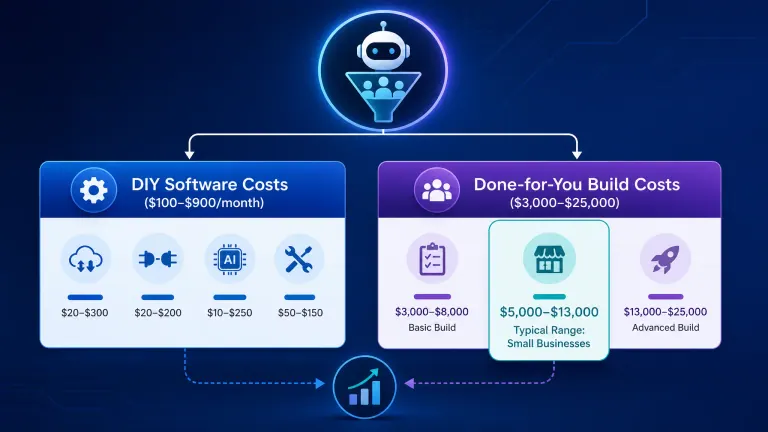
GET FREE AUDITAutomating sales lead qualification for a small B2B business typically costs $100–$900/month in software if you build it yourself with existing tools, or $3,000–$25,000 as a one-time build if you hire someone to set it up for you. Most small businesses land in the $5,000–$13,000 range for a working system that scores, routes, and books qualified leads without a human touching the first pass.
Software-only route: $100–$900/month for tools like HubSpot, Clay, or a scoring layer bolted onto your CRM — cheapest entry point, but you configure and maintain it yourself. Done-for-you build: $3,000–$25,000 one-time, delivered in 2–6 weeks, depending on how many data sources feed the score. Ongoing cost after launch: $50–$300/month in API and tool fees once the system is running — small compared to the labor it replaces. Typical payback window: 4–10 weeks for businesses processing 50+ inbound leads a month. Where the price swings: number of qualification criteria, whether it needs to pull firmographic data automatically, and how many places it needs to write the result back to (CRM, calendar, Slack).
If you're still manually eyeballing every form fill and inbound email to decide who's worth a callback, you already know what it's costing you — just not the number.
That number matters right now because implementation slots move fast this time of year, and the gap between "I should automate this" and "I automated this" is usually a scoping conversation, not a technical one. The rest of this post breaks down exactly what you're paying for, what happens if you build it wrong, and what a working system looks like inside your first month.
If you want the short version: skip the DIY tool-stacking phase most small businesses waste six weeks on, and go straight to a 24/7 Pipeline Engine built to qualify and route leads the moment they come in.
3 implementation slots open this month. We're booking August builds now — after that you're looking at a mid-September start. Book a 30-minute scoping call and we'll tell you exactly what your setup would cost, no generic pricing page required. Book Your Slot →
Table of Contents
- What Actually Drives the Price
- DIY Tools vs. a Done-For-You Build
- The Real Payback Math
- Who This Is For
- Frequently Asked Questions
What Actually Drives the Price
Every quote you get for lead qualification automation will land somewhere between "surprisingly cheap" and "why is this $25K" depending on four things.
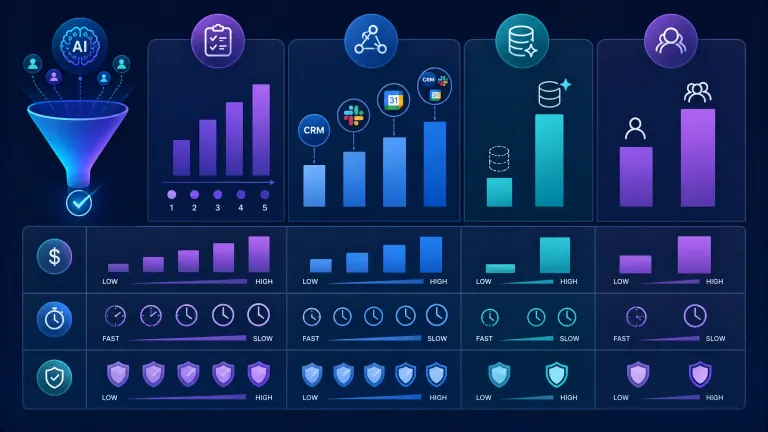
How many qualification criteria you're scoring. A system that just checks "did they fill out company size and budget" is a few hours of setup. A system that pulls firmographic data, checks intent signals, cross-references your CRM history, and scores against a weighted model is a different project entirely.
How many systems it has to talk to. If the lead only needs to land in one CRM, that's simple. If it needs to update your CRM, ping Slack, add a calendar hold, and trigger a follow-up email sequence, you're paying for integration work, not just scoring logic.
Whether it needs enrichment. Pulling company size, industry, and revenue data automatically (instead of asking the lead to type it in) means paying for a data provider like Clearbit or Apollo on top of the build. That's usually $50–$300/month depending on volume.
Who builds it. A freelancer on Upwork might quote $1,500–$4,000 for a basic Zapier-based scoring flow — similar territory to what we compare in our Make vs. Zapier vs. n8n breakdown if you're weighing the DIY route. An agency or consultant building something more durable — one that doesn't break when a form field changes — runs $5,000–$25,000. Neither is wrong; they're solving different problems.
Here's how AI Essentials helps here: we scope the build around your actual lead volume and CRM, not a generic template, so you're not paying enterprise pricing for a small business flow — or underpaying for something that falls apart at month two.
Not sure which scope fits your lead volume? Get a specific number, not a range — book a 30-minute walkthrough and we'll map the build to what you're actually running. Get My Scope and Price →
DIY Tools vs. a Done-For-You Build
Most small businesses try the DIY route first, and there's a real case for it — if your lead volume is low and your qualification criteria are simple. Here's an honest comparison of what each path actually costs and what it actually gets you.
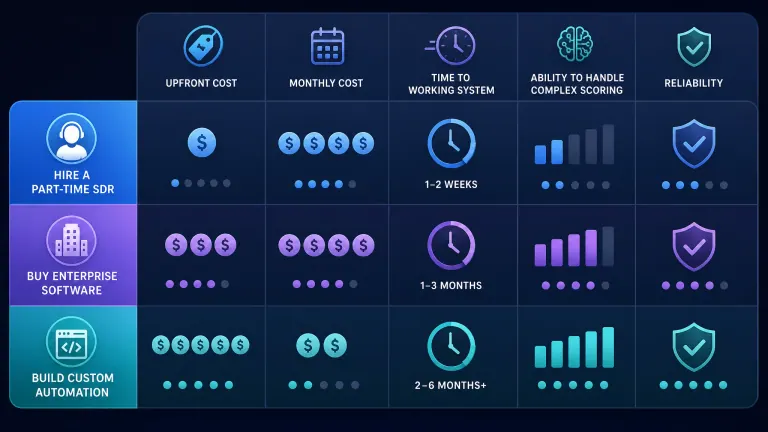
| DIY (Software Only) | Done-For-You Build | |
|---|---|---|
| Upfront cost | $0 (just monthly subscriptions) | $3,000–$25,000 one-time |
| Monthly cost | $100–$900/month | $50–$300/month after build |
| Time to working system | 2–6 weeks of your own time | 2–6 weeks, someone else's time |
| Handles complex scoring | Rarely — most tools cap at basic rules | Yes — custom logic and weighting |
| Breaks when something changes | Often — you're the one fixing it | Rarely — built with your workflow in mind |
| Best for | Under 30 leads/month, simple criteria | 50+ leads/month, multi-source scoring |
According to McKinsey's research on generative AI in sales and marketing, AI-driven productivity gains in these functions could unlock $0.8–$1.2 trillion annually — but that value only shows up when the system is actually configured correctly and maintained. A DIY setup that breaks silently three weeks after launch isn't saving you anything; it's just hiding the manual work again.
The honest answer: if you're comparing this to hiring a part-time SDR at $35,000–$50,000/year to do first-pass qualification, even the $25,000 done-for-you build pays for itself inside the first year — and it doesn't take PTO. If you're also weighing whether a broader AI consultant is worth it beyond just this one workflow, our AI consultant cost breakdown covers pricing for larger engagements.
Already know you need the done-for-you version? See exactly how we build this for businesses like yours — book a 30-minute walkthrough with real examples, not slideware. Book a Walkthrough →
The Real Payback Math
Here's an original breakdown using numbers a typical small B2B business would actually see. If you want a personalized version, our free AI Revenue + Savings Plan runs this same math against your actual numbers.
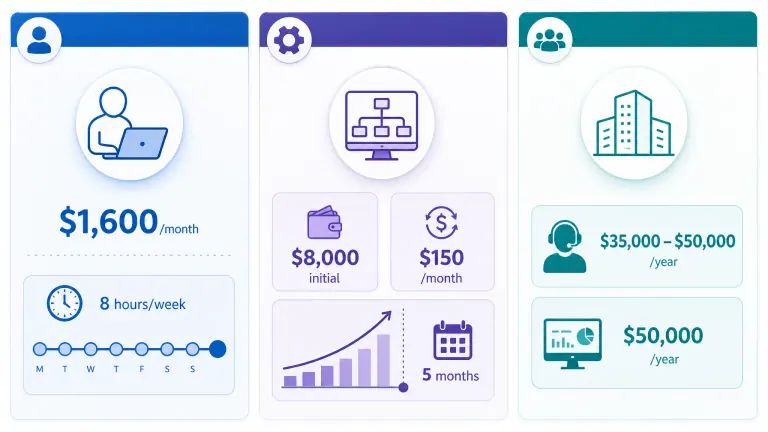
Before automation: A business owner or sales rep spends roughly 8 hours/week manually reviewing inbound leads, checking company details, and deciding who's worth a callback. At a $50/hour blended cost, that's $1,600/month in labor spent just triaging leads — before any selling happens.
After automation: A $8,000 one-time build plus $150/month in enrichment tools. The system scores every lead within seconds of form submission and only surfaces the ones that meet your criteria.
Payback timeline: $8,000 build ÷ $1,600/month in reclaimed labor = 5 months to break even, and every month after that is close to pure savings, not counting the deals you close because you responded faster.
That speed factor matters more than most owners expect. Research from Harvard Business Review and the Lead Response Management study found companies that respond to a lead within 5 minutes are dramatically more likely to qualify it than those that wait 30 minutes or more — and manual triage almost never hits that window consistently.
Comparison to alternatives:
- Hiring a part-time SDR: $35,000–$50,000/year plus benefits and ramp time, versus a one-time build under $25,000.
- Buying a $50,000+/year enterprise platform (like 6sense) to get similar scoring power a custom build gets you for a fraction of the cost, without the annual contract.
- Doing nothing: Continuing to manually review leads costs you the $1,600/month in labor indefinitely, plus every deal lost to slow response time.
Want your own payback number, not a generic example? Book a 30-minute call and we'll build the math against your actual lead volume and team cost. Get My Payback Timeline →
Who This Is For
This is ideal for:
- Businesses getting 30+ inbound leads a month where manual review is eating hours every week
- Teams tired of chasing unqualified leads while good ones sit unanswered for hours
- Owners who've priced out a full-time SDR and want the qualification piece solved without the headcount
Consider alternatives if:
- You're getting under 10 leads a month — a simple CRM filter or checklist will do for now
- Your qualification criteria change constantly week to week — automation needs stable rules to score against
- You don't have a CRM or lead capture system in place yet — that needs to exist first
Why AI Essentials specifically? We scope every build to your actual lead volume and CRM instead of selling a fixed package that's either overkill or underpowered. Builds typically go live in 2–4 weeks, and we're transparent about the exact cost before you commit — no discovery call bait-and-switch pricing.
Frequently Asked Questions
What does it mean to automate a process?
Automating a process means a system handles a repetitive task — like scoring or routing leads — without a person doing it manually each time. For lead qualification specifically, it means every inbound lead gets evaluated against your criteria the moment it arrives, instead of sitting in a queue for someone to review.
How do you automate a process?
You define the rules first (what makes a lead qualified), then connect a system — usually a mix of your CRM, a scoring tool, and enrichment data — to apply those rules automatically. For lead qualification, this usually means a workflow tool or custom build that pulls in lead data, scores it, and routes the result to the right person or list.
What is another word for automating?
Common alternatives include "systemizing," "streamlining," or "mechanizing" a process. In the lead qualification context, you'll also hear "automated lead scoring" or "AI-powered lead routing" used interchangeably with lead qualification automation.
What is a process automation example?
A common example: when a lead fills out a form, the system automatically checks their company size, industry, and stated budget, assigns a score, and either books them directly on a sales rep's calendar (if qualified) or adds them to a nurture sequence (if not) — all without a human touching it.
What's the average cost to automate B2B sales lead qualification for a small business?
Most small B2B businesses spend $3,000–$25,000 for a one-time done-for-you build, or $100–$900/month if they build it themselves using existing SaaS tools. The done-for-you route typically pays for itself within 4–10 weeks based on labor hours reclaimed.
What's the ROI of automating sales lead qualification for a small B2B business?
Businesses processing 50+ leads a month typically see payback in under 6 months, factoring in reclaimed labor hours and faster response times. Beyond direct savings, faster qualification means faster response to hot leads — and response speed is one of the strongest predictors of whether a lead converts at all.
What's the cost of lead scoring software for a small business?
Standalone lead scoring tools run $99–$2,500/month depending on the platform, with most small-business-appropriate options (Leadfeeder, Clay, HubSpot's scoring tier) landing between $99–$350/month. Enterprise platforms like 6sense start around $50,000/year and are built for a different scale of business.
How do I automate sales lead qualification for a small B2B business, step by step?
Start by defining your qualification criteria clearly (company size, budget, industry fit, stated intent). Next, choose your data sources — form fields, enrichment tools, or CRM history. Then build the scoring logic and connect it to your CRM and calendar so qualified leads route automatically. Test it against 20–30 historical leads before going live to catch scoring errors.
What's involved in implementing lead qualification automation for a B2B business?
Implementation involves three phases: scoping (defining criteria and data sources), building (connecting tools and writing scoring logic), and testing (running historical leads through the system to verify accuracy). A straightforward build takes 2–4 weeks; one requiring multiple data sources and custom routing can take up to 6 weeks.
What CRM features matter most for lead qualification in a small business?
Look for custom field support (to store scoring criteria), workflow automation triggers (to act on scores automatically), and API access (so external tools can read and write lead data). HubSpot, Pipedrive, and Salesforce Essentials all support this at small-business-friendly price points.
Conclusion
The honest number: expect $3,000–$25,000 for a done-for-you build, or $100–$900/month if you're building it yourself — and most businesses processing real lead volume break even within 2–6 months either way. The bigger cost isn't the automation. It's every week you keep manually triaging leads while the answer sits one scoping call away.
Slots for this month's builds are filling. Book a 30-minute call and walk away with your actual number — not a range.

Iliyan Ivanov
Founder of AIessentials · AI automation consultant helping B2B businesses save 20+ hours/week and grow without hiring