Which Jobs Will Survive AI? The 3 That Are Safe in 2026
[ SUMMARIZE WITH AI ]
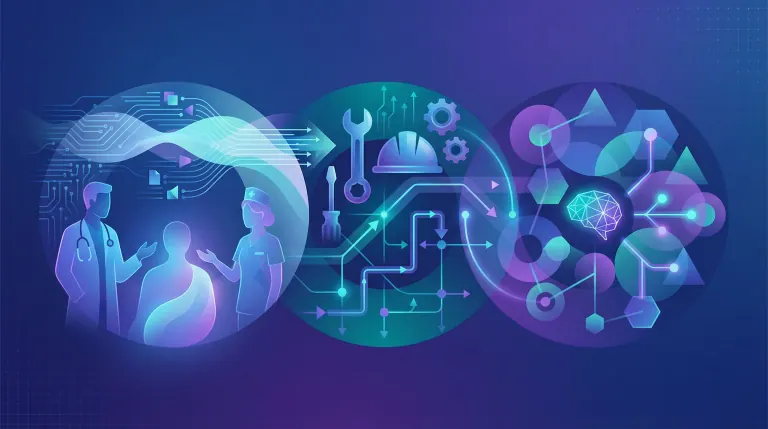
Healthcare providers, skilled trades workers, and creative strategists are the three job categories least likely to be replaced by AI. These roles require human empathy, physical dexterity in unpredictable environments, or complex creative judgment—things AI can't replicate yet.
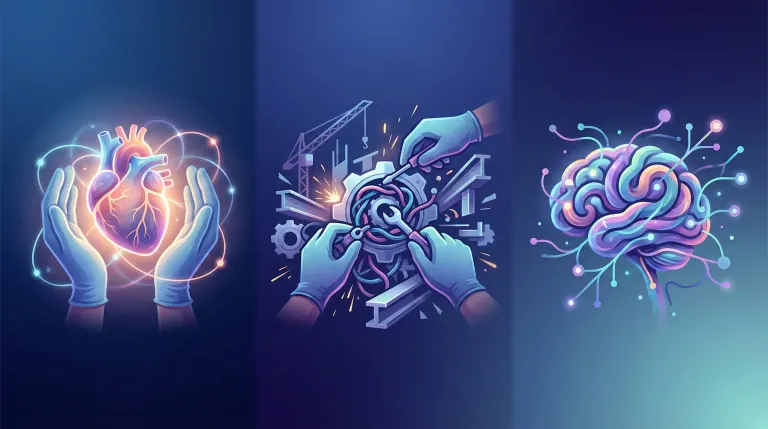
But here's the thing—it's not about entire jobs disappearing. It's about tasks within jobs changing. A nurse won't be replaced by AI, but AI will handle their scheduling and basic patient triage. A plumber won't lose work to a robot, but AI might help them diagnose problems faster. A marketing director won't be replaced, but AI will write their first drafts.
The real question isn't "Will my job survive AI?" It's "How will AI change what I do every day?" And for small business owners, the better question is: "How do I use AI to make my team more effective instead of worrying about replacement?" (If your answer is to switch sides and build the automation yourself, here's how to get into AI automation.)
Want to see how AI can enhance your team instead of replacing them? We'll show you exactly which tasks to automate and which to keep human. Book a Free Strategy Call →
Table of Contents
- The 3 Job Categories AI Can't Touch (Yet)
- Why These Jobs Resist Automation
- How AI Changes Work Without Replacing Workers
- Who This Is For (And Who Should Look Elsewhere)
- Frequently Asked Questions
The 3 Job Categories AI Can't Touch (Yet)
Let's be specific about which jobs have the strongest resistance to AI replacement—and why.
1. Healthcare Providers (Doctors, Nurses, Therapists)
Healthcare jobs combine empathy, physical assessment, and life-or-death decision-making. AI can read X-rays and suggest treatments, but it can't comfort a scared patient, adjust a treatment plan based on subtle behavioral cues, or make ethical decisions about end-of-life care.
A 2024 study from Stanford found that while AI diagnostic tools matched doctor accuracy in controlled tests, real-world medicine is messy. Patients don't describe symptoms clearly. They have multiple conditions. They're scared and need reassurance. That's where humans win.
What AI does instead: Handles appointment scheduling, insurance pre-authorization, basic symptom triage, and medical record organization. This frees doctors and nurses to focus on actual patient care instead of paperwork.
2. Skilled Trades (Electricians, Plumbers, HVAC Technicians)
Trades require physical problem-solving in unique, unpredictable environments. Every house is different. Every repair has unexpected complications. You can't program a robot to handle the infinite variations of "the previous owner did something weird with the wiring."
AI and robotics struggle with unstructured environments. A factory robot can assemble the same part 10,000 times perfectly. But ask it to fix a leaking pipe in a 100-year-old building? Not happening.
What AI does instead: Helps with diagnostics (thermal imaging, leak detection), parts inventory management, route optimization for service calls, and customer communication. The actual repair work stays human.
3. Creative Strategists (Marketing Directors, Product Designers, Business Consultants)
Creative strategy isn't just making things look pretty. It's understanding human psychology, cultural context, business goals, and how to connect all three. AI can generate content. It can't understand why a certain message will resonate with a specific audience at a specific moment.
Take marketing strategy. AI tools can generate ad copy and creative variations at scale. But they can't tell you whether launching a product in Q2 vs Q4 makes sense given your industry's buying cycles, competitive landscape, and brand positioning. That requires judgment.
What AI does instead: Generates content drafts, analyzes performance data, A/B test management, and competitive research. Strategists use AI as a research assistant, not a replacement.
Ready to use AI as your strategic assistant? We'll show you how to automate research and execution while keeping strategy human. Get Your Free Assessment →

Why These Jobs Resist Automation
Understanding why certain jobs survive AI helps you figure out which parts of your own business to automate and which to keep human.
The Four Qualities AI Can't Replicate
1. Empathy and Emotional Intelligence
AI doesn't have feelings. It can mimic empathy based on patterns in training data, but it doesn't actually care. When a patient is terrified about a diagnosis, they need a human who genuinely understands fear—not a chatbot that says "I understand this must be difficult for you" because that phrase appeared in its training data.
2. Physical Dexterity in Unstructured Environments
Robots are great at repetitive physical tasks in controlled settings. They struggle when every situation is different. A plumber crawling under a sink in a 1950s ranch house faces different challenges than in a 2020s condo. That adaptability requires human problem-solving.
3. Complex Judgment with Incomplete Information
Most AI excels when it has complete data and clear rules. Real business decisions happen with incomplete information, conflicting priorities, and ethical considerations. Should you lay off two employees or cut everyone's hours by 20%? AI can't make that call.
4. Creative Synthesis Across Domains
AI generates content by pattern-matching on its training data. Humans create by connecting ideas from completely different fields. The best marketing campaigns often combine insights from psychology, art, technology, and culture in ways no AI would predict.
How AIessentials Helps Here
When we work with small businesses, we don't focus on replacing people. We focus on removing the boring, repetitive work that keeps talented people from using their judgment and creativity — which is exactly what our AI Operating System is designed to do.
For example, a marketing consultant we worked with spent 15 hours per week creating client reports—pulling data, making charts, writing summaries. We automated the data pulling and chart creation. Now she spends 2 hours per week reviewing AI-generated reports and adding strategic insights. Her clients get faster reports. She has more time for strategy. Nobody lost their job.
Curious what this would look like for your business? We'll map your workflows and show you which tasks to automate vs which need human judgment. Book Your Free Call →

How AI Changes Work Without Replacing Workers
The real impact of AI isn't job replacement—it's task automation. Let's look at what that actually means for different roles.
What Changes for Healthcare Workers
Before AI:
- 3 hours/day on patient care
- 2 hours/day on documentation
- 1.5 hours/day on scheduling and admin
- 1.5 hours/day on insurance and billing issues
After AI automation:
- 5.5 hours/day on patient care
- 30 minutes/day reviewing AI-generated documentation
- 15 minutes/day on scheduling exceptions (AI handles routine)
- 30 minutes/day on complex billing issues (AI handles routine)
Result: Same number of healthcare workers. Better patient care. Less burnout.
What Changes for Trades Workers
Before AI:
- 5 hours/day on service calls
- 1 hour/day driving between jobs
- 1 hour/day on invoicing and follow-ups
- 1 hour/day on parts ordering and inventory
After AI automation:
- 6.5 hours/day on service calls
- 45 minutes/day on optimized routes (AI planned)
- 15 minutes/day reviewing AI invoices
- 15 minutes/day on complex parts orders (AI handles routine)
Result: More billable hours. Same number of technicians. Faster customer service.
What Changes for Creative Strategists
Before AI:
- 2 hours/day on strategy and planning
- 3 hours/day on content creation
- 1.5 hours/day on performance analysis
- 1.5 hours/day on client communication
After AI automation:
- 4 hours/day on strategy and planning
- 1 hour/day editing AI-generated content
- 30 minutes/day reviewing AI analytics reports
- 1.5 hours/day on client communication
Result: Better strategy. Faster content production. Same headcount.
Comparing AI Automation vs Hiring More People
Let's be honest about the tradeoffs:
AI Automation Approach:
- Pros: Lower cost, scales instantly, no training time, works 24/7
- Cons: Requires initial setup, needs human oversight, can't handle edge cases alone
- Best for: Repetitive tasks, data processing, content drafts, scheduling
Hiring More Staff:
- Pros: Human judgment, handles complexity, builds team culture, flexible problem-solving
- Cons: Higher cost, training time, limited hours, payroll complexity
- Best for: Customer relationships, strategic decisions, complex problem-solving, empathy-required tasks
The Smart Combination: Use AI to handle the repetitive 30% of work. Use humans for the judgment-heavy 70%. Don't try to automate everything. Don't avoid automation entirely.
Want a custom implementation plan? We'll show you exactly which tasks to automate and which to keep human for your specific business. Start Your AI Journey →
Who This Is For (And Who Should Look Elsewhere)
This approach is ideal for:
- Small business owners worried about AI replacing their team (it won't, but it will change how they work)
- Companies spending too much time on admin work instead of high-value tasks
- Businesses looking to grow without proportionally increasing headcount
You might want to consider alternatives if:
- You're in a highly regulated industry where AI oversight requirements make automation impractical
- Your entire business model is built on tasks AI can fully automate (in which case, you need a bigger strategy shift)
- You have fewer than 10 hours/week of repetitive tasks (ROI might not justify setup time)
Why AIessentials specifically? We don't sell AI replacement fantasies. We help you figure out which 30% of your work to automate so your team can focus on the 70% that actually requires human judgment. Our implementations typically take 14-30 days and come with a 60-day money-back guarantee: if you don't get the outcomes we agree on upfront (often hours saved per week), we refund your service fee.
Frequently Asked Questions
What jobs are least likely to be replaced by AI?
Healthcare providers, skilled trades workers, and creative strategists are least likely to be replaced because they require empathy, physical adaptability, and complex judgment. However, even these jobs will see AI handling their repetitive tasks—scheduling, documentation, data analysis.
How does AI impact small business jobs?
AI typically changes how jobs are done rather than eliminating them. Small businesses use AI to automate repetitive tasks (data entry, scheduling, basic customer inquiries) so employees can focus on work that requires human judgment and relationships. Most small businesses see reduced workload, not reduced headcount.
What is the cost and ROI of AI for small business?
AI implementation for small businesses typically costs $2,000-$10,000 for initial setup, depending on complexity. ROI usually appears within 2-3 months through time savings. A business saving 20 hours/week at a $50/hour loaded cost saves $52,000 annually—much more than implementation cost.
What are the best practices for implementing AI in small business?
Start with the 30% rule—automate the most repetitive 30% of your work first. Don't try to automate everything at once. Focus on tasks that are predictable, repetitive, and don't require human judgment. Get your team involved in identifying automation opportunities instead of imposing changes.
What AI trends should small business owners watch in 2026?
The biggest trend is AI moving from general tools (like ChatGPT) to specialized business automation. Expect better integrations between tools you already use, more affordable small-business-specific AI solutions, and increased focus on AI that augments workers instead of replacing them.
What are alternatives to AI for small business automation?
Traditional automation tools (Zapier, IFTTT, basic scripting) work for simple workflows without needing AI. Outsourcing to virtual assistants works for tasks requiring human judgment. Sometimes the best alternative is process simplification—eliminating unnecessary work instead of automating it.
What is a step-by-step guide for AI implementation in small business?
Start by tracking how your team spends time for one week. Identify repetitive tasks that consume the most hours. Prioritize tasks that are predictable and rule-based. Test AI automation on one workflow. Measure time savings. Expand to additional workflows only after proving ROI on the first one.
What small business AI case studies show success?
A consulting firm automated client report generation and saved 15 hours/week. An e-commerce business automated customer support triage and reduced response time from 4 hours to 15 minutes. A real estate agency automated follow-up emails and increased lead conversion by 25%.
What is the cost of AI implementation for small business?
Implementation costs range from $2,000 for basic automation (email, scheduling, simple workflows) to $10,000+ for complex multi-system integration. Ongoing costs are typically $100-$500/month for AI tool subscriptions. Most businesses break even within 3-6 months through time savings.
How long does AI implementation take for small business?
Basic AI automation (scheduling, email templates, simple workflows) takes 1-2 weeks. More complex implementations (CRM integration, custom workflows, multi-system automation) take 3-4 weeks. Full business process automation typically happens in phases over 2-3 months, with immediate ROI from early phases.
Conclusion
The three jobs most likely to survive AI—healthcare, skilled trades, and creative strategy—share a common thread: they require human judgment, empathy, and adaptability in unpredictable situations. But survival doesn't mean unchanged. AI will transform how these jobs work by handling repetitive tasks and freeing humans for high-value work.
For small business owners, the lesson is clear: don't worry about AI replacing your team. Focus on using AI to remove the boring work so your team can focus on what humans do best.
For one of the most common small business use cases, AI lead generation automation shows how to put prospect-finding on autopilot without losing the human follow-up that converts. If you're also thinking about AI from an investment angle, what the tiny 3 AI stocks are covers three under-the-radar companies building the infrastructure behind this shift. And if you're wondering how far AI can take over business operations, whether AI can run your LLC breaks down what's practical today.
Ready to identify which tasks to automate and which to keep human? Book a free 30-minute strategy call to see how AI automation can enhance your team's effectiveness without replacing anyone.
Workflow Audit
]99% sure you are not seeing all the spots AI can help you in your business.
Are your workflows optimized with the most up to date solution, or are they costing you and your team time and money?
GET FREE AUDIT
Iliyan Ivanov
Founder of AIessentials · AI automation consultant helping B2B businesses save 20+ hours/week and grow without hiring